Voicemail Transcription Software That Speaks Seafood SKUs and Outputs Purchase Order Drafts
Voicemail-to-order software for seafood must resolve species grades and catch-weight units.
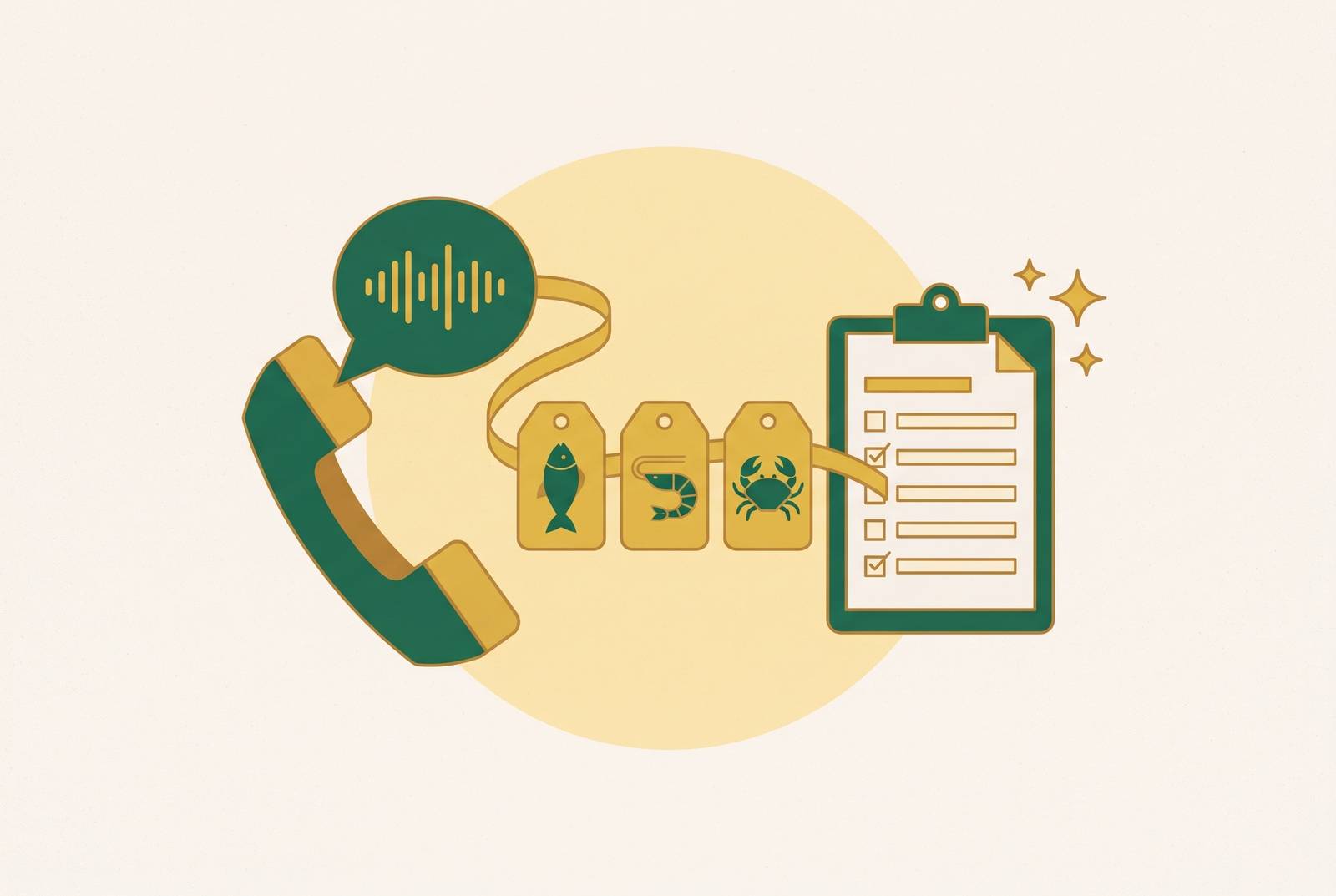
Voicemail and phone order transcription for food distribution requires more than audio-to-text software. For seafood distributors, a purchase order draft must match spoken shorthand to customer-specific SKUs, keep catch-weight quantities as given, and pass pricing and lot data into the ERP to be usable. The working approach is a transcription-to-order pipeline that presents a structured draft for human review rather than silently converting uncertain speech into picking instructions.
Why voicemail transcription fails seafood distributors before it even reaches SKU matching
A readable transcript can still be an unusable order. Seafood distributors get orders through unstructured channels such as email, text, and voicemail, and staff must re-enter them before trucks load. Standard transcription software records what a caller said, leaving the order desk responsible for converting that speech into a matched SKU, a cut specification, a catch-weight quantity, and a price.
A transcript can faithfully record a species name while leaving the product grade, pack size, or billing unit unresolved. Those omissions affect which product gets picked and how the customer is charged. Even when software gets more of the words right, it still needs the account history, catalog definitions, and inventory context to make sense of them.
What a seafood order actually sounds like over the phone — and why it defeats general-purpose NLP
ManualOut's published sample order from October 2026 shows how many different meanings one seafood message can have. Salmon sides are ordered by piece but invoiced by kilo, cod loin by portion, and mussels by kg. Seabass includes a size-grade of 400–600g, while the hake request remains open. Each line requires a different interpretation of the relationship between product, size, and unit.
Seafood shorthand also embeds specifications in words that general-purpose natural language processing cannot reliably interpret as structured order data from training alone. Terms including “IQF,” “U/10,” “skin-on pin-boned,” and “sashimi-grade” have precise contractual meaning. The notation is part of the product identity. “U/10 Sea Scallops” and count-range codes for snow crab and black tiger shrimp distinguish catalog items. Treating those codes as incidental text removes information needed to select the SKU.
Many commercially harvested species use the three-level system “Extra,” “A,” and “B,” tied to size, fat content, freshness indicators such as color and texture, and intended end use. Weight can be equally deceptive, because a pound quantity of IQF product can imply different net weights depending on the supplier's glazing ratio. Some requests cannot be completed from speech at all. A request for “whatever's landed” on hake depends on today's landing data for pricing.
The catch-weight problem — why quantity itself is ambiguous in a seafood voicemail
With catch weight, the unit used to order differs from the weight used to bill. A customer can order a case of salmon that is inventoried as a case and invoiced at the per-pound price against its actual weight when shipped. Both quantities are valid and necessary. A case count and its corresponding pound total must stay connected through purchasing, picking, shipping, invoicing, costing, and reporting. A transcript that captures only “a case” has preserved the request without supplying the complete transactional record.
That distinction also limits what inventory totals can establish. Seafood availability can depend simultaneously on lot, location, actual weight, quality status, shelf life, and customer requirements. Even with thousands of pounds in inventory, the stock may not be available for today's orders. The intake layer cannot resolve that constraint by converting a count into an estimated weight. Such a conversion would replace a known customer instruction with an assumption.
ManualOut describes a pipeline that keeps the ordered quantity exactly as spoken. Six salmon sides remain six salmon sides, preserving information lost in a guessed weight or an undifferentiated “6 units. The unit itself must survive the handoff. Otherwise, a clean-looking quantity field conceals the loss of information that the ERP needs for catch-weight reconciliation.
What a transcription-to-PO pipeline must actually resolve to produce a usable order draft
Customer identification is the first evaluation criterion beyond transcription. The pipeline needs the caller's phone number along with the account's price list, contract terms, and order history. History gives shorthand its account-specific meaning. A customer who has ordered the same product every week for two years provides context for “the usual salmon” that the transcript cannot supply.
SKU matching must then combine the live product catalog, the customer's price list, and the customer's order history. The catalog needs product names, codes, and recorded aliases or nicknames so that oral shorthand can resolve to an actual item. Cut specifications belong in the match itself. Skin-on, pin-boned, and portioned must lead to the right product code. Similarly, spoken ranges such as “2–3kg,” “500–700g,” and “400–600g” must remain part of the line item.
Quantity handling is a separate test of the pipeline. Pieces, sides, and boxes must keep their identities as logistical units, while catch-weight fields stay separate and free of guessed conversions. This preserves what the customer actually requested. It also leaves the ERP's reconciliation process responsible for the relationship between those units and the weight used downstream. A correctly matched SKU does not compensate for a quantity whose original meaning has been lost.
Uncertainty handling completes the criteria for a usable draft. When a grade is unstated, shorthand is unfamiliar, or a specification is open, the draft must flag it for human review. The original message belongs beside the draft. Experienced order-desk staff can then check the proposed interpretation against the customer's words rather than reconstruct the order through manual entry.
What the ERP connection must handle that the transcription layer cannot be asked to do
A draft supports order intake only if its structured fields reach the system that drives picking and invoicing. The connection must pass along logistical quantities, catch-weight fields, lot data, and customer-specific pricing without staff having to enter them again. Reconciliation remains the ERP's responsibility. The intake pipeline supplies clean inputs while the order system applies the rules that turn those inputs into an operational record. Customer contract pricing must also apply at the order level, since a generic price turns the draft into a correction task.
Lot context adds a seafood-specific compliance requirement to that handoff. Species and grade can change between when an order is placed and when it ships, while lot numbers have already been assigned upstream. Seafood operations must maintain applicable FSMA Section 204 traceability requirements, cold chain documentation linked to specific lots, and audit readiness across USDA, FDA, and GFSI frameworks. Lot data cannot stop at the draft. An intake tool that drops it creates a gap between the order record and the traceability records needed downstream.
The integration method determines how that handoff is maintained. A certified connector to an existing ERP is a different project from screen automation against a legacy system. Before deployment, the distributor must know who will make corrections. When a product code changes, the distributor needs to know whether the integration handles the change or a person must intervene. Reading the message is only one part of the job, because pricing and unit-of-measure rules decide whether the resulting order is usable.
How the tools available in 2026 differ in their handling of seafood-specific requirements
The late-2026 market offers different kinds of evidence for seafood suitability. Choco OrderAgent says it can handle catch-weight products and customer-specific contract pricing, and split orders by warehouse and storage temperature zone. These figures come from the vendor and have not been independently checked here. Channel coverage also needs careful distinction, because OrderAgent handles emails, SMS, images, and documents, while VoiceAgent serves live phone calls.
ManualOut describes a narrower boundary between capture and ERP reconciliation. Its seafood-specific page names catch-weight quantities, cut specifications mapped to product codes, and size grades read as part of the line item. It reads WhatsApp, email, PDFs, spreadsheets, and voice notes, and writes the sales order into the existing ERP. That description is specific about its intake role. It positions the product as preventing bad inputs rather than replacing the ERP's weight reconciliation.
Nammu presents itself as a seafood-specific platform for sales, procurement, custom builds, and workflow automation. Its published interface embeds count-per-pound grades directly in product identifiers, including “U/10 Sea Scallops” and count-range notation for snow crab and black tiger shrimp. This shows how its seafood data model works. That is a different capability from demonstrating voicemail capture, and the two should not be treated as interchangeable.
GrubMarket's GrubAssist uses company-specific training to interpret aliases. Its March 2025 upgrade lets wholesalers and distributors teach the system the codes and terms they use. GrubMarket's chief software product officer identified colloquial language and custom short codes as a major challenge to AI adoption in the food supply chain. Its positioning is not specific to seafood distribution.
Southwest Traders adopted Cut+Dry's digital ordering and payments platform with an AI-driven voice and text recognition module for orders across voice, SMS, email, and fax. The system sorts orders into categories and matches products on its own, showing how intake can be automated across food distribution. Fresho OrderPilot converts email, text, WhatsApp messages, voicemails, and PDFs into structured sales orders. Its guidance for going live calls for training on customer patterns. Fresho recommends two to four weeks of training before going live, but channel coverage alone does not establish how a tool handles seafood grades or catch weight.
How do you choose a tool for after-hours voicemail orders, and what does a working pipeline look like?
Ask a vendor to run ten actual voicemails, including catch-weight lines, grade calls, and open-spec requests. The test should expose whether aliases, customer-specific nicknames, and count/grade notation survive matching. Catalog training needs to be demonstrated. It also needs to show how it uses customer order histories before deployment.
A catch-weight test should check both the transcript and the fields it produces. The test should establish whether the system keeps sides, pieces, and boxes separate from weight or forces a conversion during intake. Both fields must remain distinct through the ERP handoff. Evaluation should also establish whether the connection is certified or based on screen automation, who fixes product-code changes, and whether customer contract pricing applies at the draft stage. Lot data must travel from the order line into traceability records.
The distributor should establish where an unresolved line appears, who sees it, how quickly it surfaces, and whether corrections feed back into the model. Silent commitment is not a substitute for approval. Data ownership terms also need to spell out whether recordings, transcripts, and catalog data are used to train a shared model or kept as the distributor's own data. Ask for certifications including SOC 2 Type II and ISO 27001 rather than accept “enterprise-grade security” as an answer.
When an after-hours pipeline works, staff spend the morning checking drafts beside the original messages. Checking can take seconds per order, replacing minutes of transcription. Staff can still see uncertain lines and resolve them. Review then catches some errors before picking, reducing the risk of errors that comes with manual re-entry.