Cold Chain Temperature Requirements by Seafood Category
Different seafood types demand their own temperature targets, not one standard for all.
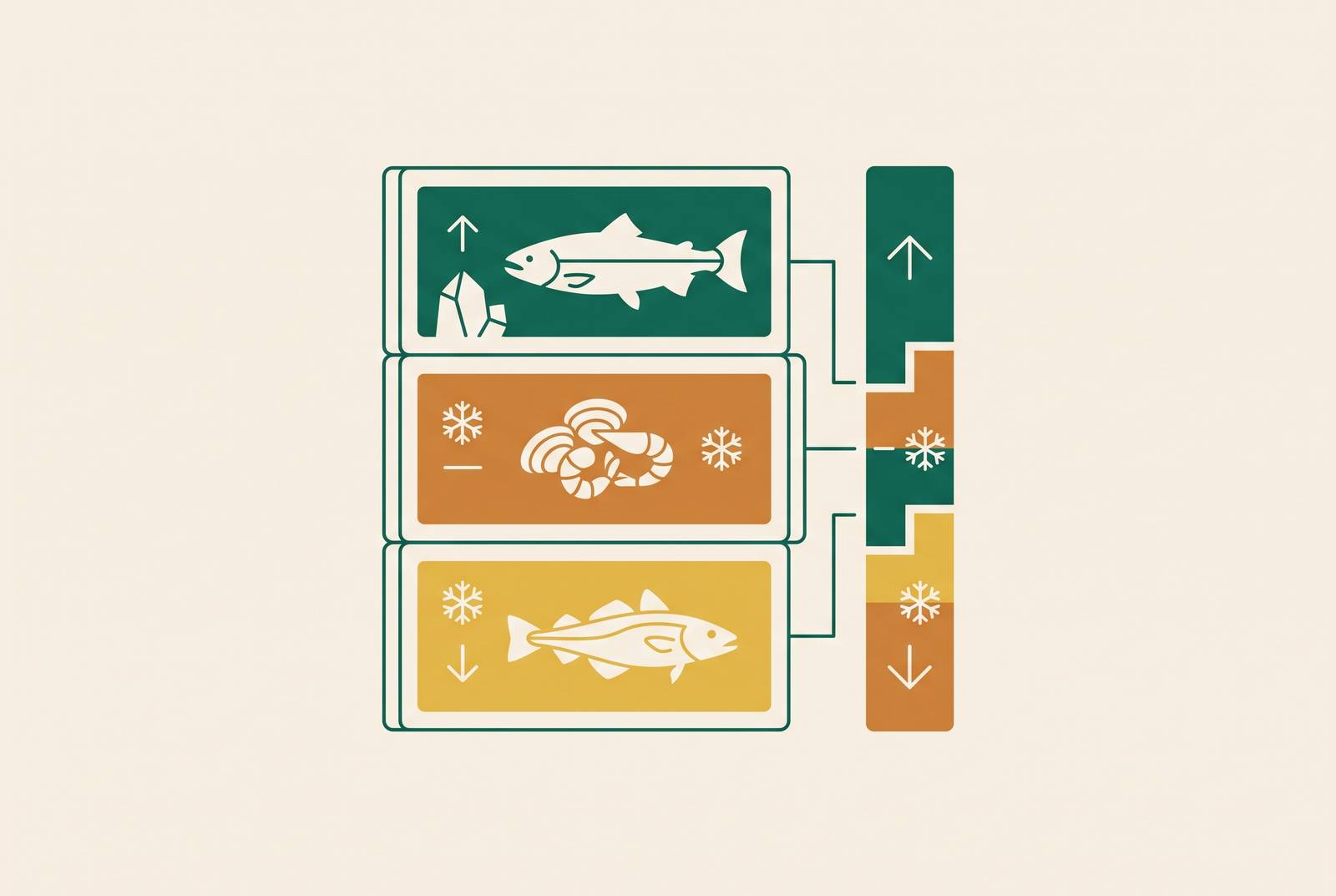
A distributor who treats "keep it cold" as one instruction is already behind, because seafood isn't one product moving through one set of conditions. It arrives alive, fresh on ice, frozen solid, cooked, or breaded and ready to heat, and each of those states carries its own biology, its own failure mode, and its own regulatory number. Applying a single cold chain standard across all of it means the operation will pass some audits, fail others, and bleed margin in the gap between the two https://www.tempcontrolpack.com/knowledge/fresh-seafood-cold-chain-regulations-equipment-2025-guide/. That gap, more than any single mistake, is what separates operations that hold their margins from ones that lose them one truck at a time.
When the paperwork is stripped away, most cold chain requirements come down to five things: temperature, hygiene, hazard control, traceability, and verification. Get the temperature wrong and none of the rest matters much. Hygiene protocols can't save a product that's already spoiling, hazard controls can't catch what's already growing, and traceability just documents the failure instead of stopping it.
Bacteria can double every 20 minutes once seafood sits in the danger zone, producing off-odors, texture loss, and in susceptible species, histamine. Category-specific targets are the only way to know which clock applies where, and treating them as interchangeable is the single most common mistake in the business.
Fresh finfish: the narrow window between quality and loss
The regulatory floor for fresh finfish is well established. The U.S. FDA Food Code sets a ceiling of 41°F, about 5°C, while EU Regulation 853/2004 calls for a temperature "approaching that of melting ice," which in practice runs 0-2°C https://www.tempcontrolpack.com/knowledge/cold-chain-standards-and-equipment-for-seafood-products-a-2025-guide/. International transport under the ATP agreement caps fish in transit at 2°C https://www.tempcontrolpack.com/knowledge/fresh-seafood-cold-chain-regulations-equipment-2025-guide/. These numbers describe a ceiling, not a target, and a distributor who manages to the ceiling is managing to the wrong number.
Serious quality programs run tighter than any regulation demands, holding fresh fish between 30°F and 34°F, roughly -1°C to 1°C https://www.tempcontrolpack.com/knowledge/cold-chain-for-seafood-products-tutorials-2025-equipment/. That's a narrower band than FDA or EU rules require, and the gap exists because of arithmetic, not caution for its own sake https://www.tempcontrolpack.com/knowledge/fresh-seafood-cold-chain-regulations-equipment-2025-guide/. Fish held at 41°F carries roughly half the shelf life of fish held at 32°F, a difference caused by temperature that is visible in lost days on the sales floor, not as a compliance footnote https://www.tempcontrolpack.com/knowledge/cold-chain-for-seafood-products-tutorials-2025-equipment/.
Bacterial growth and enzymatic breakdown both drive that collapse in shelf life, one microbial, one biological, running in parallel rather than in sequence. That combination is why finfish punishes small temperature mistakes faster than red meat or poultry does, and why the gap between "compliant" and "good" gets measured in single degrees rather than broad ranges.
Live shellfish (clams, mussels, oysters): viability over shelf life
Live shellfish require a different approach than the finfish playbook. The product in the box is still alive, and the goal isn't slowing decay, it's keeping the animal alive until someone opens or cooks it. The target range runs 0°C to 4°C, with some guidance citing 35-40°F for live mollusks, packed shells-down to hold the liquor inside the shell https://www.tempcontrolpack.com/knowledge/cold-chain-for-seafood-products-tutorials-2025-equipment/.
Humidity is the detail that trips up distributors who built their programs around finfish. Live shellfish need 90-95% humidity, because dry air opens the shell and dehydrates the meat inside, killing the animal well before any thermometer flags a problem https://www.tempcontrolpack.com/knowledge/cold-chain-for-seafood-products-tutorials-2025-equipment/. A finfish cold room, built to move dry, cold air across ice-packed product, is often the wrong environment for a pallet of live oysters sitting a few feet away.
The handling rules diverge just as sharply. Live shellfish go into shallow pans under moistened paper towels rather than sealed inside plastic or cardboard, because a sealed container cuts off oxygen and suffocates the animal. Submerging them in fresh water kills them outright, since these are saltwater organisms that osmoregulate for seawater salinity, not tap water.
The failure mode here isn't spoilage, it's mortality. A dead mollusk mixed into a live shipment isn't a quality complaint, it's a food safety and traceability problem, because a live product that arrives dead may have spent an unlogged stretch of the trip sitting in the danger zone.
Shucked shellfish and crustaceans: tighter targets, faster clocks
Once shellfish comes out of the shell, the rules invert almost completely. Shucked product needs 0°C to 2°C or a freezer, with a practical storage range of 30-34°F and a shelf life capped at 5 to 7 days, the shortest clock of any chilled seafood category. Where live shellfish need a shallow, ventilated, humid pan, shucked shellfish needs a sealed container. It's no longer a living animal that needs oxygen; it's an exposed, high-moisture protein that needs protection from air and cross-contact.
That reversal is exactly where operational mistakes happen. A warehouse crew trained on live shellfish, moved onto shucked product, reaches for the same shallow uncovered pan out of habit, and that single habit creates cross-contamination risk while burning through a shelf life that's already shorter than the label suggests.
Crustaceans split along the same live-versus-processed line. Shrimp, lobster, and crab sitting on ice need 32-35°F with high humidity, while live crustaceans such as lobster run slightly warmer, 38-40°F with real ventilation, for the same reason live mollusks need airflow instead of a sealed box https://www.tempcontrolpack.com/knowledge/cold-chain-for-seafood-products-tutorials-2025-equipment/.
Histamine-forming species and fatty fish: the species-specific risks that generic cold chain misses
Tuna, mahi mahi, and billfish carry a risk that most generic cold chain guidance never mentions: histamine. These species run high in myoglobin, which makes them perishable on their own, but the real danger is that histamine formation speeds up once the product climbs above 40°F, making this group the most time-and-temperature-sensitive finfish category that exists https://www.tempcontrolpack.com/knowledge/cold-chain-for-seafood-products-tutorials-2025-equipment/.
The storage target reflects that risk. General finfish guidance allows 30-32°F, but histamine-forming species need immediate cooling below 40°F and a hold at 30-32°F https://www.tempcontrolpack.com/knowledge/cold-chain-for-seafood-products-tutorials-2025-equipment/. Once histamine forms, no amount of cooking or freezing reverses it. It's invisible, undetectable by smell or appearance, and a regulatory event rather than a quality defect.
FSMA 204 singles these species out for exactly that reason https://www.tempcontrolpack.com/knowledge/fresh-seafood-cold-chain-regulations-equipment-2025-guide/. Histamine-producing finfish, tuna and mahi mahi among them, form one of three finfish categories on the Food Traceability List, alongside ciguatoxin-associated species and all other finfish. For a distributor, cold chain records on these species carry more regulatory weight than records on a load of cod or haddock. An excursion on a tuna shipment isn't a quality conversation with a customer, it's a traceability record that regulators can and will ask to see.
Fatty fish carry a slower-moving risk of their own: oxidative rancidity rather than histamine, a chemical clock that keeps running even inside a freezer that's holding its temperature perfectly.
Frozen standard product: why –18 °C is a floor, not a setting
The global standard for frozen seafood is –18°C or colder https://www.tempcontrolpack.com/knowledge/cold-chain-standards-and-equipment-for-seafood-products-a-2025-guide/ https://www.tempcontrolpack.com/knowledge/fresh-seafood-cold-chain-regulations-equipment-2025-guide/ https://www.tempcontrolpack.com/knowledge/cold-chain-seafood-products-2025-requirements/. The EU's Directive 89/108/EEC allows a brief excursion up to –15°C during transport or local distribution, but still requires retail display cabinets to hold –18°C and never climb above –12°C https://www.tempcontrolpack.com/knowledge/fresh-seafood-cold-chain-regulations-equipment-2025-guide/. Star ratings on freezer equipment map directly onto those numbers: a three-star unit reaches below –18°C, while a two-star unit only guarantees below –12°C, a difference that matters enormously to a distributor buying or leasing frozen storage without checking which standard the box was built to meet https://www.tempcontrolpack.com/knowledge/fresh-seafood-cold-chain-regulations-equipment-2025-guide/.
Treat –18°C as a target you occasionally hit rather than a floor you defend at every handoff, since the standard gets crossed constantly without anyone noticing. That's a story about a handful of bad freezers. It's a story about a number that gets treated as a nominal setting instead of an operational floor that has to be actively maintained through every leg of the trip.
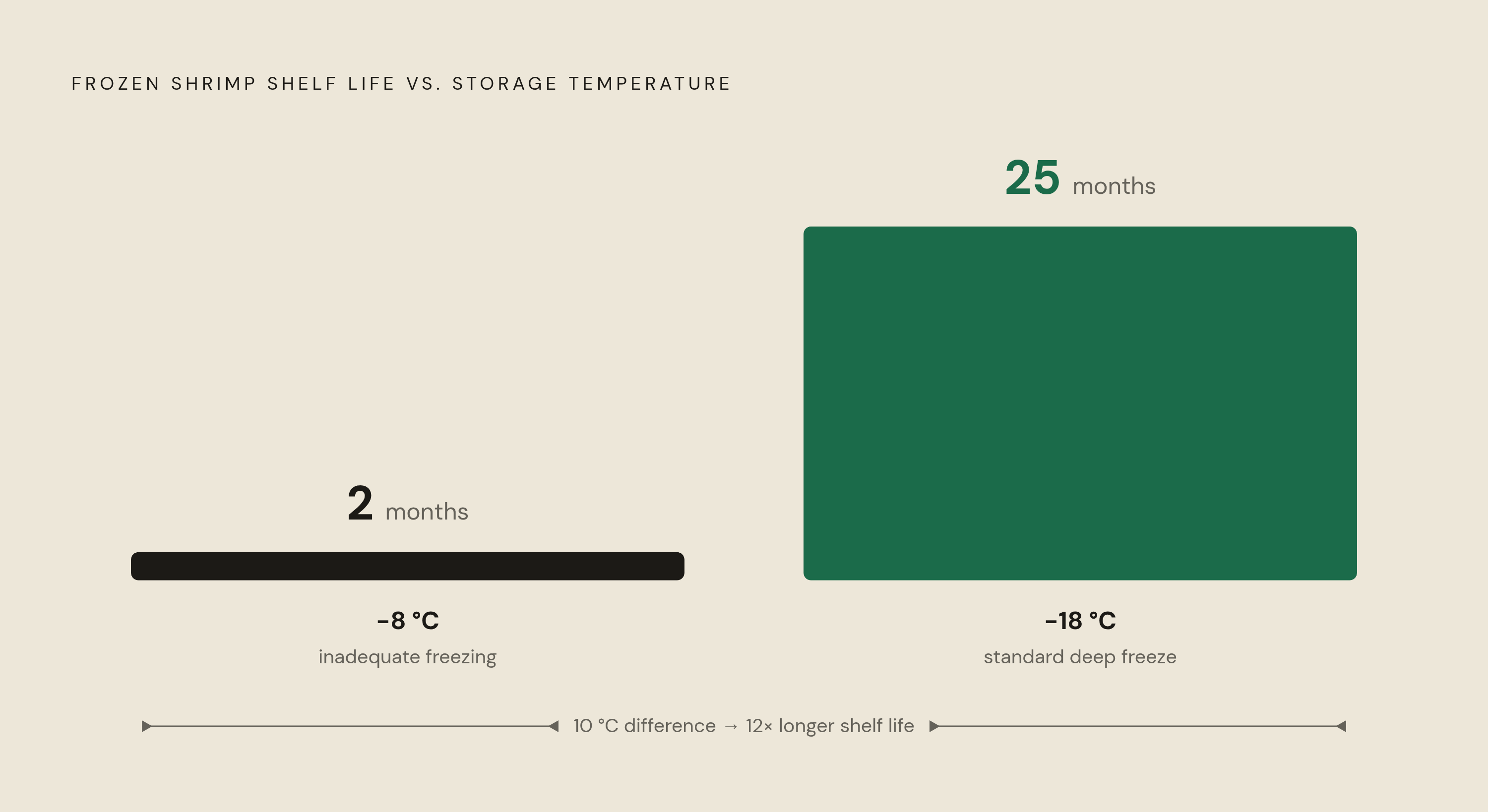
The shelf-life consequences aren't gentle. Frozen shrimp held at –8°C lasts about 2 months, while the same shrimp at –18°C lasts 25 months, a twelvefold difference produced by a gap that looks modest on a thermostat dial https://www.tempcontrolpack.com/knowledge/cold-chain-for-seafood-products-tutorials-2025-equipment/.
Temperature cycling compounds the damage in a way a single-point check will never catch. A pallet can avoid any one dangerous peak and still degrade steadily through repeated warm-cool-warm swings during loading, transit, and receiving. That cycling shortens shelf life and leaves inconsistent quality inside the same carton, some product still frozen solid, some already showing ice crystal damage from a partial thaw nobody logged. A single end-of-trip reading misses that pattern entirely, which is why continuous logging, not spot-checking, is the only method built to catch it. Research on retail and domestic storage found frozen fish products spend 40% of their time above –18°C, fluctuating between –16 and –12°C, with excursions above –8°C not uncommon.
Value-added and ready-to-eat seafood: where temperature failure is a safety event, not just a quality event
Value-added seafood covers anything processed before it reaches the distributor: ready-to-cook, ready-to-eat, breaded, smoked, or marinated product where the raw material has already been handled, cut, or partially cooked somewhere upstream. Temperature discipline here runs tighter than for raw product, and the industry's guiding rule is blunt: reject if uncertain, because there's no cooking step left downstream to kill off whatever grew during an excursion.
That precautionary posture exists because the failure modes here are primarily about hygiene and labeling. They're about hygiene and labeling. Cross-contact with raw product, a mislabeled allergen, a wrong date code, these are what actually appear in audits and recalls, not the softer quality complaints that come with a slightly warm piece of fresh fish. A distributor can run a perfectly calibrated freezer and still fail an audit because a ready-to-eat item sat one shelf below raw shrimp overnight.
The fix is separation, and it has to be physical, not procedural. Ready-to-eat product sits above raw product on any shared shelving, never below it, so drip and condensation from raw seafood can't reach product that won't be cooked again before someone eats it. It needs its own tools, its own cutting surfaces, and ideally its own receiving lane, because sharing a dock or a knife between raw and ready-to-eat product turns a temperature program into paperwork that doesn't actually stop contamination.
What temperature excursions cost across the cold chain
The dollar cost of a single excursion runs steep and stays invisible until it's too late to fix anything. Fish that warms above 41°F for even a few hours can lose 30% of its value, and that's not spoilage in the sense of an unsellable product https://www.tempcontrolpack.com/knowledge/cold-chain-for-seafood-products-tutorials-2025-equipment/. It's a markdown that eats straight into margin, usually discovered only when a buyer or end customer complains about texture or smell days later.
Running the math the other direction shows discipline pays for itself quickly. Operations that keep cold routines consistent cut spoilage by 15-30%, and one salmon exporter that put continuous temperature logging on every shipment cut spoilage claims by 25% https://www.tempcontrolpack.com/knowledge/cold-chain-for-seafood-products-tutorials-2025-equipment/ https://www.tempcontrolpack.com/knowledge/fresh-seafood-cold-chain-regulations-equipment-2025-guide/.
The losses rarely come from a dramatic freezer failure. More often it's the in-between moments: product staged too long on a loading dock, a door left open during a slow receiving process, a delivery truck that wasn't pre-cooled before product went in, a receiving area with no temperature control of its own. None of that is equipment failure. It's a decision made under time pressure, by someone who may not know that the crustaceans on that truck need a different humidity setting than the fillets stacked next to them. Up to 25% of food is wasted due to temperature breaches, an industry-level benchmark that helps contextualize distributor-level risk.
The equipment and monitoring infrastructure that makes category-specific targets achievable
Refrigeration equipment has one job: hold a temperature. It cannot cool a product that arrives warm to begin with. Every input into the cold chain, the fish itself, the ice or slurry packed around it, the packaging, the truck compartment, has to be pre-chilled before loading starts. Loading warm product into a pre-set reefer truck and expecting the truck to catch up during transit is a costly assumption, as the shelf-life numbers above show.
Glazing is a good example of equipment doing real preventive work instead of just holding a number on a dial. Dipping frozen fish briefly in near-freezing water builds a thin ice coating, typically 2-5% of product weight, that acts as a barrier against dehydration and oxidation during frozen storage https://www.tempcontrolpack.com/knowledge/cold-chain-for-seafood-products-tutorials-2025-equipment/. Matched against the right freezer rating (three-star for anything that needs to hold below –18°C, two-star only where –12°C is acceptable), glazing and equipment selection stop looking like separate line items and start looking like two halves of the same shelf-life strategy https://www.tempcontrolpack.com/knowledge/fresh-seafood-cold-chain-regulations-equipment-2025-guide/.
Monitoring closes the loop that equipment alone can't close. A refrigeration unit holding the right temperature is only useful if someone, or something, records that it held, continuously, across every handoff from processor to truck to warehouse to retail case. FSMA 204 is pushing that recordkeeping from a competitive advantage toward a flat regulatory requirement, with compliance now set for July 20, 2028, following the extension published in the Federal Register on August 7, 2025 https://www.tempcontrolpack.com/knowledge/cold-chain-seafood-products-2025-requirements/. Distributors who put off building that infrastructure should know the runway involved: enterprise food traceability implementations typically take 12 to 18 months for a mid-size operation https://www.tempcontrolpack.com/knowledge/cold-chain-seafood-products-2025-requirements/. For the most demanding product, sashimi-grade tuna, some processors hold quality at temperatures as low as –60°C in specialized super-freezers, a reminder that "frozen" in this industry spans a range wider than most non-seafood cold chains ever have to think about https://www.tempcontrolpack.com/knowledge/cold-chain-for-seafood-products-tutorials-2025-equipment/. Frozen shellfish maintain quality for 6–12 months at –10 °F https://www.tempcontrolpack.com/knowledge/cold-chain-for-seafood-products-tutorials-2025-equipment/. Frozen storage at –60 °F (–51 °C) preserves sashimi-grade quality for extended periods https://www.tempcontrolpack.com/knowledge/cold-chain-for-seafood-products-tutorials-2025-equipment/. For fatty fish like salmon or tuna, holding at –24 °C or below is often recommended to prevent fat oxidation https://www.tempcontrolpack.com/knowledge/cold-chain-for-seafood-products-tutorials-2025-equipment/. Research has reported that 40% of the total time, frozen fish products are over the recommended temperature of –18 °C, varying between –16 and –12 °C https://www.tempcontrolpack.com/knowledge/cold-chain-for-seafood-products-tutorials-2025-equipment/. When temperatures climb into the 5–57 °C danger zone, bacteria like Salmonella and E. coli can double every 20 minutes https://www.tempcontrolpack.com/knowledge/cold-chain-for-seafood-products-tutorials-2025-equipment/. Long-term storage of fatty species may require –24 °C to reduce oxidative rancidity https://www.tempcontrolpack.com/knowledge/fresh-seafood-cold-chain-regulations-equipment-2025-guide/. Standard live Eastern oysters are packed 200–250 per bushel https://www.tempcontrolpack.com/knowledge/cold-chain-seafood-products-2025-requirements/.