What Restaurant Buyers Actually Experience When a Seafood Distributor Locks the Order Window
Missed seafood orders cascade through kitchens in ways distributors never see.
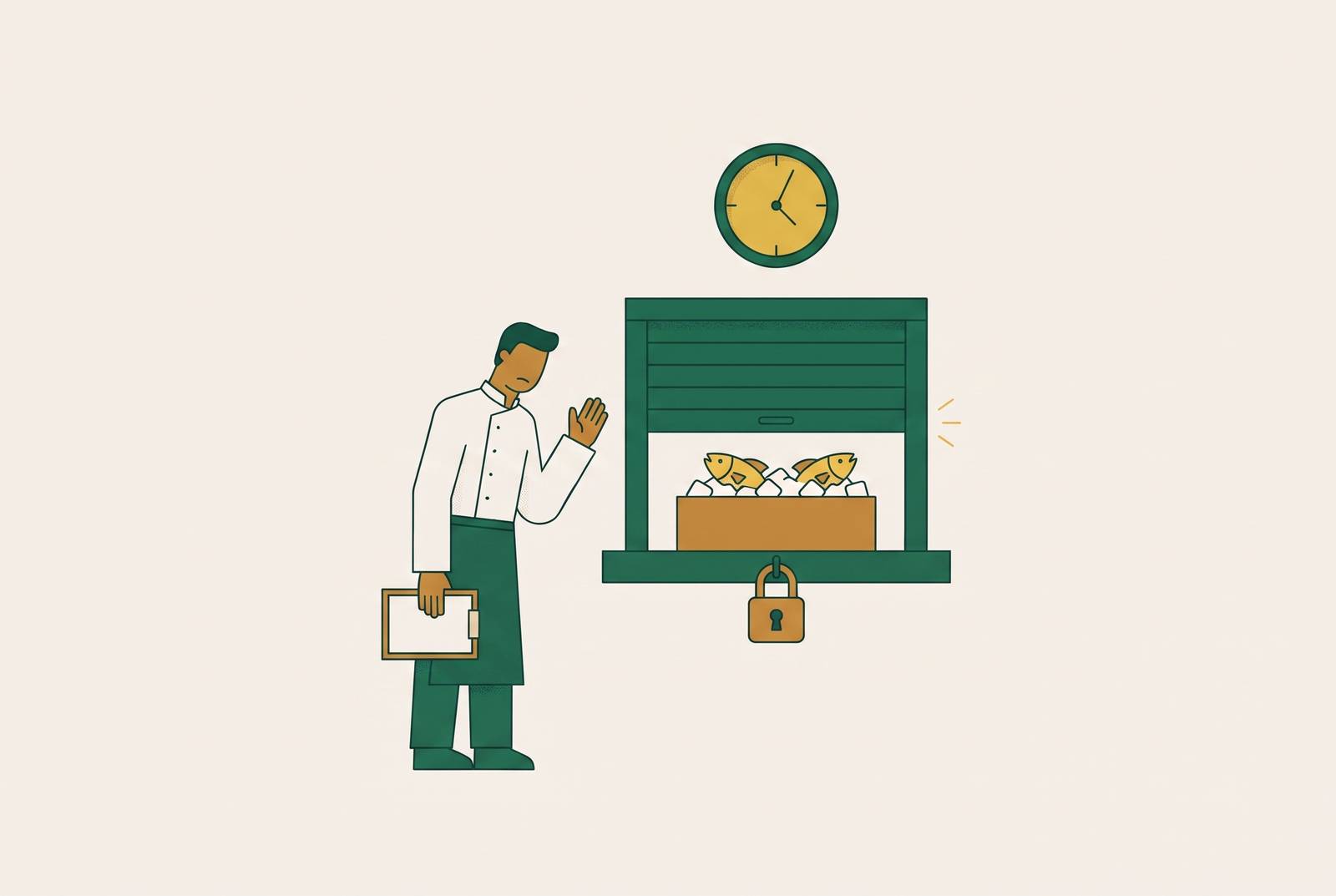
Order cut-off enforcement for seafood distributors should separate the deadline for delivery commitments from the ability to receive an order. Closing intake pushes buyers with continuing restaurant demand into uncertain substitutions, emergency sourcing, and service changes whose costs remain largely invisible to the distributor. Capturing late orders for review preserves the logistics cutoff without leaving buyers unsure whether their request has reached anyone.
Why restaurant buyers and seafood distributors work on incompatible clocks
Distributors close order windows because plans for routing, warehouse staging, and cold-chain sequencing must be set at a fixed time. Seafood’s perishable life begins when it leaves the water, and each additional hour in the supply chain compresses the time available to the restaurant. A deadline protects the sequence that gets the product to the kitchen while it still has commercial value.
Restaurant buyers work to a different clock. Chefs order late at night, between services, or during prep, when the kitchen leaves them time to assess what they need. Those moments do not necessarily coincide with supplier office hours. A Wednesday noon cutoff for Thursday delivery therefore shapes more than the timing of a purchase. It shapes the restaurant’s prep week, even when the buyer only has time to order outside the distributor’s window.
What the buyer actually experiences in the minutes and hours after the window closes
The buyer’s first response is usually to try another route. A text, a call, or a WhatsApp message follows the discovery that the ordering window has closed. Buyers can underestimate or forget the cutoff until they encounter it, but reaching out does not resolve the immediate problem. The buyer still does not know whether anyone received the message, whether the product remains available, or whether the order can make the next run. Sending is not the same as knowing.
The kitchen must decide whether to plan around the missing item or proceed without it, often before the distributor’s team returns to its desk. Waiting preserves the possibility of receiving the intended product, while changing plans means committing to a workaround before the answer is known. Neither choice can remain open indefinitely.
Adelphia Seafood states that in a high-volume kitchen, “maybe” doesn’t work, and identifies clear ordering windows and reliable delivery schedules as supplier requirements. A kitchen that prepares for both outcomes takes on extra work or risk. When confirmation is absent, the buyer has to turn uncertainty into a decision on the restaurant’s own time.
How a missed seafood order is categorically different from missing a dry-goods SKU
A missed seafood order leaves both a specification gap and a quantity gap. Grade, portion, and presentation decide whether a substitute will work in the dish and at the plate cost the kitchen planned for. The substitute must preserve the product identity on which the menu depends.
Crab meat makes that distinction visible on the plate. Jumbo Lump consists of the largest whole pieces, valued for their size and delicate taste in cocktails and high-end crab cakes that showcase the lumps. Special grade is not an equivalent replacement on a composed appetizer. The dish may still contain crab, but the guest can see the downgrade. Availability has solved only part of the problem.
Fish portions and oysters expose different limits to substitution. A restaurant needs the 6-ounce salmon ordered on Monday to look and taste like the portion received on Friday, because consistency supports both plate costing and the guest experience. Oyster grading introduces another complication. Its terms are not federally regulated, and measurements can vary between growers. A buyer cannot simply send the same shorthand to a backup supplier and assume that the same product will arrive.
The 86 cascade and how a single missed item compounds through service
When replacement is not possible, the missing item reaches the menu. Premium cuts, fresh seafood, and seasonal specials are among the high-margin items first to get 86’d, despite their contribution to stronger check averages. Removing one of them changes what the restaurant can sell before it changes anything else. The consequence spreads through the service operation.
On the floor, servers may take orders before learning that an item is unavailable. They then return to the table with an apology rather than the expected dish, a moment that erodes trust when it happens repeatedly. Meanwhile, the kitchen works through improvised substitutions under pressure. Mise en place no longer fits the service plan, and it gets harder to keep plates consistent. The same missing item is now disrupting both the promise made at the table and the work required to deliver it.
Management absorbs the third branch of the cascade. Complaints that could have been prevented reach the floor manager while servers are correcting orders and cooks are adapting plates. These are simultaneous demands. One missed order has become a front-of-house communication problem, a back-of-house execution problem, and a management problem. Its cost cannot be understood from the unfilled purchase alone.
The workarounds buyers use and why each one carries its own cost
A secondary supplier may provide a substitute quickly, but the replacement can command a meaningful premium over the contracted item without guaranteeing the same quality or specification. Broadliners and cash-and-carry warehouses provide accessible backstops, with less depth in specialty seafood. With cash-and-carry, the restaurant also has to collect the product. The buyer obtains product by spending time that the original delivery arrangement would have saved.
Buying extra in advance transfers the risk into inventory. Highly perishable seafood kept in case of a future missed window can spoil, at a cost greater than that of the original shortage. Allocation can make that hedge ineffective as well. When scarce product is rationed according to historical purchase volume, increasing the current order does not increase the buyer’s share.
Replacing a signature dish with one that has a lower margin keeps service moving, but brings down the check average. Repeated substitutions also weaken the menu’s identity for regular guests who return expecting a particular dish. Temporary removal avoids serving an unsuitable replacement, while surrendering the sale that the original item could have supported. These are rational responses to a constrained choice.
Each workaround also changes what the primary distributor sees. Product sourced elsewhere, extra stock bought defensively, or a dish removed from service can all reduce the immediate need to pursue the original order. The kitchen has found a way forward. That does not mean the interruption was inexpensive, or that the relationship emerged unchanged.
What the distributor cannot see from inside a closed intake window
A closed intake window conceals demand at the moment buyers are responding to a shortage. After-hours messages may sit in an inbox until morning without anyone recording what buyers need. The distributor therefore lacks a clear account of what the buyer wanted when the window was unavailable. This is an information gap built into intake.
Emergency sourcing is particularly easy to misread because it need not produce a complaint. It may appear instead as a slightly smaller order from the primary distributor the following week, with no explanation attached. Historical purchasing then shows the result of the workaround. Allocation based on that history can miss current need when buyers have begun adjusting orders upward or downward in response to earlier shortfalls.
The communication gap also weakens the relationship quietly. Adelphia identifies responsive communication as a non-negotiable supplier attribute, including immediate notice when a boat is delayed or a season ends early. Buyers need that information while they can still act on it. The same timing principle applies to their own requests. Information that arrives after the kitchen has committed to a workaround has less operational value, even if the eventual answer is clear.
Why the order window problem is actually an intake processing problem in disguise
The distinction is between accepting a delivery commitment and receiving a request. Routing, warehouse labor, and cold-chain sequencing still require a fixed commitment point. A chilled seafood shipment begins losing commercial value as soon as it leaves the processing facility, so opening communication cannot make those constraints disappear. The cutoff remains legitimate. What does not follow is that the distributor must stop capturing buyer demand at that same moment.
Receiving an order at 11 p.m. does not require a person to transcribe it then. A system can capture the message, convert it into a structured order draft, and queue it for human review when the team arrives. An acknowledgment establishes that the request has been received and is waiting for review. It must not be confused with confirmation of availability or fulfillment on the next run.
Captured and queued is a known state, but it is not a guarantee that the restaurant will receive every requested item. Knowing the message has been received ends the communication blackout that pushes buyers into workarounds they could have avoided, while the real limits on supply and delivery stay in place.
Reps can still catch specification errors and learn what accounts are adding to their menus, while AI transcribes orders and flags possible problems before confirmation. Seafood makes that review especially valuable. Two different count-and-presentation grades are not interchangeable merely because both are available. An intake system that recognizes the difference and flags a proposed substitution for a rep does more than pass text through a generic ordering portal.
What does a distributor that solves the intake gap look like to the buyer?
From the restaurant’s side, the change begins in the channel already in use. Text, email, WhatsApp, phone, and voicemail remain ways to place a request after hours. The message is captured, its receipt is acknowledged, and a structured draft waits for review. The buyer has not gained an exception to every deadline. The buyer has gained visibility into whether the request has entered the process.
The system has to understand the order itself to give buyers that visibility. Multilingual and shorthand-fluent intake lets buyers use a mix of languages or species-specific terms without simplifying the request to suit the system. Shell-on counts, whole-weight designations, and named crab grades must retain their meaning. Otherwise, the system has merely moved undecoded text from one place to another. The distributor’s ERP needs a clean, structured order draft, with potential issues available for human review.
The administrative work can therefore be handled without adding headcount or extending human coverage hours. Processing and fulfillment retain their existing constraints, while the buyer’s communication no longer has to wait for an open desk. The practical relief is specific. A late order may still require a different delivery plan or a substitute, but the restaurant is no longer making that decision without knowing whether anyone has received the request.