Substitution Protocols When a Seafood SKU Is Unavailable at Order Fulfillment
Precise seafood specs and approval rules prevent costly substitution mistakes at fulfillment.

When a seafood SKU is unavailable at fulfillment, a defensible substitution protocol matches the customer’s specification, applies the right approval rule, and records the change before delivery. Structured order capture, including voicemail and phone order transcription for food distribution, preserves the details that make those decisions possible. The purpose is not simply to fill the line, but to protect the customer relationship without concealing a material change.
Why seafood substitutions fail when distributors treat them like a generic inventory swap
A picker finds that the requested SKU is out, and the clock starts. Before the order can move, someone must decide if the item in stock will work for the customer, if it needs approval, and who needs to hear the answer. A restaurant that gets the wrong cut may be unable to make its menu item. An unapproved substitute therefore becomes a failure of the distributor.
Generic inventory logic cannot make that choice because products can have the same quantities and still differ. IQF P&D tail-on Gulf shrimp and block-frozen HLSO import in the same count are commercially and culinarily different. Accurate stock-location data tells the team what is available, which it needs to know for a proposed replacement to be useful. During the fulfillment window, the team must check what is in stock against the original specification and the customer’s permission before deciding what ships.
What a seafood specification actually contains, and why every variable matters for substitution
A seafood specification is a bundle of interdependent variables, each of which can disqualify an otherwise plausible replacement. Species and origin each need to be checked because the customer must be told if either changes. Count also needs a unit basis, since the US convention is to give shrimp count per pound headless shell-on. The same count quoted for a head-on product does not describe an equivalent item. The picker or CSR must compare both the basis and the number.
Product form determines what the customer can do with the case. Head-on shell-on (HOSO), headless shell-on (HLSO), and peeled and deveined (P&D) differ in yield, appearance, and preparation labor. Tail-on and tail-off are further distinctions. IQF versus block-frozen affects thawing and the handling of partial quantities, so matching species and count still leaves a kitchen-use decision unresolved.
Glaze can also make cases hard to compare because the ice coating that protects the shrimp adds weight of its own. Declared net weight excludes glaze, so a heavier frozen case does not necessarily contain more shrimp. Count designations also describe bands, and off-count product outside tolerance is a quality failure. Descriptive terms such as “large” and “jumbo” vary across suppliers and countries, whereas numerical count bands give buyers an auditable comparison. Written buying specifications, including shrimp count per pound and fillet thickness, turn these distinctions into acceptance standards.
Those standards must survive order intake. Asakana is one option for seafood-specific order capture that preserves distinctions such as species, freezing method, count, glaze, and origin rather than reducing the request to a generic SKU number. Whether the distributor uses such a tool or another structured order system, the operational requirement is the same. Fulfillment needs to know which variables are fixed for the customer’s purpose and which the customer allows to change.
Where substitution becomes fraud — the legal boundary every distributor must know
The FDA defines offering a food for sale under the name of another food as misbranding under Section 403 of the Federal Food, Drug, and Cosmetic Act. Substituting a less expensive species for a more expensive one without disclosure is economic fraud under federal law. A misdemeanor violation does not require intent to deceive, although a felony conviction under the FDCA requires intent to defraud or mislead. An urgent stockout therefore does not turn species identity into a discretionary service detail.
The FDA’s documented examples include various snappers (Lutjanus spp.) or rockfish (Sebastes spp.) substituted for red snapper (Lutjanus campechanus), and Alaska Pollock substituted for Cod. Other examples include farm-raised salmon substituted for wild-caught salmon and skate wings substituted for scallops. Imported crabmeat substituted for blue crabmeat, and paddlefish and other fish roe substituted for caviar (sturgeon species), illustrate further identity changes. These are not differences that a matching case price resolves.
At picking, the protocol must treat a species, wild/farmed, or geographic-origin change as requiring disclosure, documentation, and buyer approval before shipment. The replacement cannot be invoiced under the original SKU. Clear intake fields for species, origin, and product form establish what was ordered, while the substitution record establishes what changed and who approved it. Approval and accurate identification are separate controls, and the protocol needs both.
Pre-defining substitution families before a stockout happens
Once the specification and legal boundaries are clear, the distributor can define substitution families before fulfillment is under pressure. A family is a pre-vetted group of SKUs that can replace one another under stated conditions. Its anchor is the customer’s end use, expressed through non-negotiable variables such as species, count, form, and certification. Wild-caught or sustainability certification requirements belong in that definition where the customer specifies them. Alternatives qualify only where their differences fall within the customer’s permitted flexibility.
Each family needs a default rule that says whether the team may auto-substitute, must ask for customer approval, or must not substitute. Species and wild/farmed changes always require explicit approval and documentation, regardless of price parity. Customer-level restrictions then overlay the family rule because an equivalent accepted by one account may be prohibited by another. Contract tolerances and no-substitution instructions must live in the order management system so they are available independently of a CSR’s memory.
Standing preferences make this practical by identifying approved equivalents, permitted categories, and items to omit if unavailable. An intake system such as Asakana keeps order history and customer preferences so the fulfillment team can see those rules in context. History supplies context, however, rather than permission for a change the customer has not authorized. With approved family logic configured in the ERP or order management system, the team can surface a valid alternative to keep the line in the order.
Getting approval that is proportional to the magnitude of the change
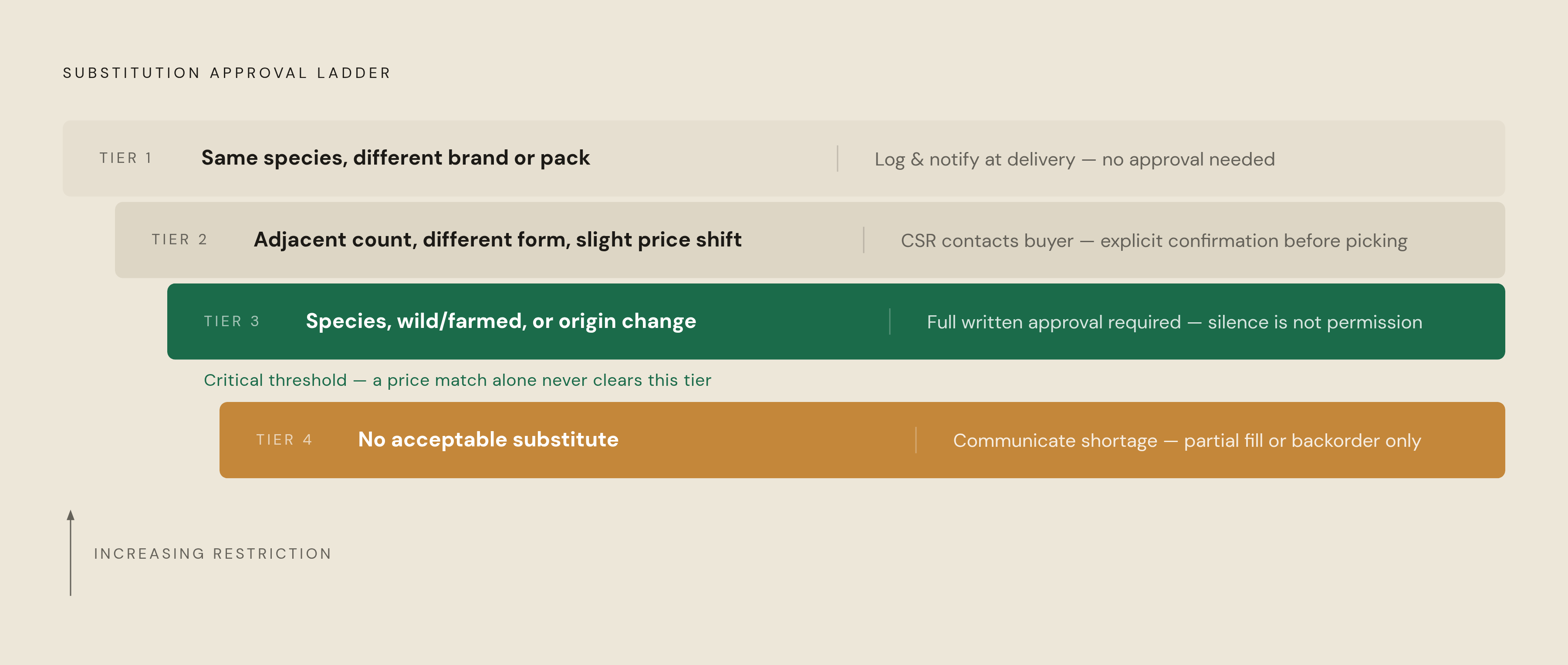
Tier 1 covers a pre-authorized equivalent, such as shrimp of the same species and count band in a different brand or pack that the standing rule permits. The team can proceed under that rule, log the replacement, and notify the customer at delivery.
Tier 2 covers a close substitute with a meaningful variable change, such as an adjacent shrimp count, a different form, or a slight price difference. The CSR contacts the designated buyer and presents the original item, the available alternative, its form, count, pack size, and price difference. Explicit confirmation is required before picking. A specific proposal reduces back-and-forth because the buyer can evaluate the actual product and avoid asking what “similar shrimp” means.
Tier 3 covers a species boundary, a wild/farmed boundary, or a geographic-origin change. The customer must give full written approval before farm-raised salmon can move in place of wild-caught salmon. Silence is not permission, and a price match does not lower the approval requirement. One approval contact for each account keeps the chef, buyer, and manager from giving conflicting answers.
Tier 4 applies when no acceptable replacement exists. The distributor communicates the shortage proactively and offers a partial fill or a backorder window rather than shipping a random product to complete the line. This tier matters because a protocol must authorize an honest short shipment as clearly as it authorizes a valid substitute.
How multi-channel order communication makes substitution decisions harder — and what to do about it
A sound approval rule still fails if the request or response never reaches the person who needs it. Orders arrive through text, email, phone, voicemail, and WhatsApp, while substitution decisions must travel back through those channels under fulfillment pressure. An email may go unread when the account normally orders by text. A voicemail approval that is never transcribed leaves no usable written trail, and a verbal preference may be unavailable when the CSR who heard it is off shift.
For voicemail and phone order transcription for food distribution, transcription is therefore only part of the requirement. The resulting order data must preserve the seafood specification and make the customer’s instructions available to fulfillment. After-hours voicemail capture addresses the morning intake burden, but substitution control also depends on retrieving the relevant preference and recording the reply. A transcript disconnected from the order leaves that operational handoff unresolved.
The practical response is to use the customer’s established ordering channel for substitution outreach and to agree on the exception workflow in advance. That agreement must state what evidence to capture, where to send it, and what response time to expect. Each exception also needs a named owner and an expected next update. These controls tie the conversation to the shipment so no one has to search separate inboxes for permission.
For distributors considering Asakana or another multichannel order intake system, the relevant criteria are structured specification capture, accessible customer history, and communication that can be logged against the order. The system should work with the channel the customer already uses and keep a timestamped record of the substitution conversation.
Documenting the substitution so it protects the distributor at delivery and in the future
Once approval is obtained, documentation carries it beyond the people who took part in the conversation. The record must identify the original SKU, quantity ordered, and reason for unavailability. It must also identify the substitute SKU, quantity shipped, and price difference. The approver, communication channel, and approval time establish the authority for the change. Conditions such as one-time acceptance, pending availability of the original, or a price held at the original must remain attached to that decision.
This record protects the handoff at delivery because the driver needs to know about the replacement before arriving at the dock. A receiving clerk who sees a SKU they do not know, with no written record to explain it, may reject the load even though the change was approved earlier. The invoice and the account manager also need the same account of what was sent and why.
Exception closeout should record the cause, the containment or correction, and any follow-up action. Shortages, substitutions, and documentation gaps should each have their own exception type within the service log. That distinction makes the log useful for understanding whether the problem was availability, product choice, or a failed handoff. Over time, customer preference profiles can include approved equivalents and firm restrictions, while one-time approvals stay marked as such.
Building the protocol into daily operations so it runs without heroics
The final step is to make these controls executable by any team member who handles the order. Substitution families and customer-level flags belong together in the ERP or order management system. Internal escalation paths should be defined by role so that any CSR knows where a Tier 3 decision goes. Customer notifications should go out through the preferred channel automatically, with no need to write a new message each time. Checking the substitution log regularly keeps standing preferences in line with the approvals on record.
This structure matters as order volume grows because substitution decisions increase with it. Without a system, that growth demands more CSR time and creates more opportunities for missed approvals and damaged accounts. Centralized, written rules reduce dependence on individual knowledge while preserving the distinctions that seafood requires.
A distributor that builds this protocol is doing more than preparing for the next unavailable SKU. It is accumulating customer preference data that makes future alternatives easier to assess and approval requirements clearer to apply. The measure of success is whether the customer receives an acceptable product, understands any change, and retains trust in the distributor.