Order Cut Times in Seafood Distribution and Why They Fail
Most seafood cut-time failures stem from jumbled orders, not missed deadlines.
Order cut times in seafood distribution fail less often because a distributor picked the wrong deadline, and far more often because the order never arrived in a form anyone could act on by that deadline. The failure comes from two structural forces: communication fragmentation on the intake side, and a relationship-first culture that makes enforcement feel like a betrayal of trust. Fixing cut-time compliance means addressing both at once, not tightening a policy that was never the real point of failure.
Why order cut times exist and what they are actually protecting
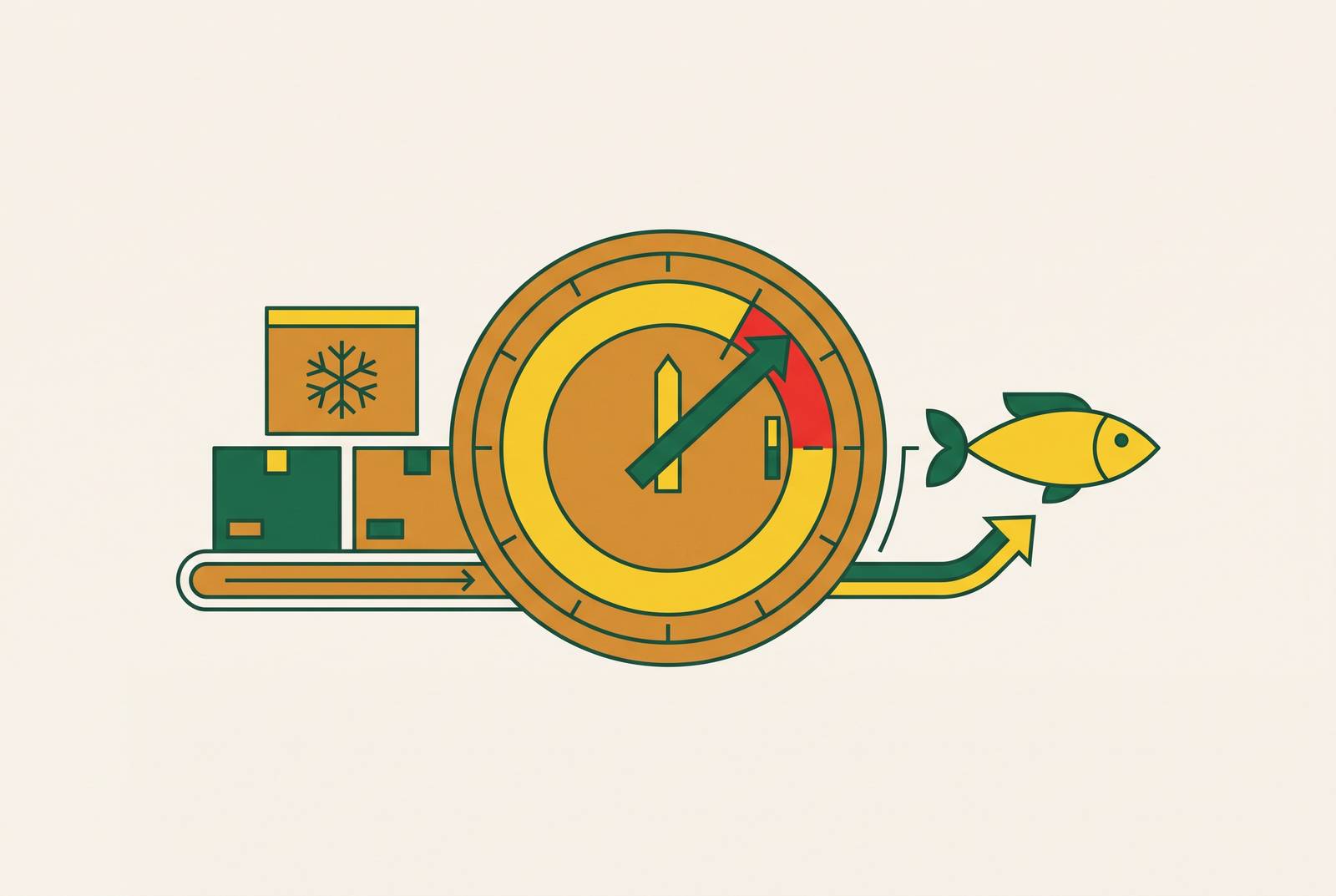
A cut time is the last moment an order can enter the workflow without disrupting picking, packing, cold-chain assembly, and routing that is already underway. It is not a courtesy deadline set to keep an office running on schedule. It marks the point past which the physical chain of operations behind a delivery can no longer absorb a change without unwinding work already done.
Seafood makes that window tighter than in almost any other food category. The cut time, then, is really the cold chain's earliest hard stop, calculated backward from the moment the product needs to leave the dock. When a cut time is missed, the disruption that follows is never simply administrative. It is physical, and it moves in one direction only.
What Happens to Warehouse Operations When a Late Order Arrives
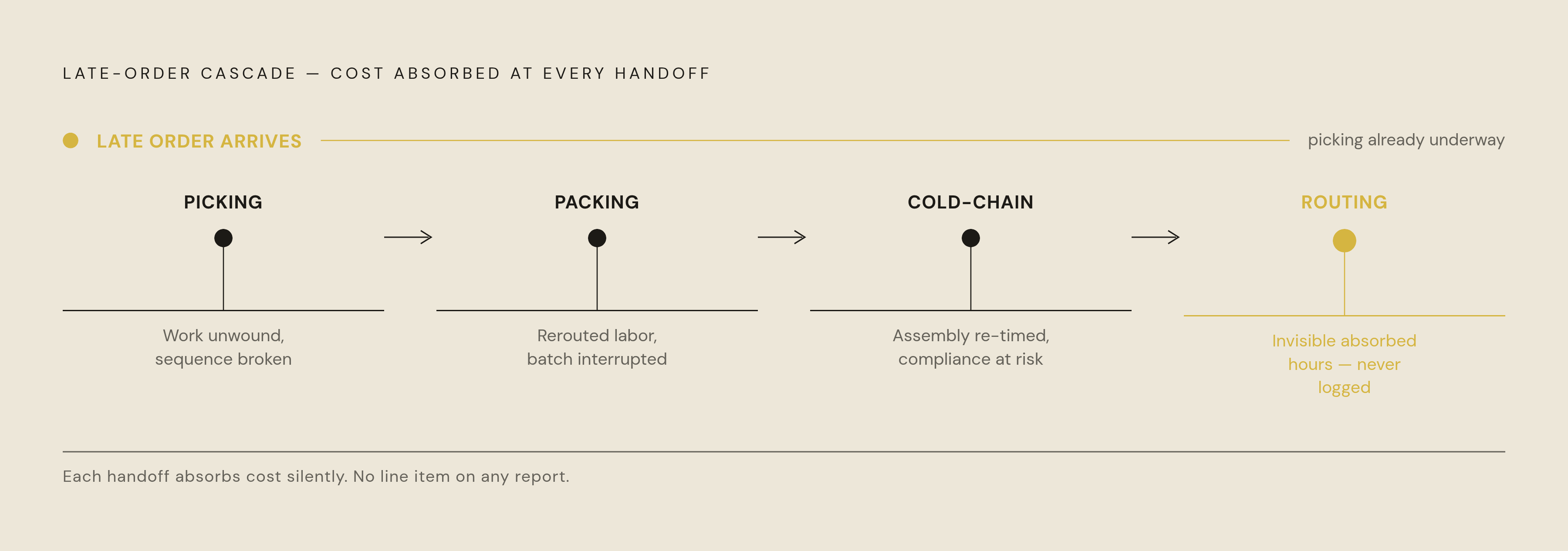
A late order landing after picking has started rarely produces a single delay. This cost is invisible because it never appears as its own line item on any report. It is absorbed into the existing labor of whoever is standing closest to the problem when it occurs.
Multiply that across several late orders in a single run, and several runs in a week: the absorbed hours add up to a real cost that never appears anywhere because no one logs "time spent reworking a late order" as its own category. The cost of a late order is never confined to the minutes it takes to process the change; it compounds across every downstream handoff the order touches on its way to the customer.
Why Seafood Makes Cut-Time Enforcement Harder
Seafood is harder to distribute than almost any other food protein, and that difficulty compresses the margin available for absorbing a late order. Each additional link raises the risk of losing data, provenance, or traceability, so a distributor receiving product is already managing accumulated uncertainty well before an order is placed against it.
Time pressure at the point of sourcing adds another layer that has no equivalent in shelf-stable goods. Some items simply cannot wait. Layered on top of that is a vocabulary that governs every B2B order in the category: H&G, J-cut, IQF, sushi-grade, U/15 diver scallop, shrimp count sizes, catch weight. These terms are standard in the industry, but each one introduces an interpretation demand that slows down every manual step in the ordering process. Freshness assessment at receiving, checking eye clarity, gill color, flesh firmness, and in some cases chemical testing for histamine levels in tuna, adds an entire onshore handling layer that dry goods distribution never has to account for.
How communication fragmentation structurally undermines cut times before an order is even placed
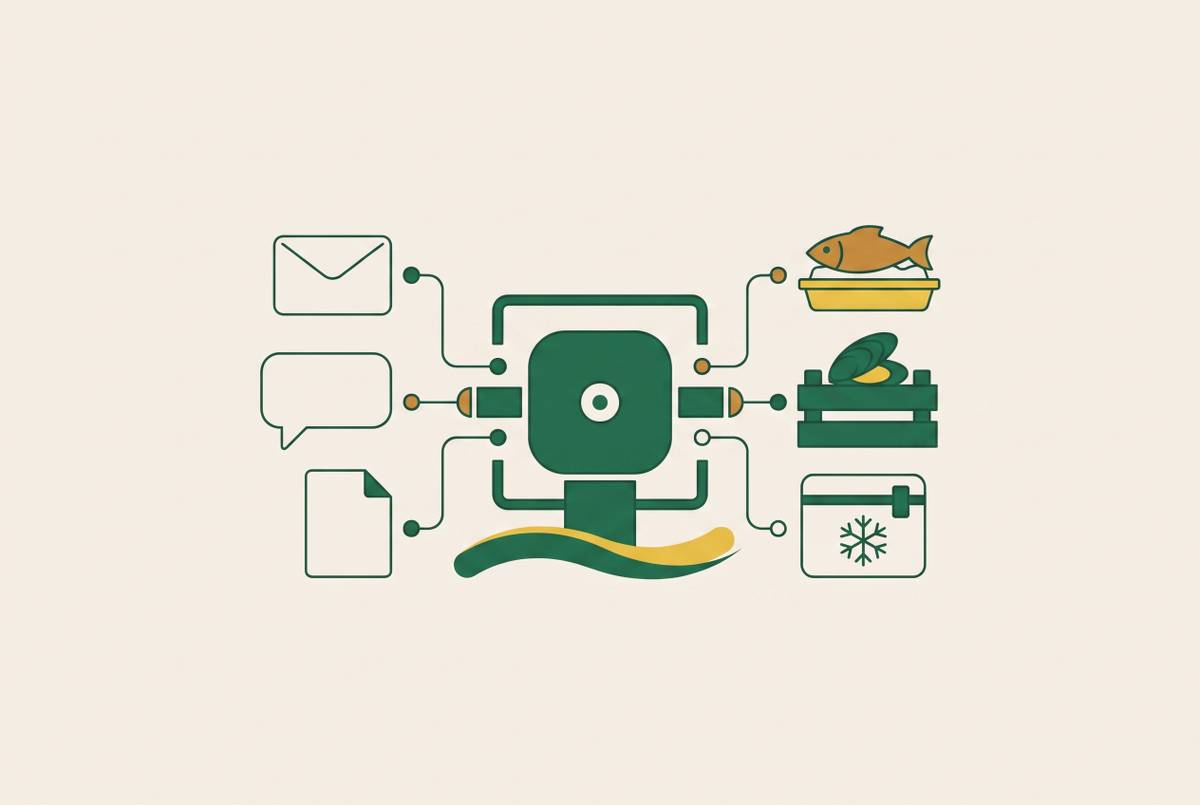
Cut times get undermined before an order ever reaches the warehouse, because orders do not arrive through one channel at a predictable moment. They arrive across text, phone, email, WhatsApp, WeChat, and voicemail, frequently in overlapping or conflicting versions of the same order. A customer might call a rep at 10 pm, text a version of the same order to customer service the next morning, and email a slightly different version to the office later still. By the time that order reaches the warehouse floor, it has been touched and retyped multiple times by multiple people, each retyping a fresh opportunity for a number or a spec to change.
Each handoff introduces its own chance for a mistake, a delay, or a duplicate entry, and none of those handoffs carries a timestamp that maps cleanly back to the cut time the distributor is trying to enforce. Asakana's intake data reflects exactly this pattern: orders land by text, call, voicemail, email, WhatsApp, and WeChat simultaneously, leaving the order desk to reconcile them manually into ERP drafts, a process that is slow, error-prone, and structurally unable to hold a deadline no matter how clearly that deadline is posted. Tools that capture orders directly from the channels customers already use, and convert them into structured drafts ready for the warehouse, collapse that reconciliation overhead and move the true order-received moment earlier, reclaiming real time inside the existing cut window.
The hidden cost of translating a scattered message into a usable order includes the tacit knowledge required to resolve ambiguity at the point of intake: which SKU a given customer means by a shorthand name, which unit they prefer, their usual delivery pattern, the product alias they have used for years. That knowledge tends to live in the heads of individual order desk reps rather than in any shared system, which means the order desk becomes a bottleneck that cannot clear fast enough to make any cut time stick, no matter how reasonable the deadline is.
Why the relationship-first culture of wholesale seafood makes enforcement feel impossible
Even where a cut time is clearly set and clearly communicated, wholesale seafood's relationship-first culture puts standing pressure on distributors to accommodate the order that arrives after it. Refusing the order can feel like putting process ahead of a relationship that took years to build, and most people in that position would feel exactly that tension.
The predictable result is a class of habitual late-order customers who have been accommodated for so long that they have no reason to change their behavior. The distributor-operator relationship in food distribution has long been expected to function as something strategic rather than purely transactional, and operations teams end up absorbing flexibility costs that are never formally named as costs. Southern Provisions removes the supplier relationship altogether, which says something about how difficult the underlying tension is to resolve through negotiation alone.
What Happens When Late Orders Collide With Supply Volatility in Seafood
Cut-time failures rarely occur in a stable supply environment; the volatility already built into seafood sourcing turns a missed internal deadline into something worse than a delay. Supply chain disruptions have extended seafood lead times well past typical windows, adding further pressure to import-facing inventory that is already stretched thin. Under those conditions, missing an internal cut time can mean the order is lost, because the product that would have filled it is no longer available.
At the interface between distributor and operator, poor communication between sales and operations produces a familiar set of failures: wrong components get shipped, deadlines get missed, inventory gets promised that does not actually exist. That pattern becomes serious once sourcing windows narrow. Without live inventory visibility at the moment an order is taken, staff can promise product that is already gone or that cannot be fulfilled within the parameters of the cold chain, and that error sets off disruptions that are already running by the time it is caught. Specialty food distributors that have outgrown disconnected systems recognize this pattern well: sales sees one quantity, the warehouse works from another, purchasing relies on exports and spreadsheets, and finance receives summarized information only after the operational activity it describes has already happened. Employees in that environment spend their time reconciling systems against each other rather than acting on information they can trust, which is exactly the kind of labor that needs to disappear before a cut time can mean anything.
Why the standard fix, stricter policies and customer-facing portals, does not hold in practice
The instinctive response to cut-time failure is to publish the deadline more clearly or push customers onto an ordering portal. Neither approach reaches the two forces actually driving the failure: fragmented communication and a relationship culture built on personal contact. Distributors who have tried either fix are not wrong to have tried it. The problem sits a level deeper than a policy change can reach.
A stricter policy only works if the order desk has the real-time capacity to enforce it across every channel an order might arrive through, and in most seafood distribution operations, that capacity does not exist. Customer-facing portals ask customers to change how they order, and in an industry built on personal contact, where customers text, call, and message in whatever format is natural to them, adoption tends to be low and forcing the change carries a genuine relationship cost. New systems in food distribution fail for a simple reason: staff will not use them, and that holds just as true for a customer-facing tool as it does for an internal one.
The strongest objection to automating intake in seafood is a specific one: catch-weight and spec-language interpretation. Seafood's vocabulary, H&G, IQF, U/15 scallop, catch weight, sushi-grade, adds a reconciliation layer every time an order arrives in shorthand or in a mix of languages, and manual parsing of that vocabulary introduces both delay and the risk of a genuine error. That objection deserves to be taken seriously rather than waved off, because a solution built on general-purpose automation, or a portal that does not understand the industry's own terms, will not resolve the intake failure it is meant to fix.
Capturing Orders as They Arrive, in the Channels Customers Already Use
The fix that reaches both dimensions of the failure, fragmented channels and relationship culture, has to capture orders the moment they arrive, in whatever channel the customer already uses, without asking the customer or the staff member on the other end to change anything about how they work. Captured and structured at the point of receipt, whether that point is a text, a call, a voicemail, an email, a WhatsApp message, or WeChat, an order becomes enforceable against a cut time because it is already in the system the instant it arrives rather than whenever a rep gets around to typing it in. The relationship stays intact because the customer keeps ordering exactly as they always have. The change happens entirely on the intake side, invisible to the person placing the order.
The catch-weight and spec-language objection raised in the previous section calls for a system that understands seafood vocabulary on its own terms, not one approximating it from general food distribution data. An AI order intake agent built specifically for the category can be trained on that vocabulary and its taxonomy deeply enough to interpret and flag ambiguous specs as they come in, rather than letting the ambiguity surface later, when a picker or a buyer is already trying to fulfill the order. Asakana is built around that specific requirement: it reads orders from every channel a food distributor's customers already use and converts them into structured ERP drafts, parsing seafood-specific terminology such as hamachi sashimi grade, dry-pack scallops, or a toro loin cut the same way as last time, and flagging anything unclear for human review before the order is confirmed, all without replacing the distributor's ERP or forcing a platform switch. A real example from the platform shows a WeChat message from a customer called Golden Bay Sushi, requesting hamachi, salmon fillet, and shrimp among other items, parsed directly into a structured draft rather than left for someone to retype the next morning.
The decision to flag rather than auto-resolve matters more in seafood than it would in most categories. AI that surfaces a potential issue for a human to approve is more useful here than AI that acts on its own judgment, because the cost of a wrong substitution or a missed spec is too high, and the relationship damage from an unreviewed error is real and hard to undo. Equally relevant to a distributor weighing a tool like this is where the data goes afterward: customer and business data is never used to train shared models, and in an industry where customer relationships and pricing are proprietary, that distinction carries weight.
What Changes Operationally When Intake Is Handled at the Moment of Receipt
When intake is handled at the point an order arrives rather than at the point someone gets around to processing it, the cut time stops depending on any individual staff member's judgment and becomes a boundary the system itself enforces. An order placed at 10 pm, written in Japanese, phrased in the shorthand of a customer relationship that goes back years, enters the system as a structured draft rather than sitting as a message waiting for someone to interpret it the following morning. That shift alone removes the single largest source of invisible delay described throughout this piece.
The operations team gains a complete, reviewable order queue in place of a scattered set of inboxes and voicemails, and what used to be invisible rework turns into a workflow anyone can see and manage. The rep who took the original call or text is no longer tied up transcribing it and can spend that time on the relationship work that actually keeps the account. None of this requires the order desk to grow at the same rate as order volume. That decoupling is the real payoff: a distributor that fixes cut-time enforcement at the intake layer removes a ceiling that has nothing to do with demand and everything to do with how many people are available to retype messages by hand, and that ceiling is the one actually limiting how much volume the business can take on.