Customer Alias and Shorthand Patterns in Seafood Ordering
How compressed customer nicknames defeat order systems designed for standard product catalogs.
Customer alias and shorthand patterns in seafood ordering look like informal slang, but they function as a compressed vocabulary that encodes real specification, sizing, and prep requirements. Understanding how that vocabulary forms, and why it breaks, explains why generic order intake software consistently fails seafood distributors.
Why seafood product specifications resist plain language
Seafood carries more specification density than almost any other food distribution category, which is the reason shorthand exists. A single species does not correspond to a single product. A single species, Alaska pollock for example, yields meaningfully different products at each combination of skin status (skinless versus deep-skin), bone status (PBO, pin bone out), and size grade (2 to 4 ounces, 4 to 6 ounces, 6 to 8 ounces), with each combination its own SKU carrying its own price and fulfillment path. Each of those combinations is its own SKU, with its own price and its own path through the warehouse.
The vocabulary built around these distinctions is extensive and precise. Terms drawn from the Pacific Seafood glossary and the Fish Markets glossary, including IQF (individually quick frozen), P&D (peeled and deveined), FAS (frozen at sea), H&G (headed and gutted), dressed weight, fillet yield, count per pound, and catch weight, are not interchangeable descriptors. Each one resolves to a different handling procedure, a different pricing basis, and in many cases a different labeling requirement. Shrimp sizing makes the stakes concrete because it runs on a count-per-pound system where receiving product one size band off from what was ordered is grounds for legitimate rejection, not a rounding error a buyer shrugs off.
Layered on top of product specification is a traceability burden that most food categories never encounter at the same level of granularity: species-level documentation, harvest area records, and catch-weight accuracy on every transaction. None of this vocabulary is decorative. It exists because the product itself demands precision at every step from harvest to plate. Almost no buyer communicates in this register when placing an actual order, and that gap between the complexity of the specification and the informality of the communication is where the entire alias system begins.
How customers compress specification-dense orders into shorthand
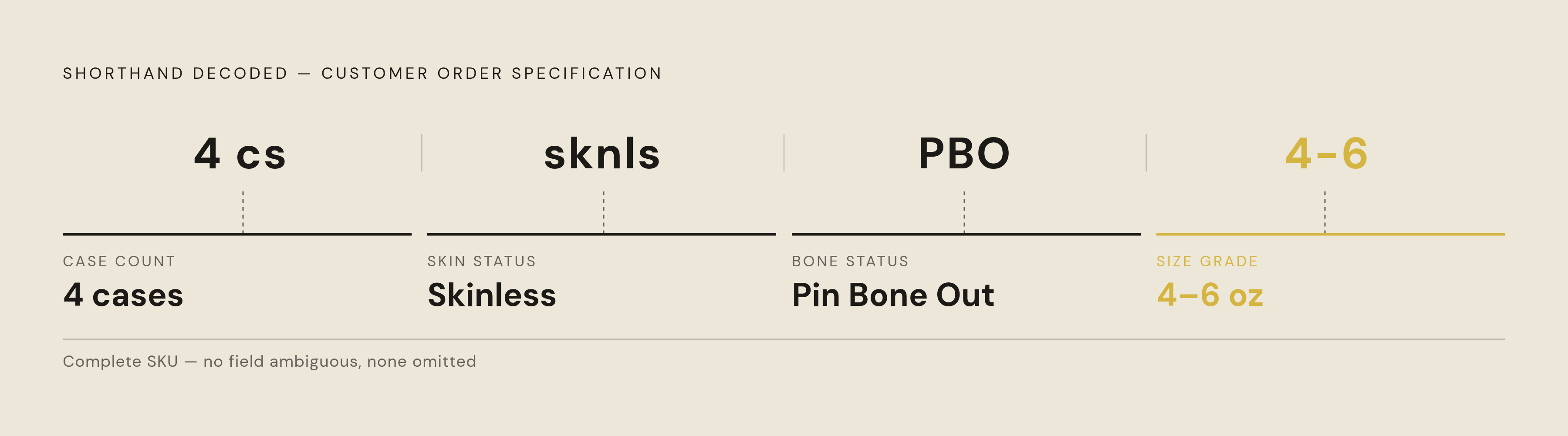
Foodservice buyers do not place orders through structured procurement portals as a rule. They text, call, email, and message on WhatsApp, and in each of those channels they develop compressed language that collapses several specification decisions into one phrase their rep already understands. A message reading "4 cs sknls PBO 4-6" is a complete product definition. It is a complete product definition, specifying case count, skin status, bone status, and size grade, written in a format that does not appear verbatim in any standard product catalog. The message works because both sides already share the context needed to decode it.
This compression is a rational response to the alternative. Spelling out every specification in full on every order would take longer and would not improve accuracy for a buyer who already knows precisely what they want and trusts the rep to translate it correctly. The shorthand is not confined to abbreviated specs, either. Buyers assign their own nicknames to recurring orders. A restaurant that always orders the same salmon portion might simply call it "the usual fillet," or refer to it by a house code that exists nowhere in the distributor's item master.
None of this is new behavior invented by careless buyers. The trade itself already runs on compressed vocabulary: terms like H&G, CoC, and count per pound function as industry-standard shorthand that everyone in the business already accepts as carrying full specification meaning. Customer alias patterns extend that same logic one level further, applied not across the industry but within a single relationship between one buyer and one rep. The shorthand works, and it works well, right up until the person who holds the translation isn't available to provide it.
What alias patterns carry and lose in translation
A customer alias is not a nickname in the casual sense. At minimum it carries a product identity (species, form, grade), an implied size or count band, frequently a prep requirement, and sometimes a pricing tier or packaging preference, compressed into a form that exists only within one relationship and is documented nowhere in the distributor's systems. That alone would make it a significant piece of institutional knowledge. But aliases often carry history as well as specification. A nickname that once pointed cleanly to one SKU may have shifted meaning when the distributor changed suppliers or repacked the same product under a new lot, and the only person who knows the mapping has moved is the rep who handled that transition.
Formal product names in an ERP item master serve a different purpose entirely. They are built for internal consistency, reflecting how the distributor classifies product rather than how any individual customer actually thinks about what they're buying. The alias is the customer's own translation layer, bridging their kitchen's vocabulary and the distributor's catalog. That layer does real work. It lets a chef who has never seen a spec sheet order with total confidence, because the rep on the other end absorbs the complexity for them.
The trouble is where that translation layer lives. When it exists only inside one person's memory, it is invisible to everyone else in the organization. The order desk covering for a rep on vacation does not have it. The warehouse picker working from a pick ticket does not have it. Billing, reconciling delivery against invoice, does not have it either. All of them operate without the context that gave the alias its meaning in the first place, and the alias resolves correctly only for as long as the right person happens to be the one reading it.
Why alias ambiguity propagates downstream
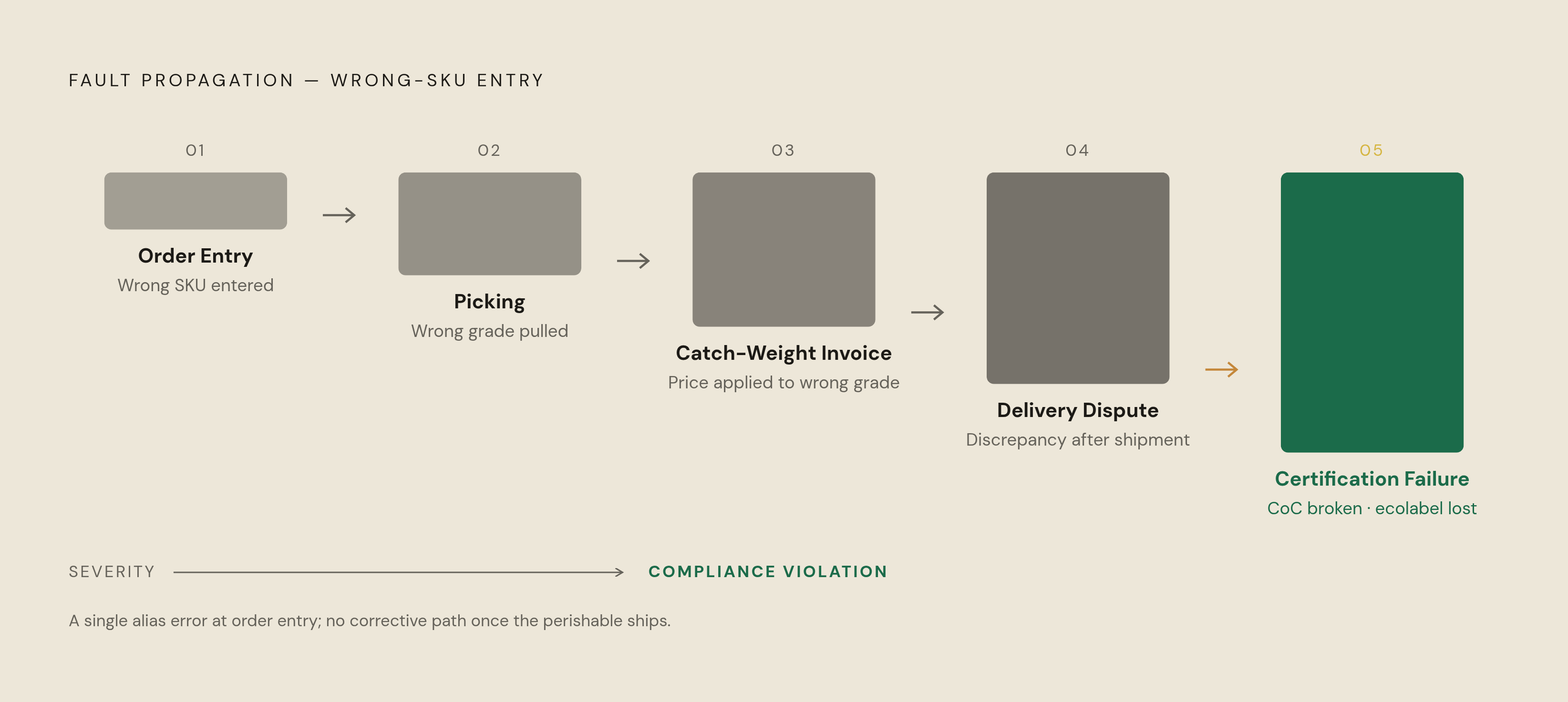
An ambiguous alias that resolves to the wrong SKU at order entry does not stay a small, contained mistake. Every downstream step, picking, catch-weight capture, invoicing, and lot traceability, executes against the wrong product from that point forward, and the error compounds rather than correcting itself along the way.
In a catch-weight environment, where product is priced by actual weight rather than by unit, a wrong-SKU pick is not simply the wrong item leaving the warehouse. The invoice applies a price-per-pound calculation meant for one grade to a different grade entirely, and that discrepancy becomes a dispute that has to be unwound after delivery has already happened. For perishable product, there is no clean way to reverse the mistake. A wrong-grade or wrong-species pick cannot be restocked and resold the way a mislabeled dry good can, and the window to catch and correct the error before the product spoils is short. In some cases, a wrong-species shipment is not just an operational headache but a labeling compliance failure in its own right.
Seafood manufacturers and distributors also contend routinely with last-minute order changes, customer edits, and urgent requests, and without a flexible way to handle them, a mid-order change to a spec may never get reconciled against the original alias the rep entered. The Fish Markets glossary entry on Chain of Custody makes the stakes for certified product explicit: if a distributor loses CoC segregation because product was picked against the wrong lot, that product can no longer be sold under its ecolabel. An identity error at order entry becomes a certification failure at the point of sale.
The problem stays invisible until the organization outgrows one memory
The alias system is not fragile at small scale. It works reliably when one person, usually a founding rep or an owner-operator, holds every mapping in memory and personally handles most of the orders that come in. At that size, there is no gap between the alias and its correct resolution, because the person who wrote the shorthand and the person who decodes it are often the same one.
What that reliability masks is accumulation. Revenue can look healthy and the team may know every customer on a first-name basis, but every new SKU, every new warehouse, every new sales channel, supplier, lot number, and customer agreement adds another dependency that the informal system has to absorb, with no mechanism in place to document or audit any of it. Nothing forces the fragility to the surface while the person holding the memory is still there.
The break, when it comes, tends to be sudden rather than gradual: a new hire who doesn't share the context, a key rep's departure, an illness, or simply a spike in order volume removes the one person whose memory functioned as the system, and aliases that resolved cleanly the day before become unreadable the day after. Because the failure only becomes visible under load or during a staff transition, it typically gets blamed on the person, described as a new hire's mistake, rather than traced to its actual cause: a process that never had a documented translation layer to begin with. That misattribution is why the structural problem so often goes unaddressed even after it has already caused damage.
Generic order intake tools and seafood shorthand
Generic order intake tools are built around standardized product names and structured input, and they have no mechanism for resolving a customer-specific nickname to the correct SKU when that mapping was never documented anywhere and exists only inside one relationship. That is a structural limitation, not a configuration gap that a settings change can fix.
Purpose-built seafood ERP platforms such as FreshByte and Seasoft do far more than generic systems on the product side: they manage lot tracking, catch weights, and traceability, and FreshByte in particular documents species, harvest area, and vessel tracking as well. Even these platforms, though, do not automatically resolve customer alias patterns at order entry. They handle the product side of the equation well, but the communication side, the shorthand a customer actually uses to place the order, sits outside their scope. Generic ERP systems fare worse still, since they are built for standard manufacturing workflows and cannot handle catch-weight pricing, vessel-level traceability, species-level yield tracking, or certification management at all. A generic order intake layer placed on top of a generic ERP compounds the weakness at both ends of the stack rather than fixing it at either.
The IFDA's 2025 Foodservice Distribution Industry Technology Report shows a majority of companies adopting AI for ordering and workflow automation, but adoption is not the same as successful deployment. A meaningful share of smaller distributors run into integration friction connecting AI order capture to ERP systems that lack any structured customer alias table in the first place.
That raises the strongest objection to automating alias resolution at all: in a perishable-goods business, where a wrong-species pick cannot be unsold and may create a labeling violation, the accuracy threshold matters enormously. Choco's Autopilot, for reference, maintains error rates below 1 to 5 percent with configurable automation thresholds, which makes the decision of where to set that threshold, and which orders get flagged for a human to check rather than processed automatically, considerably more consequential here than it would be in a non-perishable category. That is a real design question worth weighing, not a reason to dismiss automation.
What effective alias resolution requires in practice
Solving this starts with building a per-customer translation layer, one that maps each customer's own vocabulary, their nicknames, abbreviations, size-band shorthand, and recurring order patterns, to the correct SKU in the distributor's item master, and that gets actively maintained as product lines shift and customer habits change. A static mapping built once and left alone will drift out of accuracy the same way an undocumented rep's memory does, just more slowly.
Choco's Autopilot offers a working model for how this operates at real volume. Processing more than 8.8 million orders annually by Choco's own figures, the system automatically reviews incoming orders, checks them for accuracy, and either processes them immediately or routes them to a human for review, with configurable thresholds that let the distributor decide how much uncertainty warrants a person's attention rather than full automation. That flag-for-review structure fits seafood's demands specifically, because it preserves human judgment for the genuine edge cases: the ambiguous alias, the mid-order change, the unfamiliar shorthand from a customer the rep hasn't dealt with before. The system handles the clear matches on its own, and people handle the exceptions, which is close to how the best human-run order desks already operate, just made consistent and auditable.
None of this works without a clean foundation underneath it. A deduplicated, consistently described product catalog with well-structured customer records is what the alias mapping layer actually resolves against, and without that hygiene, even a well-designed automated system has no reliable way to determine which SKU a given nickname is supposed to point to. Item-master cleanup is not an exciting part of the project, but it makes everything built on top of it trustworthy.
The customer experience is what makes this approach viable rather than disruptive. Customers keep ordering the same way they always have, by text, by email, over WhatsApp, or on a phone call, using the same shorthand they have used for years. What changes is where the translation work lives: instead of sitting in one rep's memory, it moves into a documented, auditable system that survives staff turnover, growth, and time off.
Multichannel ordering and market growth strain alias resolution
The conditions that let the informal alias system survive for years are shifting, and two pressures in particular are narrowing the window for distributors to act before the gap turns expensive. Order channels are multiplying, so customer shorthand now arrives in more formats than ever, and the U.S. seafood market is expanding in ways that reward distributors able to scale order intake without adding administrative headcount at the same rate.
B2B food distribution has moved well past a simple warehouse-to-distributor model. Orders now arrive by email as PDFs, inline text, or attachments, by phone and voicemail, over WhatsApp and SMS, through EDI, via customer portals, and as free-text messages to sales reps. Each of those channels is simply a different container for the same alias-laden shorthand, and each requires the same resolution logic applied with the same consistency, regardless of which format the message happens to arrive in.
The infrastructure required to do this is proven. Carlsberg Breweries automated the capture of emailed distributor orders across multiple markets and, in Sweden specifically, reached a 92 percent touchless order processing rate while saving more than 140 staff hours per month. That model transfers directly to seafood distributors managing customer bases across several regions, where the same alias problems recur in every market's own mix of communication channels. Gordon Food Service took on a related challenge from the supply side, automating data exchange across a large supplier network to strengthen FSMA preparedness, improve supply chain efficiency, avoid shortages, and manage price and cost more precisely. The lesson from both examples is the same: investment in resolving this kind of complexity pays off across several parts of the operation, including beyond the point of order entry.
Distributors who cannot resolve alias complexity as volume grows are left having to hire more order-entry staff every time they add a customer or a new channel, putting them at a structural disadvantage against competitors who have already built the translation layer into their systems. Choco's own figures point to a significant reduction in manual order entry once alias resolution is automated, showing that administrative burden does not have to scale in lockstep with order volume. Customer alias and shorthand patterns are a compressed vocabulary carrying real specification, real history, and real operational stakes, and distributors who engineer around that vocabulary are positioned to keep growing without the system quietly breaking underneath them.