IQF vs. Block Frozen Seafood Specs in Distributor Purchasing
Glaze percentage and freezing method hide the true cost per kilo of usable product.
How glaze percentage distorts the invoice price
Format decides cost more than any number on the invoice admits. IQF and block frozen come out of different manufacturing processes, with different cost structures baked into each one, and a buyer who compares them on quoted price per kilo is comparing the wrong number. Freezing method changes yield, changes labor, changes how tight the product stacks in a warehouse, and changes how it holds up once a cook actually opens the box. Freezing method changes yield, labor, and how tight the product stacks in a warehouse, so none of that appears on the quote a supplier emails over. Get the format call wrong and every number built on top of it, glaze, drip loss, deblocking labor, inherits that first mistake.
IQF, individually quick frozen, pushes each piece through a fluidized-bed or spiral tunnel on its own, down to somewhere around -30°C to -40°C in a matter of minutes. The cold moves fast enough that ice crystals stay small, so the pieces stay loose instead of welding together. Block frozen goes the other direction: pressed into 15 to 25 kg slabs and plate-frozen near -35°C over several hours, it comes out as one dense slab. That difference in method, not the marketing language on the case, decides how much usable product survives thawing, how much labor it takes to break down, how it packs into a container, and which sales channel it actually belongs in.
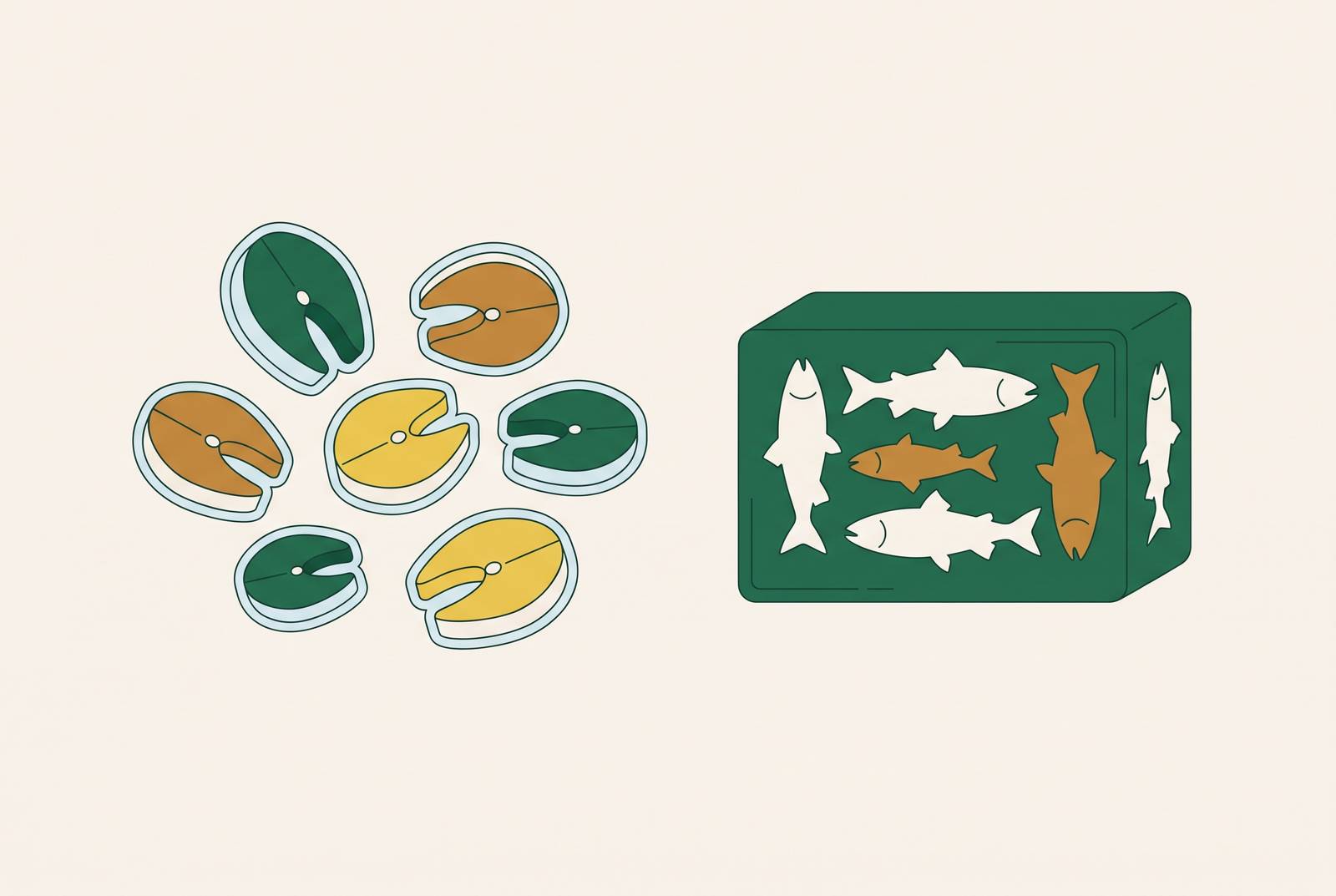
Glaze is the layer of ice sprayed or dipped onto product during freezing. It does real work: it blocks oxygen, prevents freezer burn, and stretches shelf life. But it's water, and a lot of invoice pricing in this trade still charges for it like it's fish.
Regulatory standards for glazed foods are clear on paper: net weight excludes the glaze. Plenty of quotes in the market get built on glazed weight anyway. The price per kilo printed on the page is not the price per kilo of fish actually changing hands, and the gap between those two numbers is where a lot of margin quietly disappears.
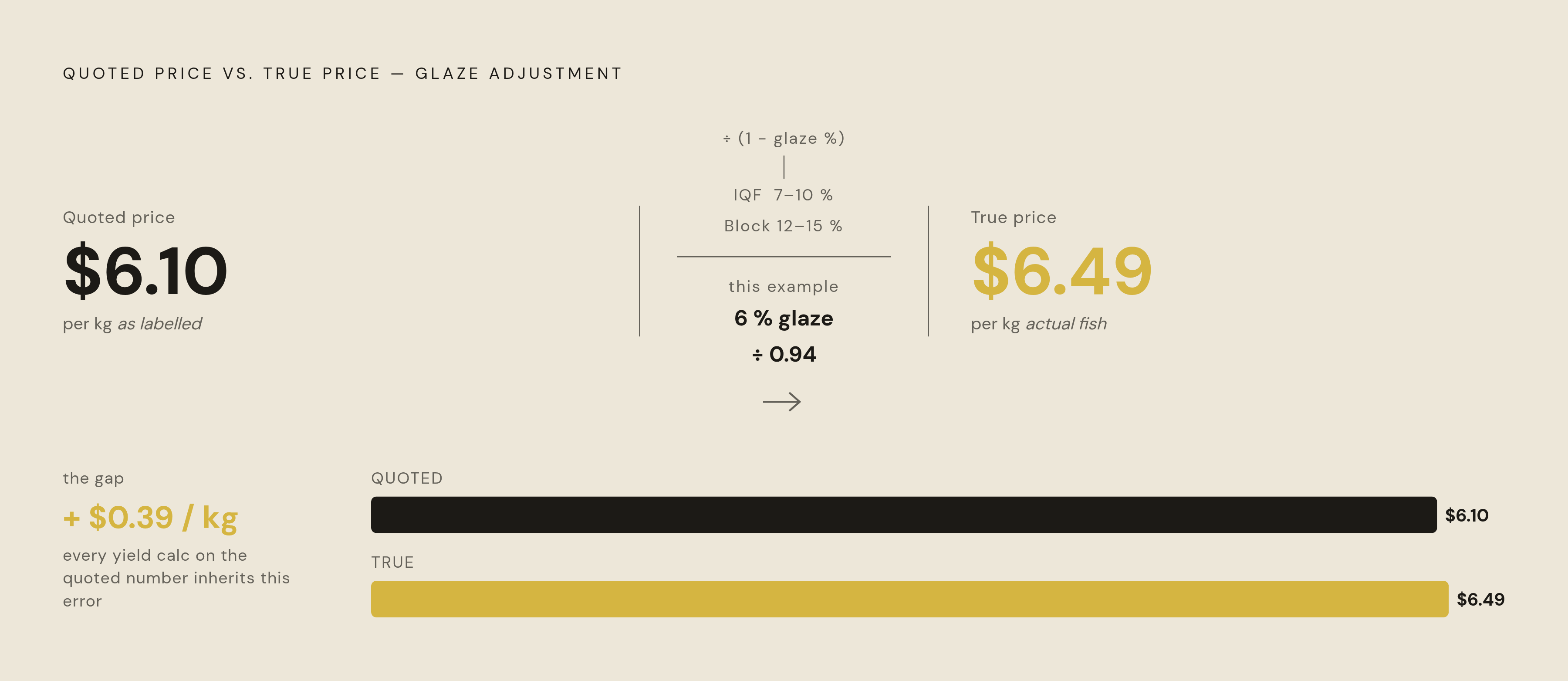
The glaze bands run differently by format, and that difference carries most of the story. IQF typically runs 7 to 10% unless a buyer specifies otherwise. Block runs heavier, usually 12 to 15%, unless there's a protective spec written into the contract. Retail and foodservice IQF shrimp is in a tighter band, 6 to 10%, and the spec worth putting in writing reads 8% ±2% by weight, net weight stated as exclusive of glaze.
Running the math makes the gap concrete. A product priced at $6.10/kg with 6% glaze actually costs $6.10 ÷ 0.94, or $6.49/kg, once the ice comes out of the denominator. That's before drip loss, before trim, before anything that happens once the box gets opened on the receiving dock. Skipping that division means every yield calculation stacked on top of it is wrong before the work even starts.
Thaw and drip loss: the yield gap between formats that rarely appears on the invoice
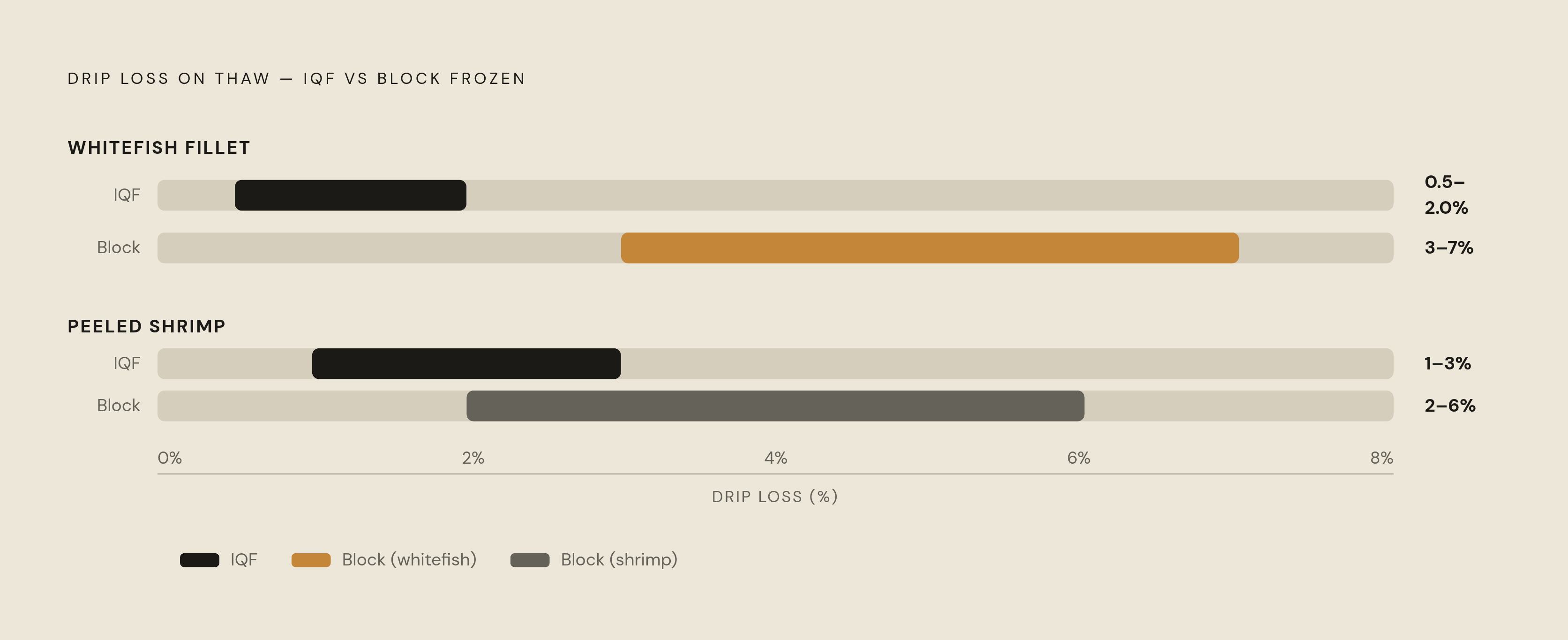
Freezing speed sets ice crystal size, and crystal size decides how much of the product survives thawing intact. That single mechanism explains most of what follows. IQF's fast freeze keeps crystals small, so cell walls stay mostly whole. Block's slow freeze grows larger crystals that puncture muscle fiber, and when the product thaws, that damage appears as water running straight out of the flesh.
The published numbers make the gap concrete instead of theoretical. A properly deglazed IQF whitefish fillet loses 0.5 to 2.0% to drip. A block frozen whitefish fillet loses 3 to 7%, depending on how clean the cut was and how carefully it got thawed. Shrimp shows the same pattern at a smaller scale: IQF peeled shrimp loses 1 to 3%, block loses 2 to 6%. Spread either range across a full pallet and it stops looking like rounding error.
Kitchens feel this on the cutting line directly. Portioning a thawed block can lose up to six percent of product to drip and trim if the crew rushes it, and that's yield that never makes it to a plate. There's a texture cost stacked on top of the weight loss: larger ice crystals leave block product softer on the cook, and a customer notices a mushy fillet faster than they'd ever notice a missing half-percent of case weight. That's the version of this loss that gets a dish sent back to the kitchen.
Deblocking labor and container utilization: the costs that don't show up until the P&L
Getting product out of a block takes real labor. Someone has to unwrap it, temper it, break it apart by hand or saw, and re-ice whatever needs it. None of that appears as a line on the invoice, but it raises the labor budget regardless. Depending on the facility and wage environment, that labor adds a meaningful cost per unit of processed product. Facilities paying low wages absorb that cost without much notice. In higher-wage markets, that same range is often enough by itself to flip the comparison back toward IQF, even once you account for IQF's higher price per kilo. Anyone comparing formats on unit price alone, and skipping this line, is comparing the wrong total.
Block does hold one real advantage, and it isn't a matter of taste: it packs tighter. Block frozen product can reach around 950 kg per cubic metre, while bagged IQF rarely clears 650 kg per cubic metre. On an Asia-to-US lane, that density gap turns into real freight savings per container. Cold storage tells a smaller version of the same story, with the denser block stack saving roughly one to two pallets of space over a typical dwell period. That's real money, but it's modest money next to what IQF saves on yield, and a buyer who fixates on the freight line while ignoring the yield line is optimizing the wrong number.
Species and product form: how the right format changes by what you're buying
No format wins across the board. The right call depends on the species and on what happens to the product after it thaws, and pretending there's a single right answer is how buyers end up locked into the wrong contract for a year.
Squid makes the point cleanly. IQF squid commands a 10 to 20% premium over block, and it earns that premium: it's the standard for retail rings, tubes, and tentacles, where portion control is the whole point of the purchase. Block squid works fine for breading lines or mince production, where the downstream process hides whatever small drip loss occurs. Species matters here as much as format. Argentine squid (Illex argentinus) is built for rings and breaded product. North Pacific squid tends to run into Asian-seasoned and dried lines. Giant squid mostly ends up in processed food and mince, and T&T packs (tubes and tentacles) and whole round block serve the price-sensitive end of the market where the premium format simply doesn't pencil out.
Shrimp leans IQF almost everywhere in retail and foodservice, with block serving the price-sensitive bulk end. Texture damage from larger ice crystals is especially consequential in shrimp, where the muscle is directly exposed to the freeze-thaw cycle.
Tilapia fillets run thin and freeze fast. That is why IQF performs so well on that cut. Block tilapia suits processors running high-volume mincing or breading lines instead. In parts of Africa, whole tilapia gets sold block frozen and thawed fresh each morning for individual sale, and that is the standard practice for this channel. It's a channel where block is the correct call, full stop.
Writing specs that protect yield
A spec sheet is a manufacturing instruction sent down the supply chain, nothing softer than that. The tighter it's written, the more predictable the cost stack looks on the receiving end, and a vague spec is how buyers end up arguing about an invoice six weeks later instead of catching the problem at intake.
A well-written 2025 purchase order needs a glaze cap: 6 to 8% for IQF, 10 to 12% for block, unless otherwise agreed, with net weight stated explicitly as exclusive of glaze rather than assumed. It needs a count-per-pound or count-per-kilo tolerance that's actually narrow, "16 to 20 count," not "10 to 20." A rep who logs "16-20 count" as "10-20" can send a kitchen the wrong shrimp size for Saturday night service, and there's no fixing that once the truck has left the dock. Drip loss tolerance at the point of receipt belongs on the spec too, along with the production date rather than just the expiration date. That last detail matters more for squid than most buyers realize: flavor and texture start degrading after 12 months, even though the product stays commercially stable at -18°C for 18 to 24 months.
Terminology has to be exact, because loose terms produce loose orders. Cut and preparation terminology needs to be spelled out precisely for fillets and whole fish alike. Glaze measurement methodology needs to be spelled out clearly in the spec, and a contract that leaves measurement terms ambiguous is setting up an argument for later. Inventory rotation protocol for short-shelf-life seafood needs to be built into the workflow itself rather than left to whoever happens to be on the floor that day.
Packaging has started showing up in these conversations too. Block cartons run around 90% recyclable today. IQF polybags aren't expected to reach full mono-material recyclability until 2027 at the earliest, and some buyers are already writing that gap straight into supplier requirements.
Where format decisions break down in daily distributor operations
Every rule above is only as good as the order intake process carrying it forward, and that's exactly where it tends to fall apart.
Seafood orders don't arrive through one clean channel. They come by phone during dinner service, by voicemail after hours, by text to a rep's personal cellphone, by email with a photo of a handwritten list attached, by WhatsApp in whatever language the customer speaks that day. Spec-critical shorthand like "16-20 PBO IQF" or "10 kg block W/C tubes" gets typed fast, under pressure, by someone who isn't thinking about EU glaze regulations or drip-loss benchmarks in that moment. One wrong field, wrong count, wrong format, wrong cut, wrong grade, and the wrong product ships.
A rep transcribing "16-20 count" as "10-20" doesn't just create a paperwork mismatch. It sends a kitchen the wrong shrimp on the one night it can least afford the error, and the cost runs well past the price of the box itself. It's a missed service, and for a distributor, it puts the whole account relationship at risk, a steep price to pay for a typo made at 11pm on a Friday.