Seafood Distribution Software Built by Industry Insiders
Purpose-built software handles seafood's unique inventory and pricing needs generic platforms can't.

A seafood order that comes in as a voicemail, in a mix of English and Cantonese, naming a size grade instead of a quantity, cannot be handled by the same software that runs a hardware distributor's purchase orders. Transcribing phone and voicemail orders for a food distributor into structured ERP entries requires software that understands catch weight, grading shorthand, and multilingual trade language, not a generic order portal with a few extra fields bolted on. This article lays out why that mismatch exists, where the leading seafood ERPs close the gap and where they don't, and how AI-driven order intake, including tools like Asakana, handles the voicemail-to-ERP problem without asking buyers to change how they place an order.
Why seafood distribution breaks generic software assumptions
Generic distribution software assumes an order is a stable, countable thing: a customer wants 50 units of a given product, the warehouse picks 50 units, the invoice reflects 50 units. Seafood distribution does not work this way at any layer. A case of fish is ordered by piece or by case but priced by the pound, so the number on the order and the number on the invoice are related only loosely, and a system that can't carry both figures at once will misprice the line every time. Shelf life compounds the problem: fresh product has to move from dock to customer within days. The software needs built-in logic for time and temperature that simply has no equivalent in dry-goods or industrial distribution. Species-level variability adds another layer entirely, since size grading, freshness grading, wild-versus-farmed status, and country-of-origin documentation all generate product definitions that shift faster than a standard item master was ever built to track. And because prices, availability, and even the exact specification of a product can change between the moment an order is placed and the moment it's picked, substitution is a routine part of daily fulfillment in seafood.
The seafood ERP landscape makes this point without much ambiguity: once seafood leaves the water, the clock starts running against it in a way that durable goods never face, and the technology supporting that supply chain has to carry real-time inventory, regulatory compliance, product traceability, and multiple units of measure as baseline requirements. A natural objection follows: can't a general-purpose ERP simply be configured to handle catch weight, lot tracking, and the rest? Configuration can patch individual symptoms, but it can't replace the data model: the system underneath was never built to hold two quantities, two units, and a shifting product spec on one order line. The configuration itself becomes a permanent cost center, re-done every time a new species, grading convention, or regulatory requirement appears, rather than something a seafood-built system already assumes from day one.
The five operational realities that generic ERPs consistently get wrong
The breakdowns above aren't scattered incidents; they recur in the same five places across nearly every distributor that has tried to run seafood through a general distribution platform.
Catch weight is the first and most persistent of these. Lot traceability tied to cold-chain movement is the third failure point, and it isn't optional. Batch processing with variable yield is the fourth: a batch of portioned fish doesn't produce the same output weight twice in a row, and recipes need to flex for seasonal availability and substitute ingredients, which Acctivate's batch processing handles directly, including spillage accounting.
The fifth failure point is the one that does the most daily damage, and it has nothing to do with inventory logic at all: order intake. Restaurant buyers, kitchen managers, and purchasing staff place orders by phone, text, voicemail, and shorthand that only makes sense inside an existing relationship, phrases like "16-20 count," "a box of the usual," or "five of yesterday's special." A generic order portal has no way to parse any of that, and a staff member re-keying it by hand can transcribe it wrong just as easily. Type "16-20 count" as "10-20" and the kitchen preparing for Saturday service receives the wrong size grade entirely, a mistake that looks small on a screen and large on a loading dock. That single transposed character is a more realistic account of how seafood errors happen than any inventory mismatch, because it originates upstream of the ERP, in the gap between how an order arrives and how someone keys it in.
How Vertical ERPs Handle What Generic Ones Cannot
When people who have actually worked inside seafood operations build software, they make different foundational choices from the start. The data model, the default workflows, and even the terminology on screen are calibrated to the trade, not retrofitted onto a general distribution template after the fact.
CAI/Seasoft has been in operation since 1978, and its platform is designed to handle the full lifecycle of seafood processing and distribution, integrating catch or procurement, production, inventory, logistics, and finance into one system. NetYield occupies a similar space among purpose-built seafood ERPs, built to handle a scenario generic systems routinely mishandle: product bought by the case, broken down into bags, sold by the ounce, and priced by the pound. NetYield was named best for seafood in a 2026 evaluation of order management software for foodservice distributors.
Aptean's Food & Beverage ERP takes a broader industry-focused approach, offering advanced tools for inventory management, traceability, and compliance, and it finds its strongest fit among seafood distributors who also handle in-house processing or repack work and need production and distribution synchronized on the same platform. Acctivate takes a different path entirely, built for distributors who already run QuickBooks and want seafood-specific depth, catch weight, lot traceability, forecasting, flexible pricing, batch processing, order management, without a full ERP migration. Seafood distributors Channel Seafoods International and Heron Point Seafood run on the platform, and Channel Seafoods International's owner says he can run a profit-and-loss statement on any single purchase order, tracking exactly where every pound went and whether that order actually turned a profit, without manual reconciliation.
FoodReady positions itself as the strongest overall seafood distribution platform for mid-market companies that want traceability and operational control without stitching together separate ERP, quality management, inventory, and production applications. It links receiving, supplier records, quality management, inventory, production, purchase orders, sales orders, and analytics into one system, and CAPA, nonconformance, and audit workflows sit directly beside inventory data rather than living in a disconnected compliance tool off to the side. Pricing is by custom quote, with licensing and implementation scaled to scope, user count, and number of sites, and it's available on web, iOS, Android, and through an API. Canopy also appears in this category as an ERP platform for food and beverage distributors that offers real-time data and automation, aimed at distributors who want a modern interface over core distribution functions.
Where vertical depth ends and integration gaps begin
A seafood-specific ERP solves the data model: catch weight, lot traceability, multiple units of measure, variable batch yield. It does not automatically solve order intake, and for a large share of distributors, intake is where the most time and the most costly errors occur.
The reality of how orders actually arrive explains why. Restaurant buyers, kitchen managers, and purchasing staff don't log into portals to place orders; they call, they text, they send voice notes, they message on WhatsApp or WeChat, because the portal adds a step and the chat thread doesn't. Jordan Aldrich, Executive Chef at The Nickel and a Seattle Fish App user, put the underlying reason directly: "A lot of corporate apps are confusing. Operators running a kitchen during service don't have the time or patience for logins and extra steps, so the order flows through whatever channel is already open on their phone, not through whatever channel the distributor's ERP was designed to accept.
That channel mismatch creates a specific bottleneck. Orders land across phone calls, texts, and voicemails, and someone on the distributor's side has to key each one into the ERP before a picker can even start pulling product, which inserts a lag between when the order is captured and when the system actually has it. Voice, text, and email are all just transport, so the channel itself was never the hard part of this problem. The hard part is the shorthand riding inside them: "16-20 count," "a box of the usual," "five of yesterday's special," a voicemail that names a species and a rough quantity and nothing else. None of that is simple transcription. You have to interpret each phrase against a specific customer's order history and the distributor's live inventory, and no portal and no generic re-keying process was built to do that. Distributors who try to solve this by adding headcount usually find that what grows is the administrative burden, not the capacity for the customer relationship work that headcount was meant to free up, and transcription errors don't shrink as volume rises, they multiply.
How AI order intake handles seafood's communication complexity
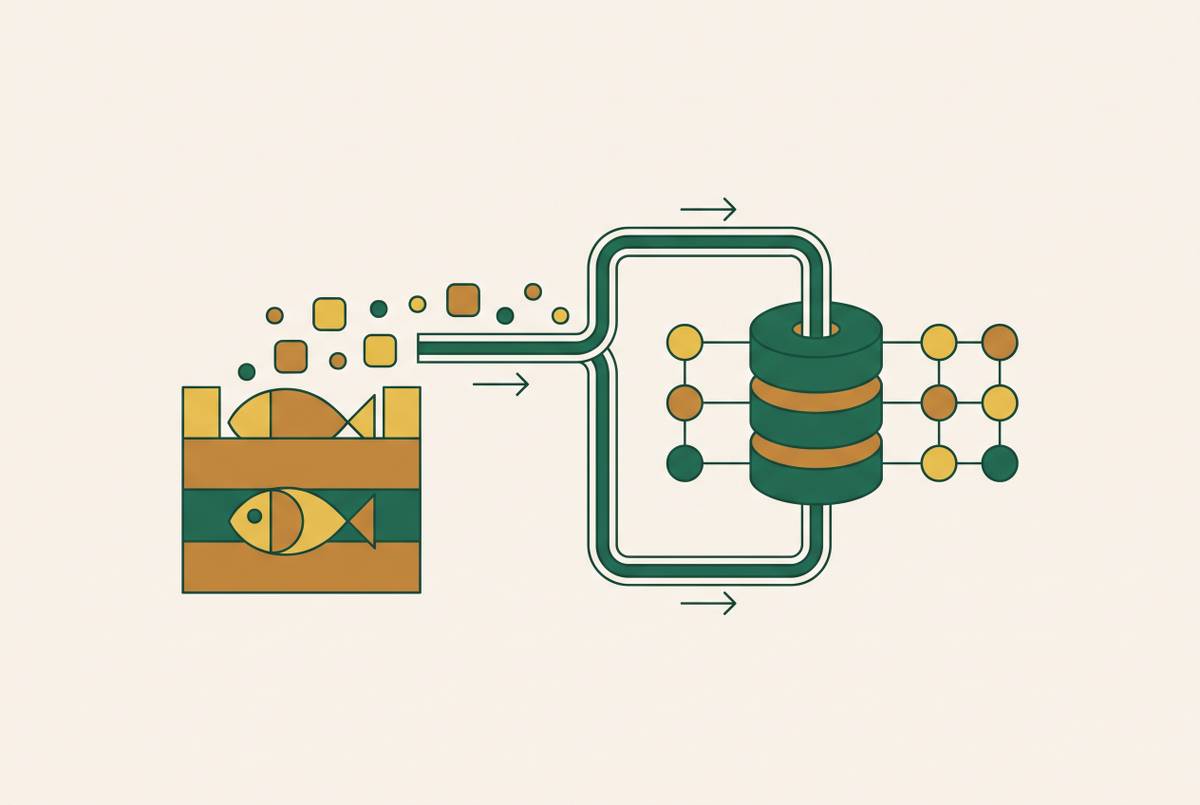
AI order intake is the capture layer that sits upstream of a seafood-specific ERP, turning the messy, informal, often multilingual reality of how food distributors actually receive orders into structured data the ERP can act on directly.
Seafood intake is harder than generic food distribution, and in a specific way. Shorthand varies by region and by supplier, size grades, count ranges, species abbreviations, grading terms that mean one thing in one market and something slightly different in another. Communication itself is often multilingual within a single order: a restaurant owner or kitchen staffer writes in whatever language is natural in the moment, Spanish, Cantonese, Vietnamese, English, sometimes switching mid-message. The channel mix leans further away from formal EDI than almost any other distribution category, spread across voice notes, SMS, WhatsApp, WeChat, email, and forwarded voicemails. And because last-minute substitutions are routine rather than exceptional, a usable system has to flag a gap, say, a species that's unavailable or a size grade that's short, and surface a substitute for a human to approve rather than silently passing a mismatched order straight to the warehouse floor.
What separates a genuinely useful AI intake system from a demo that stalls out after a couple of months is architectural: the captured order has to flow through pricing, picking, invoicing, and the customer record without handing off to yet another manual step, and the corrections a team makes along the way need to actually improve how the system performs the next time. Human oversight has to stay built into that loop by design, with pricing anomalies, substitution decisions, and unusual quantities flagged for a person to review rather than acted on autonomously, which is what earns the system trust from both the distributor's staff and its customers.
Order intake automation that understands industry-specific language and context, recognizing that "16-20 count" is a precise size grade and not a typo, and that "the usual" might reference a standing substitution or a long-running customer preference, sits right at the boundary between how an order arrives and how it has to be structured before it can enter the ERP, catching ambiguity and routing exceptions to a person before anything reaches the warehouse. Asakana is built specifically for that layer: it captures inbound orders from text, email, WhatsApp, WeChat, phone calls, and voicemails, interprets industry-specific shorthand, and converts the result into structured order drafts directly inside whatever ERP or spreadsheet a distributor already runs. Because its roots are in seafood and food trading, it can handle the category's particular terminology and communication habits, so no customer ever has to change how they place an order. A buyer who has always texted "the usual, Thursday" keeps texting exactly that; the structured draft that reaches the ERP is where the change actually happens, invisibly, on the distributor's side of the relationship.
Choosing the right combination: matching your operational layer to the right tool
No single platform does all of this well, and the more useful question for a distributor isn't which ERP wins outright, but which combination of vertical ERP and intake layer actually matches the operation in front of them.
A few questions narrow that choice quickly. A distributor that also processes, portions, or repacks product should expect a full vertical ERP with production integration, Aptean, FoodReady, or CAI/Seasoft among them, to be worth the configuration investment, since synchronizing production and distribution is what those platforms are built around. A distributor already running QuickBooks that isn't ready for a platform migration has a clear path in Acctivate, which adds seafood-specific depth without forcing a system change. One whose core pain point is lot traceability and compliance documentation, rather than how orders come in, should anchor around FoodReady or a comparable traceability-first platform. And a distributor whose biggest daily operational cost is order intake itself, the sheer number of channels, the hours spent re-keying, the error rate that follows, is looking at a problem the ERP was never designed to solve. An AI intake layer such as Asakana fits that gap.
The integration principle that makes any of this work in practice is straightforward: the intake layer should write into the ERP a distributor already uses, keeping AI-assisted intake a practical addition. Across both categories, ERPs and intake tools alike, the vendors that consistently perform in seafood share one trait: their design decisions were made by people who had already lived inside the trade's specific complexity before they ever wrote a line of code, which is the actual explanation for why configuration-heavy generic tools keep failing in the same predictable places, year after year, distributor after distributor.