Standing Order and Par Level Habits Among High-Volume Seafood Buyers
Seafood's volatility makes standing orders fail where other food categories succeed.
Standing orders and par levels are procurement's answer to predictability: fixed reorder points that let buyers and distributors stop renegotiating every transaction from scratch. Seafood breaks that answer in ways other food categories don't, because its supply chain, its pricing, and even its product specifications resist the stability the whole system assumes. Understanding where that resistance shows up, and how buyers have adapted to it, is the real work of managing seafood procurement at scale.
What standing orders and par levels assume
A par level is the minimum quantity you want on hand before you need to reorder fast. The reorder point sits above that minimum as a trigger, the signal that tells a buyer or an automated system to place the next order, and safety stock is built into the par level as a cushion against delay or demand spikes. The three marks only do their job when the item behind them stays the same: same form, same price, same availability, week after week. Distributors built standing orders around that same stability. A standing order turns a buyer's recurring need into a fixed delivery window and a contract price, so the distributor gets predictable volume and the buyer has one less decision to make every week. The arrangement works because both sides are betting on the same thing: that the item ordered this week will be, in every way that matters, the same item delivered next week. That bet holds up well if the goods are canned, dry, or shelf-stable broadline staples. It starts to fail almost as soon as the product in question comes out of the water.
Why seafood is categorically harder to pin to a standing order than other food categories
Seafood is hard to standardize for reasons that go beyond the fact that it spoils fast. Its supply chain runs through more independent stages than almost any other food category, and at each stage the product can change without its name on the invoice changing. Harvesting happens across different boats, waters, and seasons. Handling and processing happen at different plants, under different protocols. Logistics then has to route the product through different cold chains before it lands on a distributor's dock. Land-based agriculture deals with some of this, but a bag of frozen corn from one week to the next doesn't usually vary by harvest location, processing date, freeze method, and glaze level the way a shrimp order can under the exact same SKU. That variability is the normal condition of the category.
Regulation adds another layer of instability that has nothing to do with the distributor's operations and everything to do with the resource itself. In 2025, NOAA cut Atlantic cod catch limits by 37 to 71 percent through an emergency rule under a new four-stock management framework, and the cut was so large that buyers who had carried cod as a standing order staple had to substitute right away. Around the same time, NOAA's Pacific sardine rules kept the directed fishery closed under a court-ordered rebuilding plan, with the allowable catch limit held at 2,200 metric tons. Neither change was a matter of a distributor mismanaging inventory. Both were regulatory responses to the condition of the fish stock itself, and both landed on buyers as a supply interruption they had no way to see coming when they signed a standing order months earlier. Price volatility compounds all of this, since seafood prices can shift within a single week by enough that a distributor honoring a fixed standing-order price is absorbing real financial risk just to keep the contract's promise intact.
How seafood's specification language encodes the volatility standing orders try to suppress
The instability is also written into the language buyers and sellers use to describe seafood in the first place, and that language carries more hidden variation than most line items in a broadline catalog. Take freezing method. IQF, or individually quick frozen, product commands a meaningfully higher price than block frozen product of the same species, because IQF preserves individual pieces rather than fusing them into a solid mass, and that price difference has to be written into the standing order spec directly. If you leave it to convention, or assume this week's fulfillment matches last week's, you end up paying IQF prices for block product, or you find a glaze problem when the order arrives.
Glazing is its own hidden variable. A glaze is the layer of ice applied to frozen seafood to protect it in storage, and it adds real weight to the product, weight that counts against the net seafood content a buyer is actually paying for. If a standing order is locked to a fixed case price, its effective cost can shift meaningfully depending on the glaze percentage applied, so U.S. import compliance regulates glaze declaration as a requirement. When glaze level goes undeclared on a standing order, the buyer is exposed to a cost swing hidden inside a line item that looks identical to the one ordered the week before.
Grading standards built by NOAA make the same point from the regulatory side. For shrimp, NOAA's official grading framework uses count-per-pound, the number of individual shrimp it takes to make a pound, as a primary size designation, layered alongside separate score-based quality tiers that apply to products like fish fillets and fish sticks. The fact that a federal grading standard needs this level of granularity shows that spec precision in seafood is the industry's working language, not an optional refinement buyers can skip for convenience.
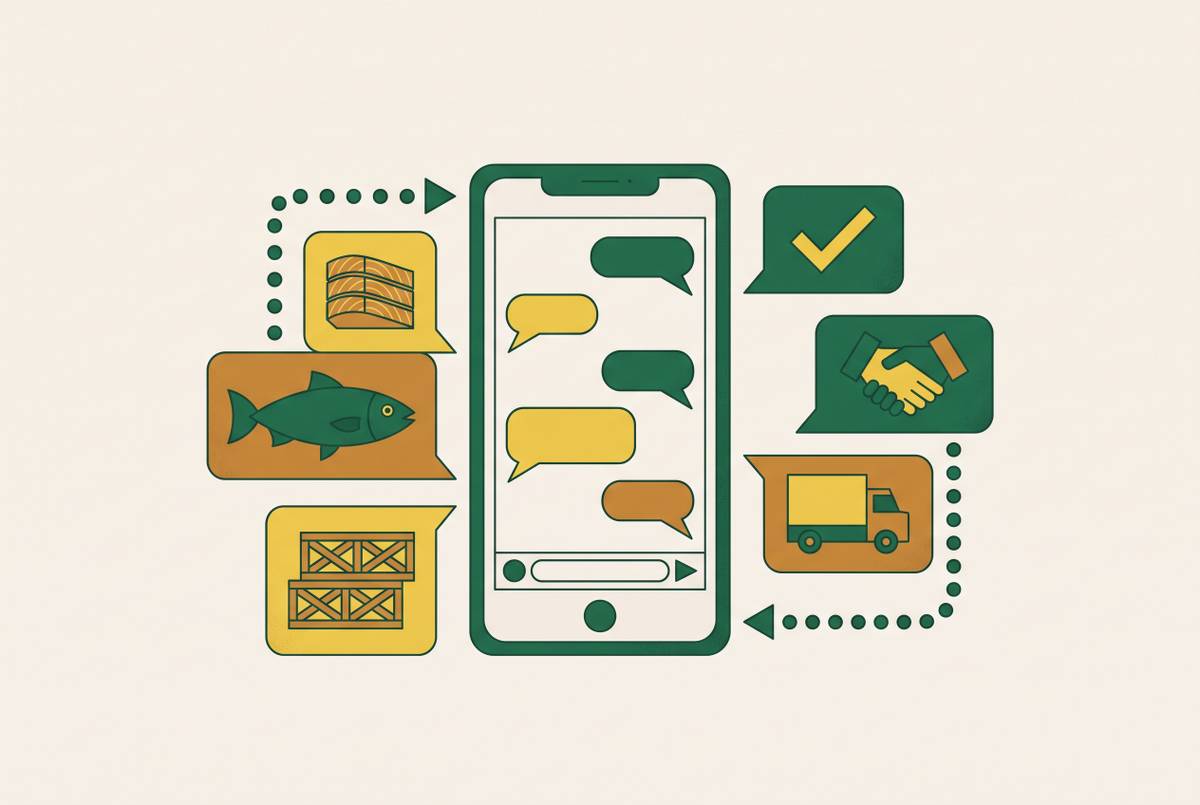
That language shows up daily in abbreviated form, and resolving each abbreviation correctly carries operational weight. IQF, already covered, separates individually frozen pieces from block frozen. H&G means headed and gutted, a processing state that changes both yield and price per pound compared to whole fish. GGS stands for gutted, gilled, and scaled, a further processing step beyond H&G, and it affects both cost and the kitchen labor required downstream. PBO means peeled but deveined only partially, or in some usage peeled-back-on, and P&D means peeled and deveined, a distinction that changes both price and what a prep cook receives on delivery day. FAS marks product as freezing-at-sea, so it was frozen aboard the vessel rather than after landing, and that affects both quality claims and price relative to product frozen onshore. IVP refers to individually vacuum packed product, and S/P denotes skin-on or skinless depending on convention, and this too changes both kitchen labor and price per pound. These abbreviations move through text messages, WhatsApp threads, and voicemails all the time, and you have to resolve each one correctly against the distributor's SKU catalog before you can fill the order. If you confuse H&G with GGS, or miss a P&D designation, you don't get a cosmetic error. Confusing an abbreviation causes the wrong product to arrive at a kitchen that has already built its prep schedule around the one that was supposed to come.
Par Levels for High-Volume Buyers
Buyers who move high volumes of seafood have adapted the standard par-level system to survive this volatility, and the adaptations are smart. They don't treat par levels as fixed numbers so much as ranges with built-in flexibility. Safety stock buffers tend to run wider in seafood procurement than in categories with more stable supply, because they need to absorb substitution risk. Buyers keep approved-alternate specs for their key items, so if the primary spec isn't available, a substitute is already agreed on. And buyers invest in distributor relationships that give them early warning, visibility into availability changes before an order is confirmed rather than after a truck fails to show up with the right product.
The standing order itself usually works as a core list you negotiate at the edges every week, not a document you sign once and leave alone. A buyer confirms the standing core and then adjusts for whatever the distributor has flagged, a supply shortfall, a price change, a grade shift, before the order is locked in. High-volume institutional buyers, hotel kitchens and large foodservice operators among them, often negotiate contract pricing windows that hold price steady for a defined stretch of time, and they accept some flexibility on exact spec in exchange for cost certainty. That trade only works, though, if the distributor actually has real-time visibility into inventory and pricing, because a distributor promising a locked price without that visibility is making a bet it may not be able to honor.
A layer of human expertise keeps the whole system functional: the distributor's order desk. Reps who have worked a territory for years carry customer-specific knowledge in their heads, which buyer wants IQF and which wants block, which unit of measure a given kitchen always uses, which delivery pattern a given account expects. That knowledge functions as the de facto translation layer between a buyer's informal, often verbal order and the distributor's structured ERP record. These are rational, capable adaptations to a genuinely difficult environment. The system depends on institutional knowledge sitting inside individual people, and that kind of knowledge is fragile by nature. It doesn't scale, and it doesn't transfer easily when the person carrying it leaves.
Where the system breaks down as order volume grows
The workflow that holds together at moderate volume becomes a hard constraint as a distributor's customer base grows, because the manual translation layer scales with the number of people available to do the translating, not with the revenue those orders represent. Orders arrive through email, text, voicemail, WhatsApp, and occasionally fax, and every one of them has to be read, interpreted, and manually keyed into the ERP by a human being. A standing order placed for the hundredth consecutive week takes the same labor to process as the first one did, because nothing in the channel itself retains a memory of what was agreed to the week before.
One distributor documented by Choco was fielding orders from 240 customers a week through email alone, handled by a team of four people who could not keep pace. The constraint wasn't the number of orders coming in. It was the volume of manual interpretation each individual order required before it could become a usable record. That burden falls almost entirely on one side of the relationship. Buyers keep ordering through whatever channel is most convenient for them, text, phone, WhatsApp, a PDF attachment, and none of the cost of translating that into a structured order lands on them. All of it lands on the distributor's order desk.
Seafood makes the consequences of a dropped detail worse than they'd be in most other categories. In broadline distribution, a generic order entry mistake is usually just a wrong case count, so you can catch and fix it easily. In seafood, the same kind of slip can mean the wrong grade, the wrong freeze format, or an undeclared glaze level, and those errors carry real yield and cost consequences that a kitchen notices the moment prep starts. The institutional knowledge that would normally catch these mistakes, the fact that one customer always means IQF when they say "frozen," the fact that another always wants FAS and never domestic, the correction a buyer texted last week that never made it into the ERP, lives in individual reps. When those reps leave the company, that knowledge leaves with them, and the next person at the order desk starts from a blank slate with the same account.
Stabilizing Standing Order Management at Scale
Distributors managing this complexity most effectively are turning to AI-assisted order intake and ERP-connected ordering tools, aiming to rebuild that institutional knowledge layer in a form that survives staff turnover. US Foods rolled out AI-driven ordering on its MOXē platform, and it takes uploaded photos, PDFs, and even handwritten notes and converts them directly into structured orders, so the gap narrows between however a buyer naturally communicates and whatever format the ERP needs to receive.
Choco's VP of Engineering noted that the hard problem was never transcription: converting a voicemail or a text message into readable text is the easy part. The hard part is capturing the implicit context that a human rep carries, which customer's SKU maps to which product, what unit of measure a given account prefers, what delivery pattern a given kitchen expects, and encoding that context somewhere it can persist.
Generic distribution software tends to get a layer of product-form complexity wrong, and seafood-specific ERP systems like NetYield are built to handle it. Seafood is routinely bought by the case, sold by the ounce, and priced by the pound, all within a single transaction, and a system built for broadline goods often has no clean way to reconcile those three units against each other. NetYield's platform also handles boat settlements, FDA holds on imported product, and truck load sheets, operational realities specific to seafood that a generic ERP was never built to track. Buyers who work with these systems consistently point to one differentiator above the software itself: the consultants behind these platforms tend to come out of seafood plants rather than general software backgrounds, so they already understand the product before they try to build a system around it. The common thread across every one of these approaches is that none of them ask the buyer to change how they order. The channel stays the buyer's choice. What changes is the structured data layer the distributor builds on the other end of it.
What a well-run standing order system for seafood requires
Managing standing orders well in seafood means treating three separate problems as three separate problems: the spec, the channel, and the ERP record. Solving one without the other two just moves the failure point somewhere else down the line.
Spec discipline comes first. Every standing order line item needs enough detail, size grade, freeze format, processing state, glaze expectation, to survive a substitution without ambiguity. A buyer who orders "salmon" and a buyer who orders "IQF P&D salmon, 10% glaze max" are not making the same request, even though both might look identical on a one-line invoice.
Channel flexibility has to pair with structured output on the back end. Whatever channel a buyer uses to place an order, email, text, a phone call, a photo of a handwritten note, that order needs to resolve into the same structured ERP record with the same level of spec precision every time. The channel is the buyer's choice to make. The output format is the distributor's responsibility, not the buyer's problem to solve.
Real-time visibility into inventory and pricing matters because a standing order makes an implicit promise: this item, at this price, on this day. A distributor can only keep that promise if it knows, at the moment of confirming the order, what's actually available and what it actually costs. Given how fast seafood pricing and availability move, that visibility has to operate daily, not on a weekly cycle.
Human review still belongs in the system, but in a specific place: catching mismatches, a wrong grade, an ambiguous spec, a price that's drifted from the contract, before an order gets confirmed, rather than keying in every order from scratch by hand. The expertise sitting at the order desk is worth more as a check on the system than as the primary method of data entry.
All of it comes back to where the knowledge lives. Customer-specific preferences, approved alternates, historical SKU mappings, delivery pattern notes, all of it needs to sit in a record that outlasts any single employee. A distributor that knows a given buyer means IQF every time they text "frozen squid" is holding something valuable. That value only counts if it survives the day the rep who knew it decides to leave.