Species Substitution Risk in Seafood Distribution
Nearly a fifth of global seafood trades under a false species label.

Species substitution is the most common form of seafood fraud, and it may touch as much as a fifth of everything traded worldwide. The FAO's report on food fraud in fisheries and aquaculture puts the fraud rate at roughly 20 percent, citing a fraud probability estimate of 20.6 percent, well above meat at 13.4 percent and produce at 10.4 percent, a gap far wider than enforcement variation alone would explain. That gap is a direct product of how the seafood trade is built: thousands of species, dozens of jurisdictions, and a price structure that rewards deception at nearly every point of sale. It's a direct product of how the seafood trade is built: thousands of species, dozens of jurisdictions, and a price structure that rewards deception at nearly every point of sale.
Scale alone makes the problem hard to police. Global seafood output hit 185.4 million metric tons in 2022, worth an estimated $195 billion, moving through supply chains that cross more borders and more regulatory regimes than almost any other food category. Over 12,000 species get traded internationally, each with its own naming conventions, its own inspection authority, and its own paper trail, or lack of one. The complexity is the industry. It is the industry.
The economic logic explains why the fraud persists rather than getting stamped out. Price gaps between premium and commodity species start wide and, the FAO report finds, widen further as product moves from first sale toward retail. Farmed sea bass sold in Italy as locally caught can fetch two to three times what the same fish would bring correctly labeled as imported from Greece or Turkey. That spread is the entire incentive. Nobody needs a conspiracy to explain species fraud, just a label that costs nothing to change and a buyer three steps removed from the water.
None of this means the sector is uniformly rotten, and the record does not support that read. Industry voices have argued that mislabeling is species-specific rather than systemic, and the FDA's own 2012-2013 investigation found 85 percent of seafood tested was labeled correctly. Fifteen percent mislabeled is a serious number, but it's a long way from a supply chain in collapse. Fraud clusters hard in certain species and formats while leaving others largely alone, and it clusters hardest exactly where verification gets weakest, which tends to be furthest downstream from the boat.
What species substitution looks like across product categories
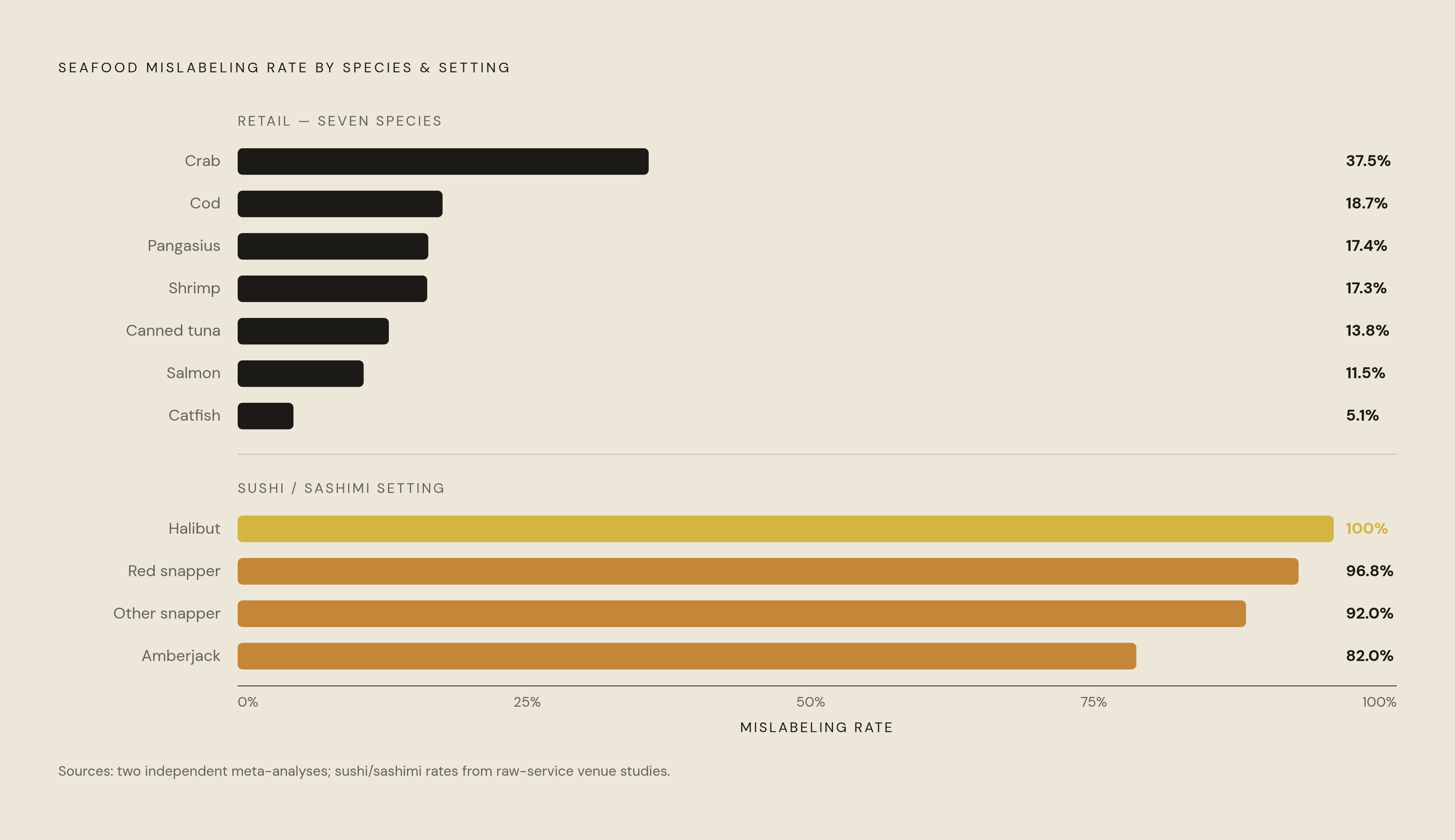
The clustering is visible cleanly in the data. A ScienceDirect meta-analysis of the most-consumed seafood species found crab mislabeled 37.5 percent of the time, cod at 18.7 percent, pangasius at 17.4 percent, shrimp at 17.3 percent, canned tuna at 13.8 percent, salmon at 11.5 percent, and catfish down at 5.1 percent. These numbers come from pooling many independent studies, not one lab's fluke result, and the pattern holds across all of them: species that are hard to identify by eye once processed carry far more risk than species that aren't.
Raw-service settings make the numbers worse, not better. The same meta-analysis found substitution rates in sushi and sashimi running far above retail: halibut mislabeled 100 percent of the time, red snapper at 96.8 percent, other snapper species at 92.0 percent, amberjack at 82.0 percent. A separate meta-analysis out of Chapman University, pooling 35 studies and more than 4,100 samples, found nearly 40 percent of the country's most popular seafoods mislabeled. That figure is the broadest domestic aggregate available, and it tracks the category-level numbers above instead of contradicting them.
It helps to place substitution inside the fuller taxonomy of seafood fraud the FAO report lays out, because substitution rarely travels alone. The report identifies multiple types, including adulteration (adding water, ice, or colorants to inflate weight or appearance), counterfeiting (fabricating products to resemble premium seafood), simulation (processed seafood presented to resemble a different product), species substitution, origin mislabeling, false sustainability claims, diversion, and tampering. Substitution is the type most directly tied to price arbitrage, but it often occurs next to a second or third kind of fraud on the same product, not alone.
Weight fraud runs alongside it constantly. An FDA assignment covering imported frozen seafood from 2022 to 2024 found 36 percent of samples, ten out of 28, violative for short weighting, largely from ice glazing that inflates the declared net weight. That's a different mechanism than species swapping, but it comes from the same incentive structure, often from the same supplier.
And the harm isn't only financial. Escolar, sometimes mislabeled as white tuna or sea bass, can cause acute gastrointestinal illness and is banned outright in Japan and Italy. Certain substituted flatfish species carry food-safety risks that differ from those of the premium fish they replace. These aren't hypothetical edge cases dredged up from obscure specialty markets. They sit in exactly the species distributors move every day, on the exact order lines a restaurant places every week.
Why the distributor's position is structurally exposed to substitution entering the supply chain
Research into the seafood supply chain finds that mislabeling can enter at landing, at processing, at distribution, or at retail. There is no single choke point where fraud gets introduced and everywhere else stays clean, and looking for one is the wrong instinct.
Once a fish is skinned and filleted, visual identification stops being reliable. NOAA has flagged this as the point where a low-value species like catfish can be sold as grouper with almost no risk of getting caught by eye. Before that point, a trained inspector can often spot a substitution. After it, the fish is just flesh, and the label is the only thing anyone has to go on.
Federal oversight doesn't cover that gap the way people tend to assume. NOAA's Seafood Import Monitoring Program tracks 1,100 species across 13 groups and requires recordkeeping and reporting, but SIMP's mandatory reporting ends at the border. Past that point, NMFS keeps audit authority but exercises it on only about 0.5 percent of imports, so effective oversight drops off a cliff right where domestic distribution begins. Given that 70 to 85 percent of seafood consumed domestically is imported, most of the product a distributor receives has already moved past the last point of mandatory federal chain-of-custody by the time it hits the receiving dock.
A DNA-barcoding study conducted in Los Angeles mapped this out directly: mislabeling rates were low at processing plants, moderate at retail, and highest of all in sushi restaurants. Contamination builds as product moves downstream, and distributors sit right at the inflection point, the spot where the curve starts climbing.
The FAO report frames this as an information asymmetry problem, and the framing holds up. The incentive to commit fraud grows as product moves downstream, while the buyer's ability to verify what they're actually holding shrinks at the same time. Distributors sit on both sides of that asymmetry at once. They're downstream buyers receiving product that may already carry a false name, and they're upstream sellers passing specifications forward to restaurants and retail accounts who have even less ability to check anything. A 2026 study by Piao and Guo in PLoS One found that origin falsification in procurement persists especially where penalty mechanisms are weak, which points to something beyond biology: procurement documentation practice is itself a lever on fraud, not just a record of it.
That's the crux of the distributor's legal exposure. A distributor who receives mislabeled product and sends it on under the wrong name is exposed legally even if they never touched the fraud itself. What protects or exposes them comes down to what records they were keeping the whole time, nothing more mysterious than that.
How ambiguous product naming turns a fraud problem into an order-entry problem
Not every mislabeling case involves intent, and treating all mislabeling as fraud misses half the picture. ScienceDirect research points to genuine ambiguity as a real source of unintentional substitution: closely related species get misidentified at the point of capture, common names shift meaning as product moves along the chain, and catch-all trade names like "snapper" or "skate" cover ground that no single species actually occupies.
Canada's CFIA Fish List makes the problem explicit rather than incidental. It allows more than 200 species to be sold under the single label "snapper," including a vulnerable species like Northern red snapper (Lutjanus campechanus). A single trade name, used correctly under the rules, can still cover a wide and biologically meaningless range.
Research into seafood naming conventions has drawn a clear distinction between precise names that point to one species only and ambiguous names that could legitimately mean several, with the finding that ambiguity in naming doesn't prevent mislabeling, it hides it, and hides species of conservation concern specifically. Australian data tells a similar story. Only 25.5 percent of seafood products there were labeled at the species level; most relied on vague common names or umbrella terms like "flake" and "snapper," and the products with the worst labeling had the highest mislabeling rates and concealed the threatened and overfished species most often.
The problem stops being abstract for a distributor the moment a chef texts "send me the snapper." An order desk rep transcribes that into the ERP. The word "snapper" could legitimately mean dozens of species, and the instant it gets typed into a system without further specification, ambiguity has entered the distributor's own permanent record. Nobody committed fraud in that moment, but the record itself is now vague in a way a regulator, an auditor, or opposing counsel in a lawsuit would treat as a gap, and rightly so.
Multichannel order intake makes this worse, not better. Orders come in over text, WhatsApp, phone calls, voicemail, and email, almost always in informal shorthand that skips the scientific name, the SIMP species group, or the FDA market name. Fraud that happens upstream is something a distributor inherits. Ambiguity in their own order records is something a distributor creates, and unlike fraud introduced upstream, this part is fixable at the operational level. Roughly 76 percent of seafood consumption concentrates in just ten species categories, yet the FDA's Seafood List covers more than 2,000 seafood species. The distance between how people actually talk about fish on the phone and what the regulations expect them to say on paper is wide, and that gap is exactly where the ambiguity lives.
The regulatory framework distributors are operating inside, and its limits
Species substitution, selling a cheaper species under the name of a pricier one, is prohibited outright under the Misbranding provisions of Section 403 of the Federal Food, Drug, and Cosmetic Act. Selling any snapper species other than Lutjanus campechanus as "red snapper" is named specifically as a violation, not left open to interpretation.
The FDA's Seafood List is the reference point that makes enforcement possible: the authoritative catalog of acceptable market names for seafood sold domestically, covering more than 2,000 species, updated periodically as the commercial seafood market evolves. Import Alert 16-04 names firms that have imported misbranded seafood; companies on its Red List have been found offering seafood under fictitious, substituted, or otherwise incorrect species names.
SIMP does real work at the border, setting recordkeeping and reporting requirements for those 1,100 species. But as already noted, that requirement ends at the border. Domestic distribution operates largely outside any mandatory chain-of-custody rule once product clears customs, and this is the limit of the framework that matters most for distributors.
The deeper structural asymmetry is this: no mandatory, product-by-product federal inspection program exists for most fresh seafood sold in the United States in the way that comparable programs operate for other protein categories. Voluntary inspection and grading services exist for seafood, though the FDA does require every seafood processor to follow HACCP-based safety plans. Safety gets mandatory oversight. Species identity, mostly, does not, and that asymmetry is the whole story.
That gap is why a distributor's own paperwork carries more legal weight in seafood than it would in a protein category with mandatory inspection. Without a federal inspector confirming species identity at every step, the distributor's intake and shipping records often become the only contemporaneous evidence of what was actually ordered, received, and sent out the door.
Detection technology is improving on the enforcement side, even if it never reaches the distributor's shelf. The FDA runs DNA testing against a regulatory reference database built with the Smithsonian Institution. The FAO report cites isotope analysis and nuclear magnetic resonance as established tools, with portable X-ray fluorescence and machine-learning classification models flagged as newer methods entering use, and private DNA testing labs are starting to compete on price as sequencing costs fall. All of that matters, but it operates upstream and at the border. None of it protects a distributor sitting downstream with a shipment already on the truck. That protection has to come from somewhere else.
What good distributor-level documentation defends against
Two separate liability scenarios deserve to be kept apart, because they call for different fixes. In the first, a distributor receives mislabeled product from a supplier and passes it forward unknowingly; liability turns on whether intake records show what name the product arrived under and what name went out on the invoice. In the second, the distributor's own order records introduce the ambiguity, an unspecified "snapper" with nothing behind it, and that gap belongs to the distributor regardless of what the supplier did or didn't do upstream.
The practical defense against both is the same habit, applied at different points: structured, species-specific order records that capture what was ordered by name, what physically arrived, and what got invoiced, building a contemporaneous chain that can show good-faith handling even when something upstream went wrong. Supplier vetting sits above this: certificates of origin, species-specific lot documentation, and SIMP-compliant records for the species that program actually covers all reduce how much risk a distributor absorbs before an order ever reaches their own desk.
Fragmented order intake undercuts all of it. When orders come in by text, email, phone, or voicemail and get typed by hand into a system, what is in the ERP is often a paraphrase of what the customer actually said, not a verbatim capture. The original message and the system record drift apart, and that drift is exactly where ambiguity settles in and stays.
Traceability, in the end, is not mainly a technology problem. A 2025 study by Violino et al. in Foods, examining traceability across the Italian seafood sector, found these systems earn their value by creating a documented chain running from sea to table, a chain built to be checked, not just to exist on a server somewhere. The same principle holds at the distributor level, one link in that chain among several.
None of this is a claim that paperwork stops fraud from happening upstream, and saying otherwise would be dishonest. What good documentation actually does is narrower and more useful: it creates a defensible record, it speeds up recall response when something goes wrong, and it draws a clear line between a distributor's liability and a supplier's.
How structured order intake reduces the distributor's exposure at the point where ambiguity is created
The operational gap is specific enough to name directly. Distributor order desks take in informal, shorthand orders across several channels at once, text, WhatsApp, email, phone, voicemail, and every manual transcription step is a chance for ambiguity to slip into the record at the exact moment species specificity matters most.
Structured intake means a handful of concrete things. Keeping the customer's original message alongside the paraphrased version that ended up in the system. Resolving trade-name ambiguity right at intake, mapping "snapper" or "black cod" to an actual FDA-acceptable market name before the order gets confirmed, not after the truck has already left. The order draft that reaches the ERP should carry a real species name, grade, and weight specification instead of a shorthand label copied straight from a text message, and the distributor should keep a timestamped record of what the customer actually said next to what got entered, because the gap between those two things is precisely where inadvertent mislabeling risk lives.
AI-assisted order intake fits this problem well, for a fairly narrow reason: it can parse industry shorthand and multilingual messages, match informal product descriptions against structured species names, and flag a request as ambiguous before the order gets confirmed rather than after the product has already shipped. That puts a human review step exactly at the moment ambiguity gets created, instead of leaving it to surface later during an audit or a recall.
None of this requires ripping out an existing ERP. A structured intake layer sits in front of the system already in place, resolving ambiguity before it gets typed in, and customers keep ordering the way they always have, by text or call or however they're used to. This is a bounded claim: structured intake doesn't stop species fraud from happening somewhere upstream, on a boat or in a processing plant a distributor never sees. What it does is close the documentation gap distributors create themselves, every single day, through manual transcription of orders that were never precise to begin with.
Species substitution risk enters the chain from upstream, and no distributor controls that part. But the record that ends up protecting or exposing them gets written at the moment an order is taken, and that moment, unlike everything upstream of it, belongs to them to fix.
Sources
- From Sea to Table: The Role of Traceability in Italian Seafood Consumption - PMC
- Seafood procurement auctions in the presence of origin falsification: Price-only auction versus scoring auction - PMC
- openknowledge.fao.org
- Inside the Growing Threat of Food Fraud in the Seafood Industry
- FAO: Seafood fraud affecting up to 20 percent of global trade | SeafoodSource
- sciencedirect.com
- nature.com
- news.chapman.edu