How Ethnic Grocery Retailers Order Seafood Differently Than Foodservice Buyers
Ethnic grocers order whole fish on catch weight; restaurants want pre-portioned consistency.
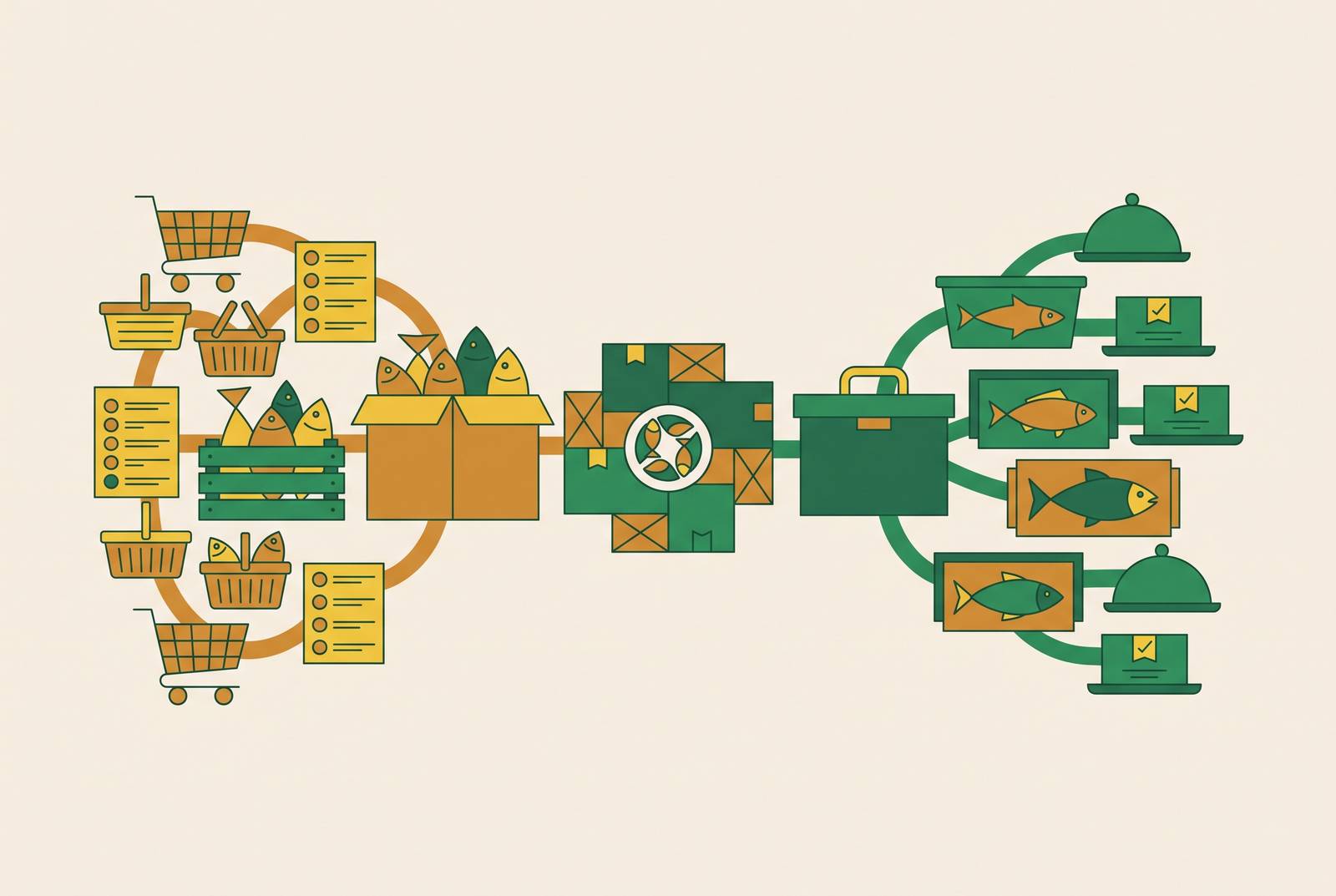
Ethnic grocery retailers and foodservice operators both buy seafood in volume, but they are not variations on the same customer. They run on different product logic, different communication habits, and different fulfillment timing, and a distributor who treats one as a scaled-down version of the other will misjudge both. Research tracking seafood purchasing behavior in the U.S. before and after the pandemic found that the share of shoppers naming traditional grocery as their primary seafood store has dropped substantially, with ethnic, specialty, and other non-traditional channels picking up much of that volume. That shift is tied to demographic change and cultural habit, so distributors serving ethnic grocery accounts are working with a buyer class that will keep growing. Everything that follows, product specification, pricing mechanics, order intake, and fulfillment rhythm, traces back to this one fact: the two buyer types are solving different problems when they place a seafood order.
What Each Buyer Type Wants from the Seafood Counter
A distributor's catalog built to serve a restaurant chain well will fall short with an ethnic grocery account, and the reverse holds just as true. The mismatch starts with what each buyer is actually trying to accomplish. Foodservice buyers want consistency they can run a kitchen on: portioned salmon fillets, cod loins, shrimp sized and counted the same way every delivery, so a cook with limited training can plate the same dish night after night. That demand is about labor economics as much as it is about taste. Fewer skilled hands are available in most commercial kitchens, so the product has to arrive doing as much of the prep work as possible.
Ethnic grocery buyers are answering a different question. Communities with long seafood traditions, where fish carries meaning tied to prosperity, heritage, or religious observance, want the species and the form their traditions call for, not whatever happens to be sitting in a broadline distributor's warehouse. That demand is specific and consistent within itself, not a matter of taste shifting around. A distributor who assumes that stocking salmon, tilapia, and shrimp has multicultural demand covered is leaving real volume on the table. That gap appears in actual orders for actual species a standard catalog doesn't carry, and adding two or three new SKUs to an existing list doesn't close it.
Some distributors assume ethnic grocers can just order off the standard catalog and swap one species or form for another. That assumption breaks down at the shelf, not just at the warehouse. A Vietnamese shopper buying whole snapper is not a salmon-fillet customer who happens to prefer something else that week. The retailer's buyer understands this, because the buyer's own customer base will not accept a substitution any more readily than the buyer will.
Catch Weight as an Invoicing and Inventory Problem
The single most consequential operational difference between these two buyer types is catch weight, and it is not a bookkeeping footnote. A case of whole snapper does not have a fixed weight the way a case of pre-portioned fillets does. Each fish in the case is a different size, the case weighs whatever those individual fish add up to, and the buyer gets invoiced for the actual pounds shipped, not the weight the order assumed going in. That single fact generates two units of measure for the same transaction: the case or count the buyer ordered, and the pounds that actually left the warehouse. There is no stable conversion between the two, and an ERP system built around fixed-weight SKUs has nowhere to put that discrepancy.
Foodservice accounts mostly avoid this problem because they order pre-portioned or already-processed product, priced and invoiced by the case. Ethnic grocery accounts generate catch-weight complexity on close to every line, because whole tilapia, live crab, whole mackerel, and live shellfish make up a large share of what they buy. A distributor running a mixed book, some restaurant accounts, some ethnic grocery accounts, has to keep two parallel sets of inventory and invoicing logic running inside the same facility, often for the identical species, depending entirely on which account placed the order and in what form. Tilapia sold as a fixed-weight fillet to a restaurant and tilapia sold whole and catch-weighted to a grocery account share one species name, but they are two different accounting problems.
Live shellfish raise the stakes further. They need tighter handling windows, they carry more logistics risk than any frozen or iced product, and their pricing depends on catch weight. Ethnic grocery accounts pay well for live product delivered in the right form, so the margin is there for distributors who build the capability to handle it correctly. A distributor still running a standard fixed-weight workflow against these accounts will generate invoicing errors and customer disputes as a matter of course, unless the system is specifically configured to treat catch weight as the default.
How ethnic grocery buyers communicate orders
Foodservice buyers tend to place orders through structured channels: purchase order systems, EDI connections with broadline suppliers, or distributor portals, inputs that map cleanly onto ERP line items with little interpretation required. Ethnic grocery retailers, many of them family-owned operations ranging from small independents to sizeable regional chains, place orders through informal channels instead, in shorthand that mixes species names, size codes, and frequently a second language.
The order desk handling that message has to resolve several things at once before the order can even be entered: an informal or transliterated species name, a size grade written in shorthand, catch-weight pricing logic, and instructions that may arrive partly in another language. Each of those resolutions takes knowledge specific to the ethnic seafood trade, and a general-purpose order taker may not have it. None of this is unique to ethnic grocery buying, but it concentrates there more than anywhere else in the distribution chain. The vocabulary, the mix of channels (WhatsApp, WeChat, phone calls), and the layering of languages combine so that every order becomes a translation exercise before it ever becomes a fulfillment exercise.
An order desk serving restaurant accounts alongside ethnic grocery accounts is not running one workflow twice. The same staff switch between two vocabularies, two channel sets, and two distinct error modes, often within the same shift, and that switching causes mistakes at intake that nobody catches until the product is already picked.
The ordering cadence and fulfillment rhythm ethnic grocers run on, compared to foodservice buying cycles
Foodservice buyers tend to order on predictable cycles tied to menu planning and kitchen prep schedules, standing orders with modest variation, placed with enough lead time to fit standard distribution routing. Ethnic grocery buyers respond far more sharply to the cultural calendar. Lunar New Year, Eid, Diwali, and other heritage celebrations produce sudden, concentrated demand for specific species in specific forms that looks nothing like the background ordering pattern the rest of the year.
Live product buying adds its own timing constraint on top of that. Live fish and shellfish have narrow holding windows, and demand for them tracks the week rather than a standing schedule, because weekend foot traffic at ethnic grocery stores runs disproportionately high compared to weekday volume. Combining the cultural-calendar spikes, the live-product timing, and the informal ordering channels produces demand signals that arrive more irregularly, and through channels that are harder to monitor, than a standing foodservice order ever would. The Power of Seafood 2026 report found that frequent seafood shoppers, the core of ethnic grocery's customer base, eat seafood at least twice a week, a frequency that pushes restocking cadence well above what a typical grocery format needs to support. For a distributor, that difference in rhythm is a scheduling and holding problem as much as a sales one: routes, holding capacity, and delivery windows all have to flex around a buyer whose busiest week might be built entirely around a single holiday.
What a distributor has to manage when ethnic grocery and foodservice accounts share the same order desk and warehouse
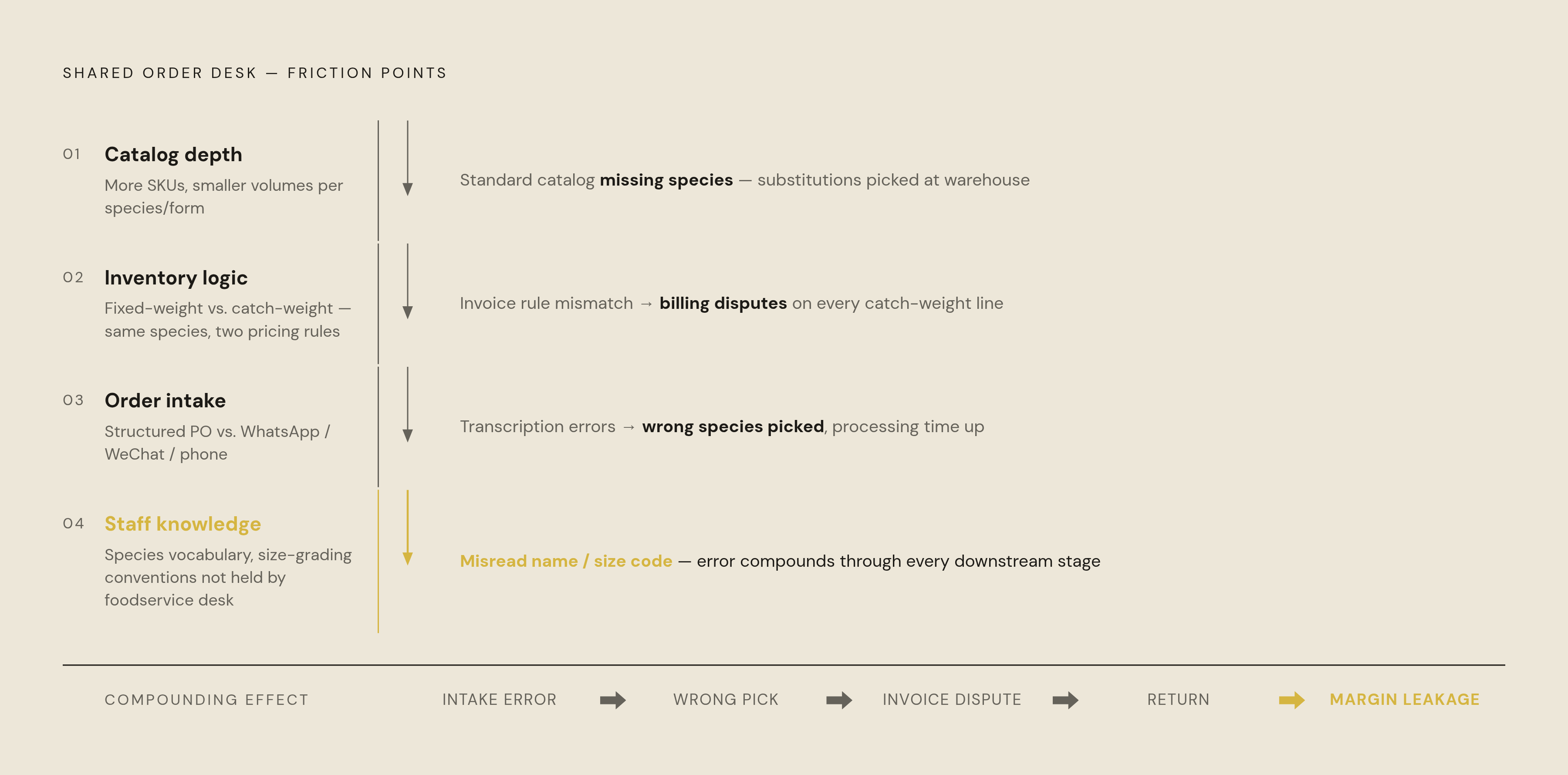
Combining the product differences, the catch-weight mechanics, the communication patterns, and the fulfillment rhythm shows that a distributor serving both buyer types out of one facility is managing two parallel operational logics, not one business with two customer lists. The friction points are specific and predictable.
Catalog depth is the first. Ethnic grocery accounts want species and forms the standard foodservice catalog does not carry, so stocking both means more SKUs, more supplier relationships, and often smaller volume per SKU than a distributor is used to justifying.
Inventory logic is the second. Fixed-weight SKUs serve foodservice, catch-weight items serve ethnic grocery, and the same species, tilapia being the clearest example, can exist in both forms at once for different accounts, so the ERP has to carry two sets of pricing and invoicing rules for one product line.
Order intake is the third. Structured purchase orders arrive from foodservice buyers, informal multilingual messages arrive from ethnic grocery buyers, and the order desk has to switch between two communication modes and two vocabulary sets all day, which raises both error rate and processing time.
Staff knowledge is the fourth. Reading an ethnic grocery order correctly takes species vocabulary in more than one language, familiarity with local size-grading conventions, and comfort with catch-weight norms, and a foodservice-trained order desk doesn't automatically have that knowledge. Mistakes made at intake don't stay contained there. They compound through picking, through invoicing, and through delivery, and each stage adds its own cost to an error that started as a misread species name or a size code nobody recognized.
None of this is a hypothetical cost. Misidentified species, incorrect catch-weight invoices, and demand spikes missed around a cultural holiday turn into customer disputes, returned product, and margin leakage, and all three happen more often when both buyer types share one intake and fulfillment system with no accommodation built in for their differences.
Building Intake and Fulfillment Workflows That Serve Both Buyer Types
Serving both buyer types well at the same time takes deliberate separation at the catalog and intake level, built with tools that can handle informal, multilingual, catch-weight-heavy orders without asking ethnic grocery customers to change how they communicate.
Catalog design is where that separation has to start. Ethnic grocery SKUs, catch-weight items, and live product lines need their own tier inside the ERP, with their own pricing logic, their own units of measure, and their own supplier linkages, rather than sitting as an afterthought bolted onto the foodservice catalog.
Order intake is where the biggest gains are available. Because ethnic grocery orders arrive informally and in more than one language, the intake step carries more interpretive work than a standard foodservice PO does, and systematizing that step cuts the error rate at its source. An AI order intake agent that understands industry-specific shorthand, maps informal species names and size codes to the correct ERP items, handles multilingual messages, and reads orders coming in through WhatsApp, WeChat, voicemail, and email can do that work without asking ethnic grocery buyers to change how they place an order. That matters because this is a relationship-driven, family-business buyer base, and meeting them on their existing channels is the only realistic way such a tool gets adopted.
Catch-weight handling needs to sit inside that same intake workflow, not get patched in afterward. An order that comes in reading "30 whole snapper, 3 to 5 lb each" has to be captured as a catch-weight line item with the right unit of measure before it ever reaches the ERP, not corrected after a fixed-weight invoice has already gone out to a confused customer.
Human review still has a place in this system, and a necessary one. Genuinely ambiguous orders, an unfamiliar species, an unusual size grade, a price that doesn't match the account's history, should get flagged for a person to check. That is where AI built to support human judgment outperforms AI built to replace it.
On the fulfillment side, planning for cultural-calendar demand separately from standard forecasting keeps an ethnic grocery spike around Lunar New Year or Eid from causing a stockout, or an over-order, that spills over into foodservice accounts sharing the same warehouse. That separation is a matter of scheduling and procurement discipline. Distributors who build it into how they run the warehouse, not just into what they stock, are the ones positioned to serve both buyer types as the volume behind ethnic grocery keeps growing.