Regional Seafood Preferences and Their Effect on Distributor SKU Breadth
Different species dominate each region, forcing distributors to stock incompatible catalogs.
Regional seafood preference is not a matter of degree. A distributor cannot serve New England and the Gulf Coast off the same core SKU list, because the species each region buys are fundamentally different products sold to fundamentally different buyers. So this one fact, more than any other, explains why multi-region seafood distributors carry catalogs that look nothing like a simple sum of two regional lists.
How regional seafood preferences fracture a distributor's catalog
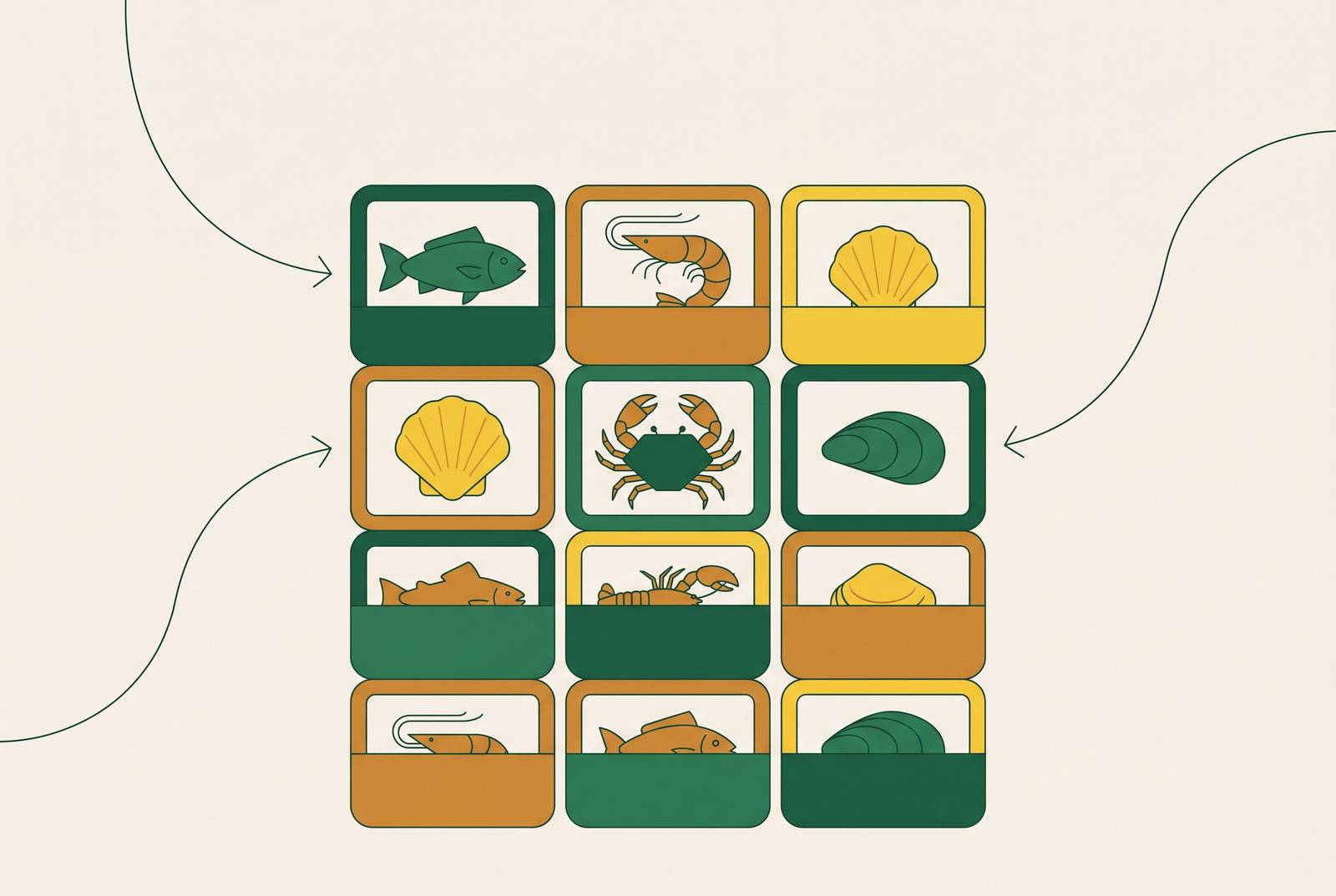
Start with the map itself. New England's top sellers run to shrimp, haddock, salmon, cod, and lobster, a lineup built around cold-water finfish and the lobster trade that defines the region's buyer base. In the East South Central market the list changes almost entirely: shrimp still sells, but catfish and pangasius take the place of haddock and cod. In the West South Central region, pangasius and catfish dominate, species that a New England buyer would rarely order and might not recognize on an invoice. Only shrimp and salmon show up with anything like national reach across these markets. Everything else is locally dominant and, just as important, locally bounded: a haddock fillet that moves steadily through one depot has no natural market in a distributor's territory on the other coast, and a catfish order that's routine in one region would puzzle a buyer in another. When a distributor adds a second or third region, it isn't layering new volume onto an existing list. The new market brings its own species, its own demand curve, and its own catalog, largely disconnected from what the distributor already stocks.
Why "premium" means something different in every region (and what that adds to the SKU count)
The fracture runs deeper than species alone, because the idea of a "premium" product is itself regional. A grading tier or prep form can command a price premium in one market and read as ordinary commodity stock in another, so a distributor can't build one tiering system and apply it everywhere. A Gulf Coast account's premium shrimp might ship in a pack size, prep form, or grade entirely different from what a New England account expects for the same species at the same price point, so the species match doesn't guarantee the SKU matches. Ready-to-eat and convenience formats push the count higher still. Marinated fillets, poke kits, and sushi trays all draw on the same underlying species base, but each generates its own line items, shaped by regional taste and by the retail channel it's headed into. A salmon fillet alone might need to exist as a plain frozen block, a pre-marinated retail pack, and a poke-cut tray, and each one is a distinct SKU with its own shelf life and its own margin profile. The catalog isn't just growing in one direction, then. It widens by species across regions, and it thickens by value tier and format within each species, and the distributor controls neither axis. Regional taste sets the first; retail channel and consumer trend set the second.
Seafood's specification language and dozens of distinct line items
Even once a distributor knows which species and which value tier a region wants, the multiplication has only just started. Seafood may be the most specification-heavy category in food distribution, because a single species generates a sprawling matrix of distinct, non-interchangeable line items before you even get to price or country of origin. Shrimp shows the pattern most clearly. Count-per-pound grading splits shrimp into size bands, and each band is its own SKU: a buyer ordering 16/20 count is not expressing a mild preference over 21/25, they're ordering a physically different product that costs differently, cooks differently, and plates differently.
Now stack product form on top of count band. HOSO, head-on, shell-on, graded by kilogram or pound depending on the market and including the head in the weight. HLSO, headless, shell-on, graded by pound, with a conversion to HOSO counts that isn't obvious and causes real ordering mistakes when staff misjudge it. PUD, peeled and undeveined. P&D, peeled and deveined. PDTO, peeled, deveined, tail-on. CPTO, cooked, peeled, tail-on. A single species run across its common count bands and its common product forms climbs past forty distinct line items, before pack size, country of origin, or whether the product is IQF or block-frozen even enters the picture.
Even after a SKU is defined, the language around it stays treacherous. Glazing percentage, the water coating applied to IQF seafood for protection, varies meaningfully between suppliers. Two vendors can ship the same count band in the same pack style and deliver noticeably different usable yield, a difference that affects margin directly and has to be captured correctly on the order and mapped to the right ERP item code. Everyday B2B shorthand compresses all of this further. "Grade A cod fillets, 4-6 oz, shatter pack, pin-bone-out" is already dense language, and a buyer's text message or voicemail compresses it even more, dropping words a human transcriber has to mentally restore. The terms themselves carry traps: "sashimi grade" describes no regulated standard at all, "shatter pack" (a carton of frozen fillets separated by plastic sheets, broken apart by dropping the carton) gets confused for "cello pack" by anyone without category training, and a count band transcribed by hand at volume carries an obvious risk of simple transposition error.
The catalog after years of serving multiple regional markets
Several years of regional expansion together produce a catalog that is not the product of sloppy SKU hygiene. It comes from the accumulated, mostly rational outcome of growth, customer-specific requests, and the demands of serving each region's actual assortment. Every new region adds species, but it also adds count bands, prep forms, pack sizes, and value tiers, all of which the ERP has to hold and correctly route when an order comes in. The grading work done upstream, at the processing level, locks this complexity in early: after washing, seafood gets graded by size, weight, and species to keep packaging and pricing uniform, and those grading distinctions carry straight through into the distributor's item master as separate, non-interchangeable SKUs.
The cold chain adds its own layer of difference on top of the catalog itself. A Gulf Coast distributor carrying live blue crab next to frozen shrimp and fresh catfish fillets needs a logistics operation built for handling needs very different from those of a New England distributor moving haddock, lobster, and chowder-cut cod. Each regional catalog carries its own routing logic, its own temperature regime, and its own delivery window constraints. None of this is incidental complexity that better systems or tighter processes could trim away. A distributor serving three regions must manage three catalogs' worth of structural variation at once, because shrinking the catalog means losing markets, while holding it still means falling behind the regional demand shifts that keep occurring anyway.
Where catalog scale breaks the manual order-entry model
A catalog this wide and this specification-heavy doesn't just mean more line items to manage. It means more distinct ways for any single order to go wrong, and that error rate climbs as both SKU count and order volume grow. The failure mode plays out in plain operational terms: a distributor running hundreds of SKUs across multiple depots takes orders by phone through the morning rush, and a staff member transcribes each one into the ERP by hand. Every transcription step, the product code, the quantity, the count band, is a place where a correct order on the customer's end can turn into an incorrect one on the distributor's end.
Timing makes the problem worse. Batch inventory updates mean the stock number a rep quotes at noon may still reflect the previous evening's count, so when two accounts both try to claim the last available units of a perishable line at the same time, both orders can confirm, and the distributor has to decide which customer gets disappointed. The terminology gaps already described become error vectors once volume is high enough: a "shatter pack" misread as a "cello pack," a count band transposed from one size to the next, a glaze percentage left off the order. Each is a small mistake on its own, but at scale each becomes a returned pallet or a quiet loss of margin. That margin erosion is easy to miss precisely because the catalog is large. Averages smooth performance across hundreds of SKUs, so pricing can look like it's working overall even while a handful of underperforming lines get quietly subsidized by the rest of the portfolio, because no single line gets watched closely enough to catch it. None of this reflects a staff that's careless. It reflects an order-intake process built for a smaller, simpler catalog than the one the business now actually runs.
Processing multilingual WhatsApp and text orders automatically
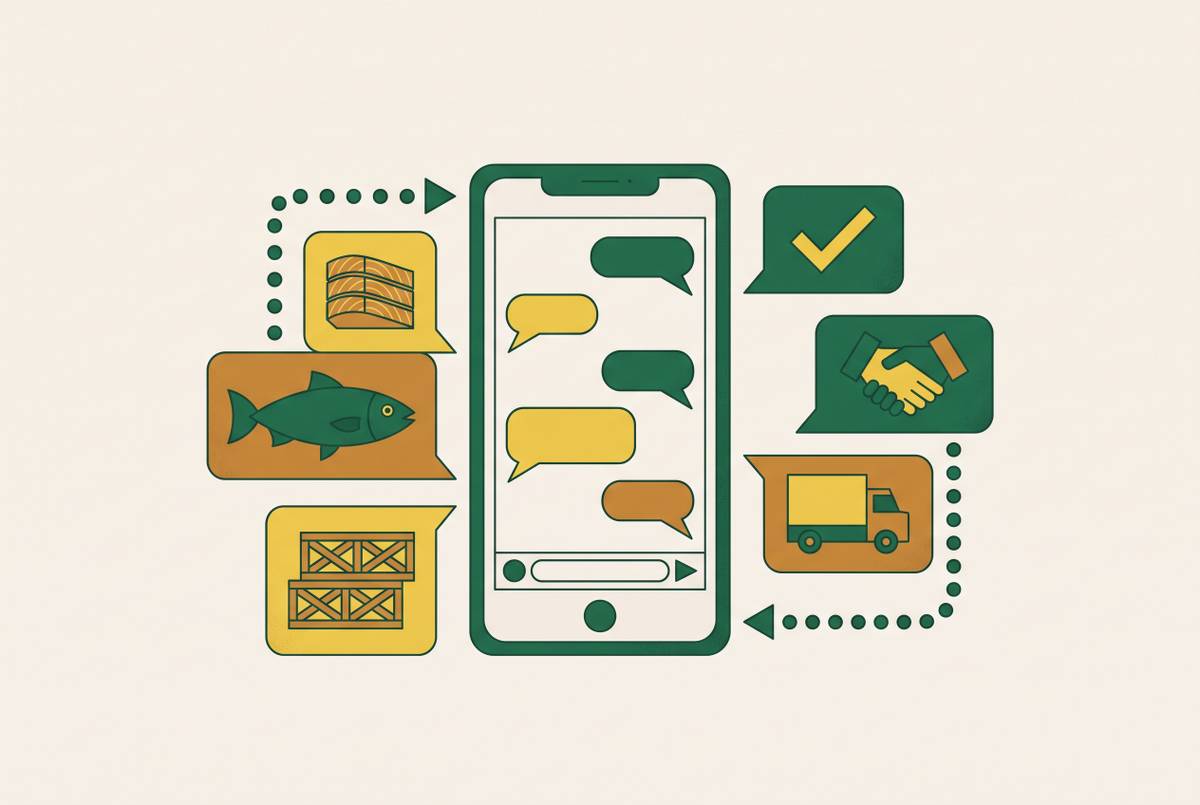
Customers in food distribution order the way they've always ordered: by text, by voicemail, over WhatsApp, over WeChat, by email, by phone call. A system that asks them to abandon those channels for a portal or an app will not get adopted, because the relationship between a buyer and their rep is built on exactly that ease of access. The practical fix for catalog-driven order complexity isn't a simpler catalog, because simplifying it would mean giving up the regional markets that make it complex. The fix is an intake process built to handle specification-heavy, multilingual, shorthand-laden orders exactly as they arrive, on whatever channel the buyer happens to use that day.
Consider a real order as it would actually come in: "Hi, for Friday morning please send 3 cs hamachi 10/12 sashimi grade, 40 lb salmon fillet skin-on, 2 cs shrimp 16/20, 1 cs Hokkaido uni trays, 6 dz Kumamoto oysters, 10 lb dry scallops 10/20, and 2 toro loins, the same cut as last time. Deliver before 9 AM to the back entrance. If Hokkaido uni is unavailable, text me before substituting." That single message carries count bands, a grading term with no regulated meaning, a customer-specific reference to a past order, a substitution instruction, and a delivery constraint, all compressed into one paragraph of ordinary customer language. An order arriving the same Friday morning in another language carries just as much detail.
This is the condition Asakana is built for. It captures inbound orders from the channels customers already use, text, voicemail, WhatsApp, WeChat, email, phone, and reads multilingual messages alongside the shorthand particular to seafood: count bands, product-form abbreviations like HLSO and PUD and PDTO, customer-specific aliases, and grading terms. It converts all of it into structured order drafts mapped to the distributor's existing ERP item codes, and the customer doesn't have to change a single habit. Rather than acting autonomously on every line, the system flags ambiguous or potentially incorrect items for a staff member to review, which matches how these businesses actually operate: someone on staff needs to catch the edge cases, not hand that judgment entirely to software. Multi-region distributors face this fracture across every channel their buyers use, with regional preferences arriving as texts, voicemails, emails, and WhatsApp messages in whatever language and shorthand the buyer reaches for, and capturing that volume without asking customers to adopt a new process is where the real operational strain sits. A tool like Asakana, built to ingest orders from the channels already in use and turn them into clean ERP drafts, can take on that load without changing a thing about how the buyer orders. The data stays the distributor's own, too: customer and business information is never used to train shared models, a distinction that matters in an industry where buyer relationships and pricing knowledge are the core competitive asset.
The payoff is that a distributor can expand into another regional market, adding species, adding customers, adding channels, without adding headcount in proportion to the new order volume, because the intake bottleneck stops being a function of how many staff hours are available in the morning rush. That's the practical way out of a catalog that, by every structural measure in this piece, was never going to stay small enough for a manual process to keep up with.
Sources
- An Overview of Retail Sales of Seafood in the United States
- APPENDIX E: SEAFOOD MARKET BASICS How Seafood Gets Distributed
- 1 PART 5
- Pacific Seafood Product Catalog
- Consumer preferences for seafood sustainability attributes: A comparative study of 12 markets - ScienceDirect
- Retail Seafood Strategy for Deli Buyers: What the Data Says Heading Into IDDBA 2026