AI Order Agents for Food Distributors With Seafood Specialization
Specialized AI handles the messy reality of seafood order processing at scale.
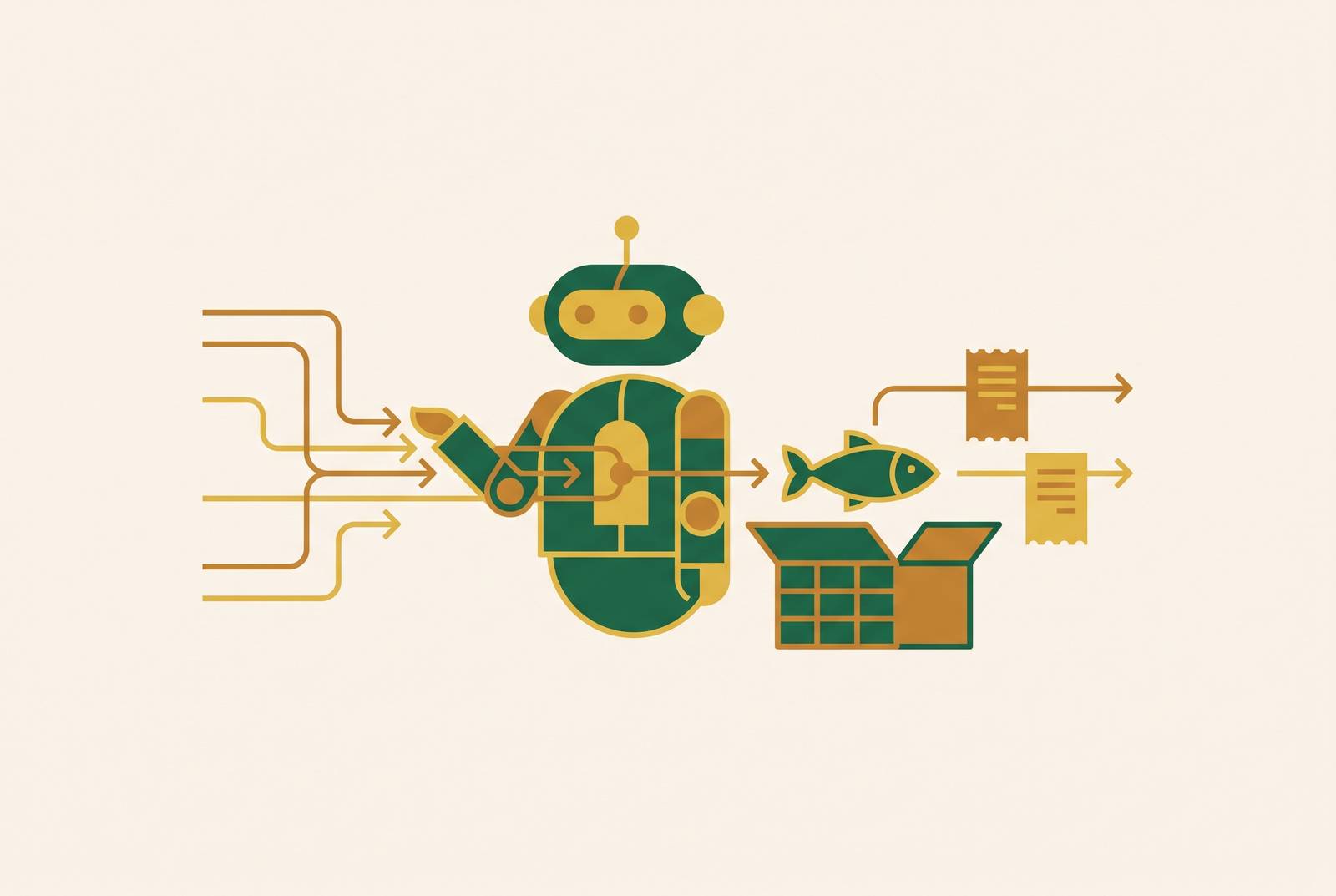
Picture an order desk on a weekday evening. Texts are landing from a restaurant kitchen mid-prep. An email with an attachment sits unread next to a voicemail nobody has transcribed yet. Someone is squinting at a photo of a handwritten note sent over WhatsApp, trying to work out whether the scrawled number is a 3 or an 8. None of this is a sign that food distributors have fallen behind on technology. Manual order intake persists because it is a structural feature of B2B foodservice, one that nothing on the market had adequately solved until recently. Restaurant operators place orders during evening prep or whatever off-hours suit their kitchen, and they use whatever channel is fastest in the moment: texts, emails, voicemails, WhatsApp, PDFs, handwritten notes, all of it arriving in parallel rather than through a single front door. Pepper's 2025 overview of the industry treats orders arriving on napkins and pizza boxes not as a colorful anecdote but as a lived, daily reality for order desks.
The cost of that chaos appears at every handoff. An order moves from the channel it arrived on, to a rep who has to read and interpret it, to the ERP system where it finally becomes a pickable, billable record, and each of those transfers is a place where an error, a delay, or a duplicate entry can creep in. The timing makes it worse: hundreds of orders can land between close of business and midnight, and all of them need to be processed before the morning pick run starts. The busiest hours for the order desk are the hours when staffing is thinnest. This is the condition AI order agents were built to address, and understanding it is the starting point for evaluating whether any particular tool actually solves it.
How AI order agents work
An AI order agent's job is not to replace the ERP system a distributor already runs on. It sits in front of the ERP, catching the unstructured mess of inbound messages and turning them into structured order drafts before a human ever has to retype anything. The basic loop looks the same across most serious implementations: the system takes in text, voice, images, or email, works out what the customer actually means by checking it against that customer's ordering history and the distributor's catalog, and produces a draft order ready to drop into the ERP.
Several companies have already built and deployed this at scale. Choco's OrderAgent, built on OpenAI's APIs, processes emails, SMS messages, images, and documents and turns them into structured, ERP-ready orders, while its companion VoiceAgent takes phone orders with sub-second response times outside normal business hours. Choco also offers an optional Autopilot mode that processes an order automatically once it clears a confidence threshold, and routes anything less certain to a human for review, a setup that keeps people involved without turning them into a bottleneck; Choco's 2026 figures put error rates under that system below 1 to 5%, with the automation thresholds configurable by the distributor. US Foods took a related but distinct approach with its MOXē platform, adding a capability in February 2026 that lets both customers and sales reps upload photos, PDFs, and handwritten notes and convert them straight into orders. GrubMarket's Sales AI Agent, launched in June 2026, pushes further into front-office territory: it handles territory-based prospect discovery, menu analysis, automatic quote generation, and proposal delivery across multiple channels, and it connects to WholesaleWare ERP, Thyme Software, Granite State Software, PICS by WaudWare, and Orders IO.
The operational case for automated order intake: what distributors gain
The return on this technology clusters around three measurable things: time recovered from reps and order desk staff, errors prevented before they reach the warehouse, and the ability to handle more order volume without hiring more people to process it. Choco reports processing more than 8.8 million orders annually, with manual order entry down and sales team productivity up, achieved without adding headcount. Brown Foodservice, running Pepper's Order Automation, reported its reps saving real time each day, time that moved from rekeying orders to actually talking with customers and selling.
Because an order flows directly into the ERP without anyone retyping it, growing order volume no longer means growing the administrative staff in proportion. A capable order-intake layer gives a smaller distributor a digital ordering experience that feels current to restaurant customers, without the cost or timeline of building a full eCommerce platform from the ground up.
None of this lands without friction on the sales floor. The National Association of Wholesaler-Distributors has flagged real resistance from sales teams toward new tools, driven by worries about being monitored and about how automation might affect commission. Seafood is the category where product itself resists the kind of pattern-matching these systems rely on.
Why seafood order language breaks generic AI agents
The clearest evidence that general-purpose AI struggles with seafood comes from a direct pilot. ThisFish tested a generative BI tool built on Google's Gemini for a salmon processor and found it performed poorly, because the model could not make sense of seafood jargon or the non-standardized, unstructured way seafood data is actually recorded. It is a documented failure of a capable, general-purpose model, in a seafood-specific business context. Generic large language models trained on web text do not carry the shorthand, count systems, certification acronyms, and cut designations that seafood B2B transactions require, and the gap is not a minor inconvenience but one that produces order errors with direct financial consequences.
The terminology itself explains why. Count per pound, the system used to size shrimp, is a numeric range describing pieces per pound, where a designation like "U/10" means under a certain threshold of pieces per pound; if a buyer's spec calls for one count range and the delivered case tests out at a looser count, the order is rejectable, so a generic agent that misreads the count has just created a return and put the account at risk. FAS, or Frozen at Sea, describes product that was headed, gutted, packaged, and frozen aboard the vessel itself, a handling and provenance designation that affects the price tier, the shelf-life expectations, and the import paperwork attached to that product. BAP, Best Aquaculture Practices, is a star-rated certification issued by the Global Seafood Alliance for farmed seafood, and an agent working in this category has to recognize not just the acronym but the star-rating system behind it and which tiers of the supply chain it actually covers. Each of these terms carries financial consequences if misread, not stylistic ones.
The obvious counterargument is that an AI agent could simply ask for clarification whenever it isn't sure. That fails in practice, because seafood buyers use shorthand precisely because it is fast, and an agent that stops to interrogate every order will lose out to a human rep who already knows that "2 ct snapper fillets" means what it says. An agent that trades speed for caution on every order has made itself worse than the rep it was supposed to help.
How seafood's supply chain structure adds complexity beyond terminology
Even a model that had somehow learned every term in the previous section would still run into trouble, because the seafood supply chain itself behaves differently from almost anything else a distributor handles. Availability is driven by what boats actually caught, not by what a catalog says is in stock: a species orderable today can vanish tomorrow because of weather, quota limits, or a vessel's schedule, and an agent that matches incoming orders against a static catalog snapshot will generate fulfillment failures that have nothing to do with language comprehension. Grading adds another layer that cannot be inferred from context. EU freshness categories, US Grade A standards, and individual buyers' own visual defect thresholds all operate at the same time, and an agent's resolution logic has to encode all of them rather than assume which one applies.
An agent that gets the terminology right but still matches against a stale catalog, or applies the wrong grading standard, produces the same bad outcome as one that never understood the jargon. The intake layer has to be aware of catch timing and grading variation at the point an order is captured, as a condition built into capture rather than a downstream correction.
Language adds a further dimension on top of all this. Multilingual buyer relationships are common in seafood, and Asian wholesale markets in particular operate heavily in Mandarin, Cantonese, and Vietnamese shorthand covering species names, cut designations, and count systems that often have no direct English equivalent. BlueTrace has built its response to this environment directly into its product: an AI order-intake agent for seafood operations that recognizes a given customer's repeat patterns, the kind of thing a longtime rep would just know, such as a note that "Chef Maria usually orders 2 ct snapper fillets on Fridays," and matches that pattern automatically to inventoried items, including suggesting relevant upsells. That pattern-recognition layer exists because seafood ordering is relationship-driven and non-standard in a way broadline grocery or paper goods ordering simply isn't.
Domain depth in practice for a seafood-capable AI agent
A general-purpose large language model is a starting point for this work. A seafood-capable agent needs fine-tuning on the distributor's own catalog, on seafood terminology specifically, and on each customer's ordering history before it can be trusted with live orders. The technical core of that work is SKU resolution. When a customer texts "large shrimp," the agent has to resolve that vague phrase to the exact count-per-pound SKU in that distributor's specific catalog, not produce a generic best guess, and this kind of precise SKU-matching is the feature that distinguishes a seafood-capable tool like Burnt from one simply repurposed from another food category.
History matters just as much as the catalog. Choco's engineering team has described this as a form of dynamic, in-context learning infrastructure that separates an agent that merely automates data entry from one that behaves intelligently. Multilingual intake belongs on this same checklist as a basic requirement for any agent serving distributors whose customers order in Mandarin, Cantonese, Vietnamese shorthand, or any language that doesn't map cleanly onto English.
Exception handling carries more weight in seafood than in almost any other category of food distribution. It can break a chef's exact recipe spec and put the whole account at risk, so the correct design flags those situations for a human to look at rather than pushing them through automatically. ERP integration has to keep pace with all of this too. Legacy EDI batch-file connections, which update inventory in scheduled batches, cannot support the kind of real-time availability that catch-driven seafood supply chains demand, and certification fields like BAP star ratings, country of origin, and EU freshness category need to map directly onto the ERP's actual data structure rather than get dropped or approximated along the way. A distributor evaluating a vendor can treat this as a working checklist: SKU resolution against its own catalog, customer-history-aware disambiguation, multilingual intake, exception routing to a person, real-time ERP sync, and accurate certification mapping.
The human-oversight question in seafood order automation
Full autonomy is not the right goal for seafood order intake. The better design lets AI handle the high-confidence, routine orders on its own and sends the genuinely uncertain cases to a person, and that hybrid approach turns out to be both more reliable than doing everything by hand and more accurate than doing everything by machine. The reasoning comes down to what an error actually costs in this category. A wrong shrimp count or a missed glazing specification doesn't end with a minor correction. It leads to a rejection, a returns conversation, and sometimes the loss of a restaurant account entirely, and that asymmetry justifies a more conservative confidence threshold than a distributor would use for canned goods or dry storage items.
Choco's Autopilot architecture offers a concrete model of what this looks like in production: roughly half of orders get processed on their own, while anomalies are routed for a person to check. That is the operationally correct position for this category, not a concession to skeptics of the technology.
Choosing an AI order agent
Domain depth, not feature count, should decide which AI order agent a seafood distributor picks. A vendor demonstration built around generic food distribution use cases says little about whether the tool can tell a U/10 count from a looser one, or whether it knows that FAS product carries different shelf-life expectations than product processed onshore. Does it recognize repeat-order patterns the way BlueTrace's agent does, the sort of thing that lets a system know a given chef orders a given cut on a given day of the week?
Does the agent connect to the ERP in real time, or does it rely on batch updates that cannot keep pace with a catch-driven supply chain where availability shifts day to day because of weather, quota, or a boat's schedule? And does it route uncertain orders to a person rather than guessing, the way Choco's Autopilot does by design, keeping error rates low precisely because it knows when not to act alone?
A seafood distributor weighing these tools should treat the ThisFish pilot on Gemini as a cautionary data point rather than a one-off. The agents built specifically for seafood order intake, trained on its terminology, its catalogs, and its customers' ordering habits, solve a different and harder problem than the generic tools built for the rest of food distribution, and that difference is what a distributor is actually paying for when it chooses one system over another.
Sources
- GrubMarket Launches AI Sales Agent for Food Distributors - Distribution Strategy Group
- Top 11 AI Tools for Food Distributors in 2025: Leaders & Emerging Technologies
- US Foods Expands AI Ordering and Reshapes Sales Model in Digital Push - Distribution Strategy Group
- Choco automates food distribution with AI agents
- OrderAgent by Choco