Size Count Nomenclature for Shrimp Across Major Markets
Different countries grade shrimp sizes differently, creating costly confusion in global trade.
Shrimp trades globally at a scale few commodities match: the market sat near USD 79.2 billion in 2025 and is projected to hit USD 121.4 billion by 2033. Yet no single sizing standard governs a kilo of it, and the costliest habit in the business is assuming a count number means the same thing wherever it's written. A buyer in Boston, a buyer in Barcelona, and a buyer in Tokyo can all type "26/30" into a purchase order and mean three separate things, because the base weight, the product form, and the reference point behind that number are set by the country of origin, and every country sets them differently.
The domestic market alone imported roughly 750,000 metric tons of shrimp in 2024, drawing heavily from India (a 29.24% share), and from Ecuador, Indonesia, Vietnam, Thailand, and Mexico. Each origin packs to its own convention, and a size mismatch almost never gets caught at the point of order. Disputes at delivery or unpaid invoices are where this cost appears, which makes it a live cost in wholesale trade, not a footnote about labeling habits. What follows maps the logic behind each system, built so a practitioner can translate between them without guessing, and it argues for one hard rule: a count number alone, without a stated product form, is not a complete specification. Anyone treating it as one is already exposed.
The count-per-pound logic that underlies North American grading
North American grading rests on one plain idea: count is the number of individual shrimp it takes to make a pound. Fewer shrimp per pound means bigger shrimp, and more means smaller ones. Two labeling formats carry that idea in the same market, often on the same price sheet.
The "U" prefix stands for "under." U/10 means fewer than 10 shrimp make up a pound, U/15 means fewer than 15, and that notation is reserved for the largest grades sold. Below that tier, sellers switch to a range format: 16/20, 21/25, 26/30, each pair giving the minimum and maximum piece count allowed in a pound of that pack.
U.S. Grade Standards turn this into something enforceable rather than descriptive. Count gets calculated by dividing the number of shrimp in a package by its net weight in pounds, so a 5-pound box labeled 11/15 count has to contain somewhere between 55 and 75 shrimp, full stop. That 5-pound box is the unit the whole U.S./Canada trade prices against.
The full common ladder, shell-on, runs U/10, U/15, 16/20, 21/25, 26/30, 31/35, 36/40, 41/50, 51/60, 61/70, 71/90, and 91/110 per pound. Shell-on product rarely sells smaller than 100/120 per pound; below that, the shrimp are small enough that peeling becomes the more practical form anyway. Many large processors layer additional tolerances on top of the range label, capping how far the biggest and smallest individual shrimp in a pack can stray from the stated count. A "16/20" pack that averages 18 but contains a scattering of 12s and 24s technically meets the label while failing a chef's expectation of uniformity, and that gap between compliant and usable is where most kitchen-level complaints start.
Verbal size names layered on top of numeric counts, and the order errors that creates
Nobody standardizes the words, and treating "Extra Jumbo," "Colossal," and "Jumbo" as if they carried fixed meaning is the single most common mistake buyers make. The same shrimp can wear three different names depending on whose box it's in. One seller's "Extra Jumbo" might be 16/20. Another brand calls that exact count "Colossal." A third reserves "Colossal" for U/15, a full size tier larger, so two buyers using the identical word could be picturing shrimp that differ by a third in weight.
Common mappings recur across sellers, with the same caveat attached every time: Extra Colossal tends to be U/10, Super Colossal U/12, Colossal U/15. Extra Jumbo is usually 16/20, Jumbo 21/25, Extra Large 26/30, Large 31/35, Medium Large 36/40, Medium 41/50, and Tiny covers 71 and up, with smaller size names filling the grades in between. Treat that table as a starting point for conversation, never as a contract term.
The number is the only language that holds steady across sellers, processors, and borders. A customer who orders "jumbo" over the phone has left the count open to whoever answers, and in some countries verbal-only descriptions still appear in actual trade documentation. That is an import/export risk, not a domestic quirk, since buyer and seller may not even share the same verbal convention to begin with.
How product form (HOSO, HLSO, PUD, PND) changes what a count number means
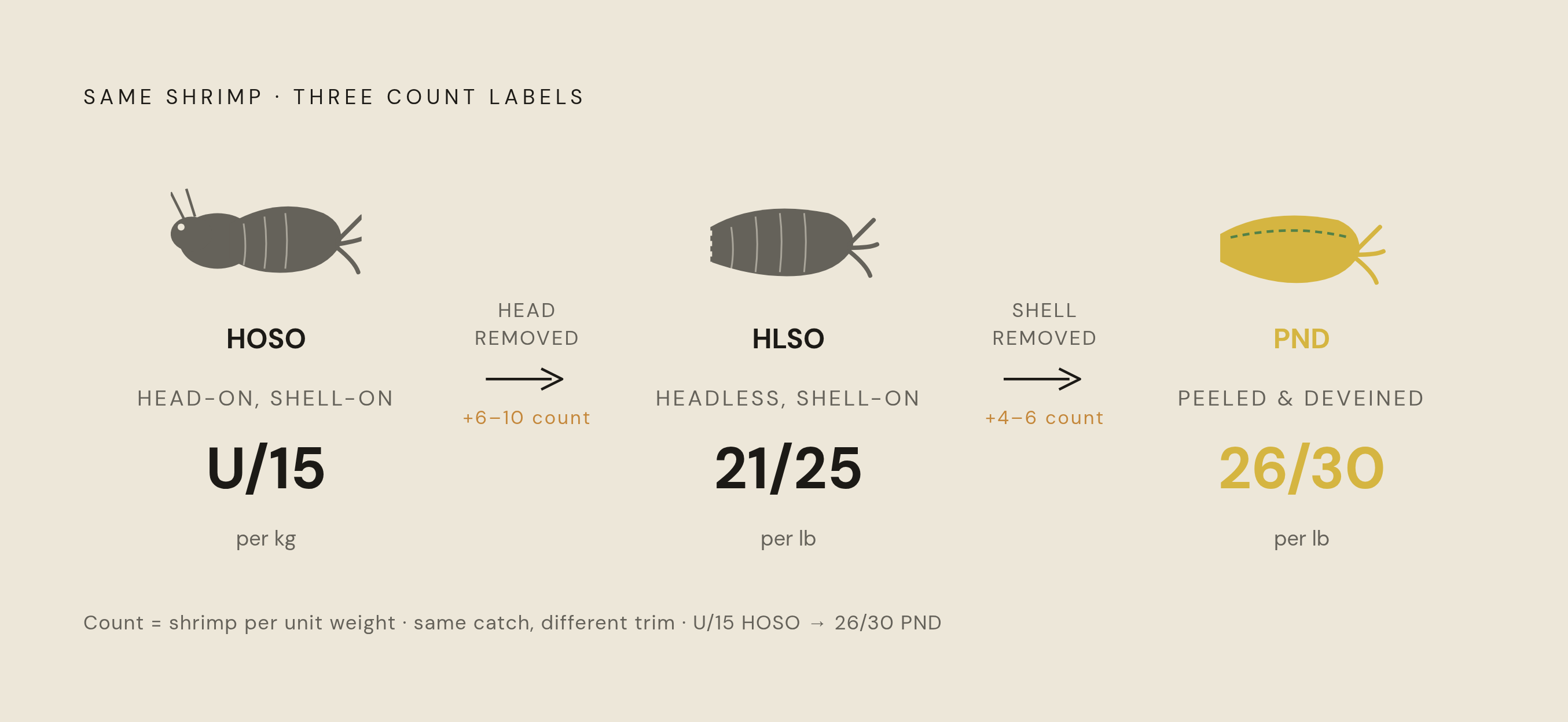
Cutting the head off a shrimp moves the count number. Peel the shell and it moves again. Industry references put the shift at roughly two count sizes with the head still attached, and roughly one size with the shell still on, so a U/15 head-on, shell-on shrimp reads closer to 21/25 once the head comes off, and closer to 26/30 once it's fully peeled. Same animal, three different labels, depending on what has been removed. Form is half the specification, not a modifier tacked onto the count, and any buyer who treats it as decorative detail is going to get an argument at delivery.
HOSO (Head-On, Shell-On) is the whole shrimp as harvested, graded by count per kilogram including the head's weight, and it dominates Asian and European tables, showing up in Chinese hotpot and Spanish tapas trade at ranges like 30/40 HOSO. HLSO (Headless, Shell-On) has the head removed and the shell left on, graded by headless count per pound or kilo, and it is one of the most common raw forms moving through North America and Europe. A 16/20 HLSO pack corresponds roughly to a 31/40 HOSO pack: the identical shrimp, wearing two different numbers because the reference point changed.
Below that sit the peeled forms. PUD or PD (Peeled, Undeveined) has the shell off but the vein still in, common in small counts feeding processed foods, specified per pound like 71/90 PUD. PND or P&D (Peeled and Deveined) is the standard ready-to-cook form on retail shelves and in foodservice kitchens, usually sold tail-off. PDTO or PTO (Peeled, Deveined, Tail-On) keeps the tail fan for shrimp cocktail and grilling presentations. Cooked forms, like CPTO (Cooked, Peeled, Tail-On), carry a count grade too, but also have to clear microbiological criteria since they are sold ready to eat.
Peeled counts hide the trap that costs the most money, precisely because the label never shows it. Some sellers state a "finished count," the actual peeled pieces per pound sitting in the box. Others state a "peeled-from" count, describing the shell-on size the shrimp started as, before peeling shrank the piece count by a size tier or two. Packaging rarely says which convention applies, so the buyer has to ask, every time, on every new supplier relationship. Broken shrimp counts carry the same trap in a different shape: one packer's "16/20 broken" means the pieces would have graded 16/20 whole, another packer's identical label means an actual piece count of 20/30, and there is no way to tell which without a phone call. A count number by itself, absent a stated product form, is a gap. It is a gap.
Per-kilogram grading and HOSO color coding in European and Asian markets
Product-form preference is what split the per-pound and per-kilo worlds apart in practice. North America buys headless and peeled shrimp by habit; Europe and Asia buy HOSO by habit, and each region's count system grew up around the form it sells most. The standard European and Asian pack runs 2 kilograms, 10 boxes to a master carton, against the domestic standard of 5 pounds, 10 boxes to a carton, so even the shipping unit reflects the underlying preference.
HOSO count bands commonly run in ranges such as 30/40 pieces per kilo, and none of those numbers translate directly to a per-pound figure without the arithmetic done first. A rough illustration: a mid-range per-kilo count translates to a notably lower per-pound number for the same shrimp, simply because a kilogram outweighs a pound.
Japan runs its own layer inside that broader Asian convention. Retail moves in small finger packs of roughly 10 to 12 pieces, while wholesale sticks to the 2-kilogram standard. Size segmentation in that market runs across a notably fine ladder feeding sushi counters, tempura kitchens, and a processed-food sector that keeps domestic demand strong. Europe, meanwhile, still leans on black tiger shrimp for the larger size grades, roughly above 26 to 31 pieces per kilo, in part because Pacific white shrimp supply thins out at those bigger sizes.
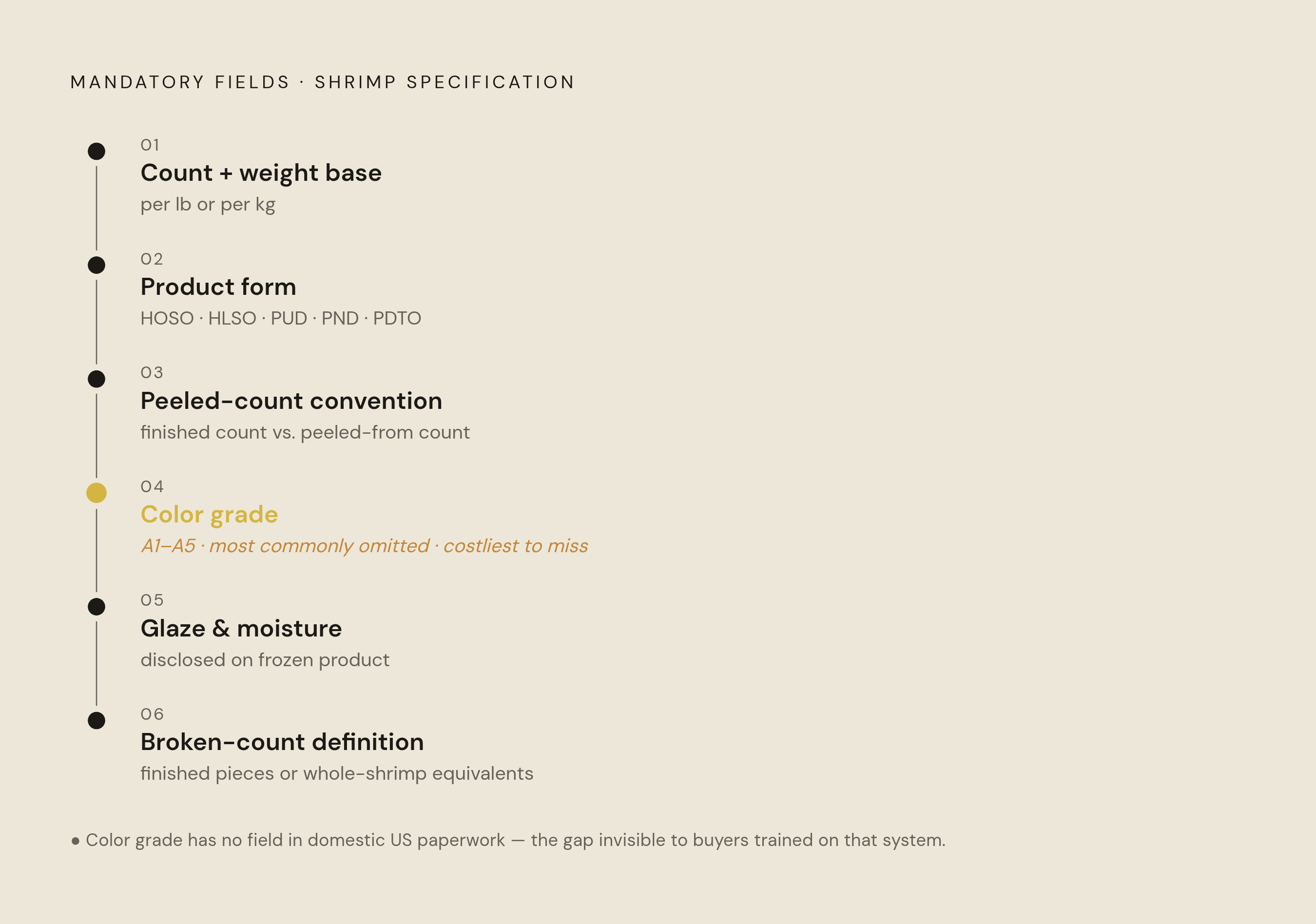
Color grading adds a dimension commercial orders in the domestic market simply do not carry. Asian wholesale trade grades HOSO shrimp on a shell-color scale running from A1, the lightest, to A5, the darkest, so a supplier quoting "30/40 HOSO A2" is packing two specifications, size and color, into one string of text. A buyer trained on domestic paperwork has no field for that second variable. Order into an Asian supply chain without specifying color, and the risk is not a size miss: it is a product that hits count perfectly while missing an appearance standard nobody thought to write down.
The Codex Alimentarius single-figure alternative in trade
Codex Alimentarius takes a different approach entirely: instead of a range, it allows size to be stated as one average count figure. The tolerance requirement is what keeps this honest: the largest and smallest shrimp in the pack each have to fall within ten percent of the stated average, a tighter internal consistency demand than a min/max range actually guarantees on its own.
Asian trade documentation sometimes shows this, where a label might just read "30" instead of "30/40." Reading that "30" as a range's lower bound, or worse, as a per-pound figure, collapses the specification. This is where a distributor unfamiliar with Codex gets burned hardest, because the number looks incomplete when it is actually a different convention doing its job correctly. Codex does not replace the per-pound system or the regional per-kilo conventions; it sits alongside them. All three notations can appear across different documents for the same shipment, and the notation by itself never tells a reader which standard produced it. That has to be settled between the parties before the number means anything.
A working conversion framework for practitioners navigating across systems
Two separate translation problems cause the confusion, and they need solving independently rather than blended into one rough guess. The first is a weight-base translation: a kilogram runs several times over a pound, so a per-kilo count for a given shrimp reads at a correspondingly higher multiple than the equivalent per-pound number. The second is a product-form translation: expect roughly a two-count-tier shift when the head comes off, and roughly a one-count-tier shift when the shell comes off.
Two anchor points are worth keeping close at hand, since they show both translations at once. A 16/20 HLSO pack, priced per pound, corresponds to roughly a 31/40 HOSO pack, priced per kilo, for the same physical shrimp. And a U/15 HOSO shrimp reads at roughly 21/25 once the head is gone, and roughly 26/30 once it is fully peeled.
A specification that survives translation across any of these markets has to state six things, and skipping even one is how disputes start. The count and its weight base is stated per pound or per kilo. The product form: HOSO, HLSO, PUD, PND, PDTO, and so on. The peeled-count convention where it applies, finished count against peeled-from count. The color grade if HOSO is headed into an Asian market, A1 through A5. Glaze and moisture disclosure on any frozen product. And a clear statement of whether a "broken" count refers to finished pieces or whole-shrimp equivalents. Where a contract uses Codex's single-figure notation, flag it explicitly in writing, so both sides confirm whether "30" means an average of 30 under Codex or a range floor under the domestic system. Verbal shorthand like "jumbo" and "large" still has its place in ordinary conversation between a distributor and a buyer, but it belongs there and nowhere else. It needs confirming in writing against numeric count and product form before the order is placed, because the verbal layer is a convenience for talking, not a specification anyone can act on.
Why food distributors bear the brunt of this complexity more than any other link in the chain
Distributors absorb every one of these conventions at once, often within a single day's order intake, and no other party in the chain carries that load. Suppliers out of Ecuador, India, or Vietnam are packing to their own regional standard. Domestic foodservice customers are calling in orders using verbal shorthand. A European or Asian buyer on the same account might be referencing per-kilo counts on that very same product line, the same afternoon.
Hotels and restaurants made up 41.2% of domestic shrimp distribution in 2025, and that customer base orders by habit far more often than by specification sheet. A kitchen manager saying "give me the jumbo like last time" is relying entirely on the distributor to hold the actual count and product form steady behind that phrase, order after order. When a size assumption is wrong, the mistake becomes visible late: on delivery, or in a disputed invoice, by which point the shrimp are off the truck and the cheap window to fix it has already closed. That is the operational weight this whole tangle of overlapping systems puts on the one party that has to speak every dialect of it fluently, and get the translation right before the box ever leaves the warehouse.