How Buyers Use WhatsApp and Text to Order Seafood From Distributors
Distributors rely on personal text threads because walk-in coolers are no place for portals.
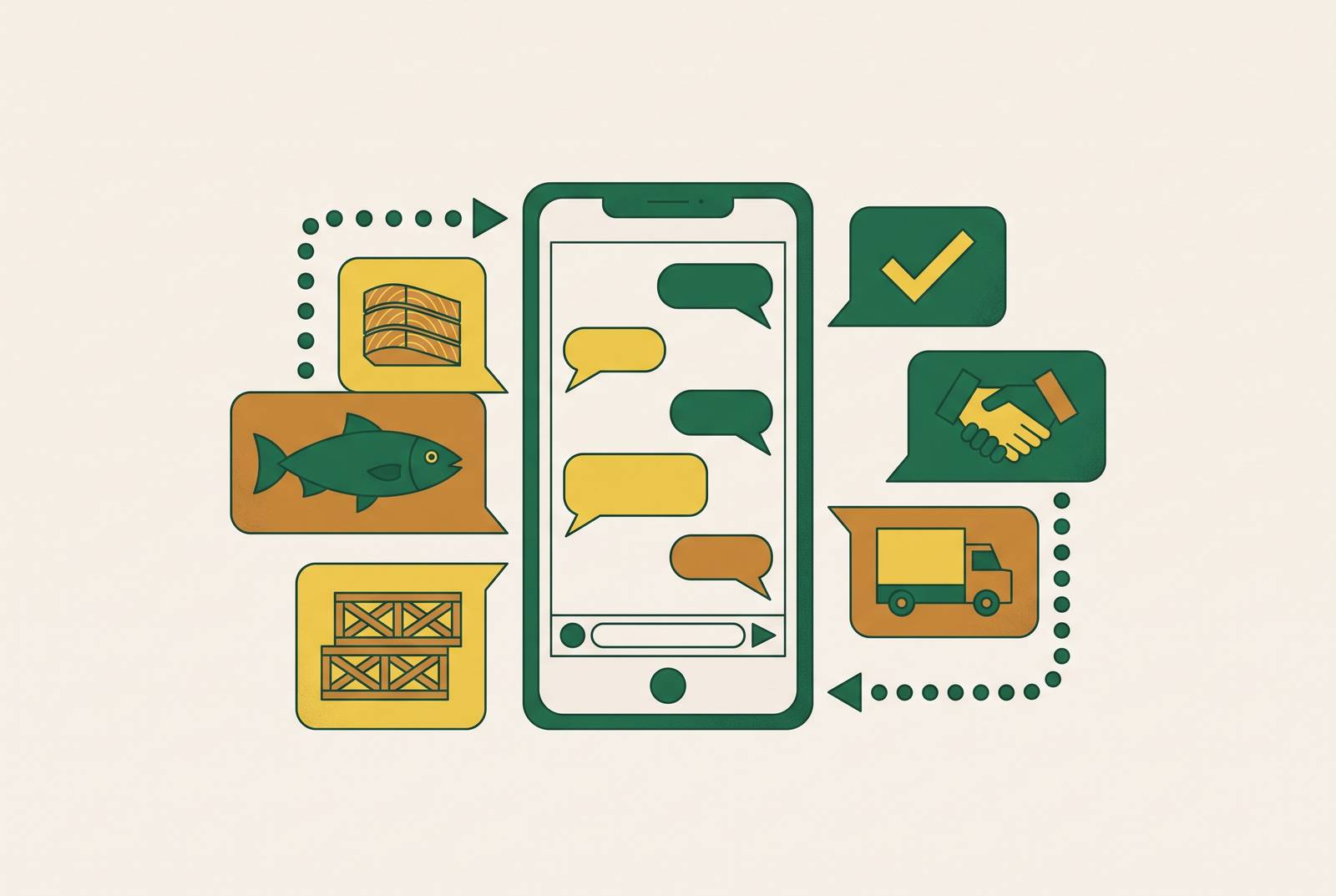
Messaging apps did not become the default channel for seafood ordering because distributors chose them. They became the default because they removed friction at the exact moment a buyer is least able to tolerate any: standing in a walk-in cooler, phone in one hand, inventory sheet in the other, deciding what to send before the kitchen opens.
WhatsApp and text as the default ordering channel in seafood distribution
Picture a chef moving through a walk-in at 7 a.m., checking stock against the day's covers, or a purchasing manager for a hotel kitchen walking the cooler with a clipboard and a phone wedged against one shoulder. These are the conditions under which a seafood order actually gets placed: in motion, under time pressure, often with wet or gloved hands, and with three other tasks competing for attention before the kitchen opens for service. Whatever channel receives that order has to work inside those conditions, not around them.
In practice, buyers have three paths available. They can call a distributor and read the order aloud, they can log into a B2B portal and enter it item by item, or they can send a text or WhatsApp message to a sales rep they already know. The third option is what happens in most markets, and the reason is not complicated. A phone call requires a human to be available and attentive at both ends, and it degrades quickly in a noisy kitchen. A portal asks the buyer to stop, open an app or browser, search a catalog that was not built with their shorthand in mind, and manually rebuild an order the system has no memory of. A WhatsApp message asks nothing new of the buyer at all: they open a thread they already have open, type or speak what they need, and move on.
That asymmetry decides the outcome before any distributor weighs in on it. Switching to a portal requires the buyer to change a habit formed over years of ordering from the same person. Sending a text requires no behavior change, and that is why the sales rep's personal phone, not any purpose-built ordering system, has become the dominant intake point for seafood orders across the industry.
How seafood orders read in a message thread
A seafood order sent over text looks, to anyone outside the trade, like a loosely organized list. Read closely, it is closer to a compressed technical specification, written in a shorthand that assumes the reader already knows the catalog, the grading conventions, and the account's history.
Consider a real order thread from a sushi buyer: three cases of hamachi graded 10/12 sashimi grade, forty pounds of salmon fillet specified skin-on, two cases of shrimp graded 16/20, one case of Hokkaido uni trays, six dozen Kumamoto oysters, ten pounds of dry scallops graded 10/20, and two toro loins specified as "the same cut as last time." The message closes with a delivery instruction, before 9 a.m. to the back entrance, and a conditional instruction attached to a single item: if the Hokkaido uni is unavailable, text before substituting. That is eight distinct line items, three different count-size grades, a market-form specification, a reference to unwritten order history, a delivery constraint, and a conditional substitution rule, all inside one message a rep has to read correctly on the first pass.
The count-size grades carry the most operational weight in that message, and the easiest to misread. A grade like 16/20 or 10/12 tells a buyer how many individual units fall within a pound. The smaller the number, the larger the item, an inversion that trips up anyone unfamiliar with the convention. Get the grade wrong and the kitchen receives shrimp or hamachi sized incorrectly for the dish it was ordered for.
Language adds another layer on top of the shorthand. Orders placed over WeChat in particular can mix English product terms with instructions in another language inside the same message, a delivery note written in Japanese, for instance, appended directly after an English list of seafood items. A rep reading that thread has to parse both the product shorthand and the instruction wrapped around it, in two languages, without losing either.
Voice notes complicate the picture further. In markets where WhatsApp ordering has taken hold, a meaningful share of B2B order volume now arrives as spoken messages rather than text, and a chef walking a cooler while recording one will speak over extraction fans, running water, and kitchen conversation in the background. The content itself resists easy parsing even without the noise: informal quantities like "the usual" or "double what I got last week," mid-sentence corrections, and six or more items run together in thirty seconds of speech.
The phrase "sashimi grade," which appears constantly in these threads, illustrates how easily this shorthand gets misread even by people who think they understand it. It sounds like a formal grading designation, the kind a regulator or certifying body would define, but it is an informal quality descriptor used industry-wide with no fixed standard behind it, and it carries no bearing on the separate requirement that any fresh seafood intended for raw consumption undergo parasite-destruction processing, a food-safety rule that applies regardless of what the chat thread calls the product.
Why ordering in seafood is rarely a single person sending a single message
The complexity does not stop at a single message. A single order from a single account typically arrives as several messages, from different senders, across different channels, spread over hours, and the distributor has to reconstruct one coherent draft out of all of it.
Commercial kitchens divide ordering responsibility by role. A head chef might specify the proteins and fish, a sous chef adds dairy and dry goods, and a pastry chef sends a separate message for baking supplies, each from a different phone, at a different time of day. This pattern, sometimes called cart delegation, solves a real operational problem inside the kitchen: no single person has to track every category of inventory. For the distributor receiving these messages, though, it means an order does not exist as one object until someone manually stitches the fragments together.
The same account can also order across several channels in sequence rather than at once: a call placed at 10 p.m. the night before, a follow-up text to customer service the next morning, and an email that arrives an hour later with a slightly different version of the same list. Each new message forces a judgment call: is this the same order restated, an amendment to it, or a separate duplicate order that happened to land on the same day? Some accounts still send faxes. Some use an ERP portal for part of their volume and text a rep directly for the rest. Some send WhatsApp voice notes exclusively. All of these can coexist inside a single customer relationship, and a distributor handling even a modest book of accounts ends up managing order intake from calls, voicemail, email, text, WhatsApp, and WeChat simultaneously, a condition that functions as the operating norm.
Recurring-order language compounds the difficulty. A message that says "the usual" or "same as last week but double the seafood, we have an event Saturday" carries no information on its own. It only means something against a specific account's actual purchase history, and a rep without instant access to that history has to guess, ask, or dig back through old threads to reconstruct what "the usual" actually contains.
What manual processing of these threads costs a distributor
The sales rep's personal phone solves the buyer's problem and creates a different one for the distributor: every order now depends on one person correctly transcribing a flood of fragmented, multilingual, shorthand-heavy messages into an ERP system during the busiest hours of the morning.
CUT Every handoff in that process, from voice note to notepad to ERP entry, is another opportunity for a number or a grade to get transposed. And when orders live inside a salesperson's personal inbox or phone rather than a shared system, the account's preferences, substitution rules, delivery instructions, and order history leave the business the day that person does.
Seafood makes the cost of any single error in that chain unusually severe. Fresh product has to be held within a narrow temperature range through the entire transit chain, and frozen product has to stay at its own specified threshold. A shipment, once dispatched, cannot simply be corrected if something was misread. A count-size grade entered wrong, a market form mixed up (shell-on sent where peeled was ordered), or a substitution flag missed entirely results in product that cannot be used by the kitchen that ordered it and cannot be returned to inventory. A detail that only surfaces late, an incomplete product code, an unspecified pack size, turns into a picking error or a missed delivery window, and the damage lands on the customer relationship as much as on the margin.
Why the industry has been slow to move orders off messaging threads
Distributors have not systematized WhatsApp and text ordering, and the reason is not that the problem went unnoticed. The tools built to replace these channels have consistently failed to match what the channels actually do.
Most B2B portals and ecommerce platforms are built around structured inputs: a SKU field, a quantity field, a delivery-date field. None of that structure has anywhere to put "the usual," or "same cut as last time," or a thirty-second voice note listing six items with a correction halfway through. The input format the software expects and the input format the buyer actually sends do not match, and the software, not the buyer, loses that mismatch every time.
Generic order management systems run into a second wall even when the message itself is clear: they lack the catalog knowledge to resolve seafood's own shorthand. A count-size grade, a dry-pack scallop designation, a sashimi-grade species code, each of these has to be matched against a live SKU catalog that carries catch-weight pricing, grading logic, and substitution rules specific to that distributor's inventory. Most systems leave that matching step to a staff member to do by hand. The software has automated almost nothing; it has just moved the manual work from one screen to another.
There is also a relationship cost to forcing the issue. In a trade built on long-standing rep relationships, where a buyer has ordered from the same person for years, asking that buyer to abandon the thread and log into a portal risks the account itself. Distributors have generally chosen to absorb the disorder of messy threads rather than risk losing a customer over a login screen. Every tool built so far has tried to replace the channel outright, asking both the buyer and the rep to change how they work, and that is the design choice that has produced resistance from both sides.
What a system that works with these threads looks like
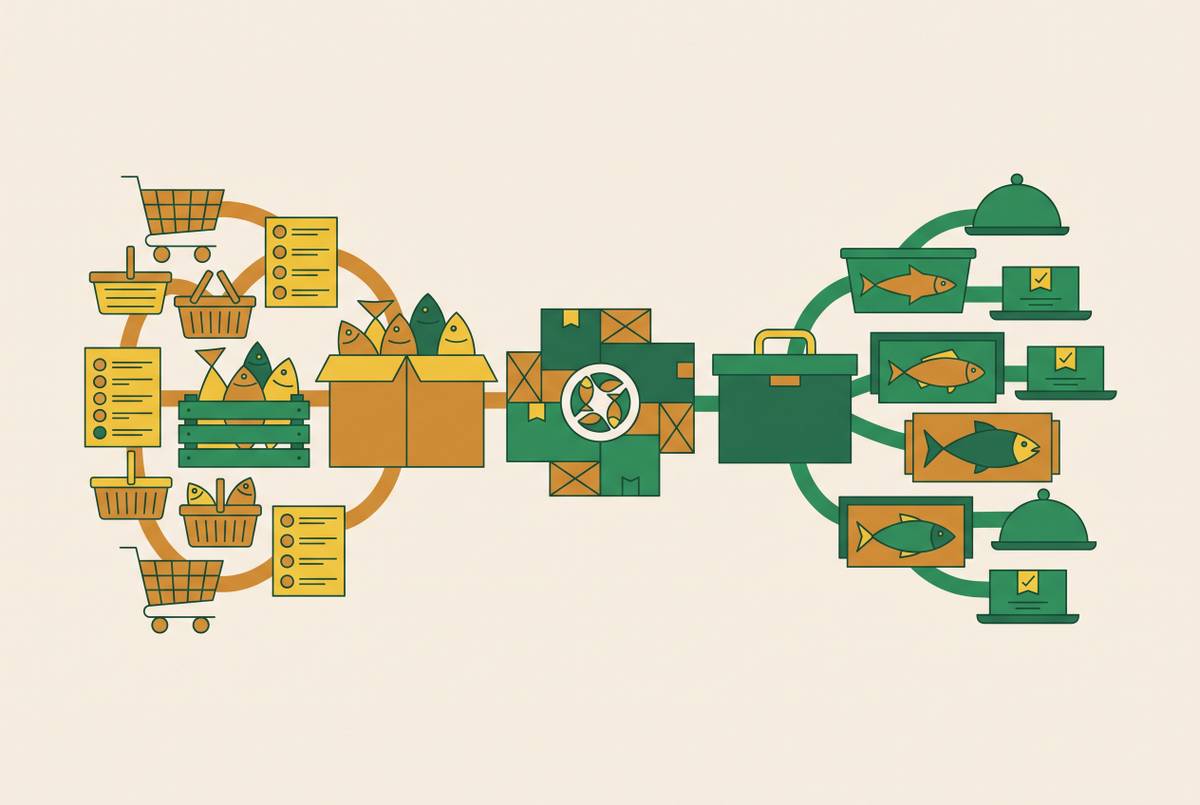
The approach that fits how seafood buyers order is a layer placed behind the channel that already exists, one where the buyer keeps texting or sending voice notes exactly as before, and an AI agent handles the interpretation, the catalog matching, and the draft creation before a staff member ever sees it.
The WhatsApp message to a rep's personal account solves the buyer's friction problem, since there is no portal to navigate and no hold time to sit through, but it leaves the distributor with a rep retyping every message into an ERP by hand during the busiest hours of the day. Tools built to accept an order exactly where it lands and convert it into a structured draft without that retyping step preserve the frictionless experience the buyer already has while removing the bottleneck on the distributor's side.
The technical requirement underneath this is disambiguation against a live catalog, not transcription. An agent handling the hamachi order described earlier has to resolve a species-grade-format string against the distributor's actual SKU list, apply catch-weight pricing correctly, recognize and flag the conditional substitution rule attached to the Hokkaido uni, and produce a structured draft, all before a staff member approves a single line of it. The complexity of seafood shorthand, count grades, multilingual delivery instructions, informal quality terms like "sashimi grade," and voice notes recorded over running water and extraction fans, is precisely the kind of industry-specific language that generic order systems were never built to parse. A system trained specifically on seafood distribution patterns can work through a thirty-second voice note mixing English and Chinese with the same accuracy as a rep who has handled the account for years, turning it directly into structured order data without a manual retyping step in between.
Fragmentation across senders and channels requires the same kind of judgment a rep would apply manually: recognizing that a text from the sous chef and an email from the head chef an hour later belong to the same order, deduplicating overlapping items, and flagging genuine conflicts for a human to resolve. Systems designed for this kind of food distribution work can identify when separate messages belong together, catching the gap that otherwise turns reassembly into a manual retyping job every morning.
Asakana works this way, reading orders from text, WhatsApp, WeChat, email, and voice channels and pulling them into one workflow without asking the buyer to change anything about how they order. It integrates into the ERP a distribution team already runs rather than asking them to adopt a new platform, so the draft lands where staff already work, with no retraining and no switch in systems. Human review stays in the loop by design rather than as an afterthought: the agent drafts the order, flags anything unclear, such as a substitution rule or an ambiguous grade, and a staff member approves it before it moves, which matters most in a category where a dispatch error cannot be corrected once the truck leaves. The policy on data is stated directly: customer and business data is never used to train shared AI models, a distinction that matters in a trade where ordering patterns, substitution preferences, and pricing tiers are themselves competitive information a distributor has every reason to protect.