USDC Lot Inspection Grades for Frozen Seafood
Understand NOAA's voluntary grading system before accepting frozen seafood into your facility.

Most seafood sold in the United States carries no federal quality inspection. That's the baseline fact distributors need to sit with before anything else: unlike chicken, beef, and pork, which fall under mandatory USDA inspection, seafood moves through the supply chain without any government agency checking it, unless a company pays for that check itself. When a lot does carry a USDC grade mark, that mark exists because someone chose to buy it, and understanding what it certifies, and what it doesn't, separates a purchasing desk that reads documentation correctly from one that's just trusting a label.
The program behind those marks is NOAA's Seafood Inspection Program, still widely called the USDC Seafood Inspection Program because of the marks and certificates it issues under that name. It runs under the Agricultural Marketing Act of 1946 and the Fish and Wildlife Act of 1956, reorganized into NOAA's hands by Reorganization Plan No. 4 of 1970, and regulated today at 50 CFR Part 260. A final rule effective January 15, 2025 (published in the Federal Register on December 16, 2024) codified how NOAA administers the voluntary program, showing that it remains an active, actively enforced regulation. It's active, and it gets updated.
The two marks distributors will see on product and what each one certifies
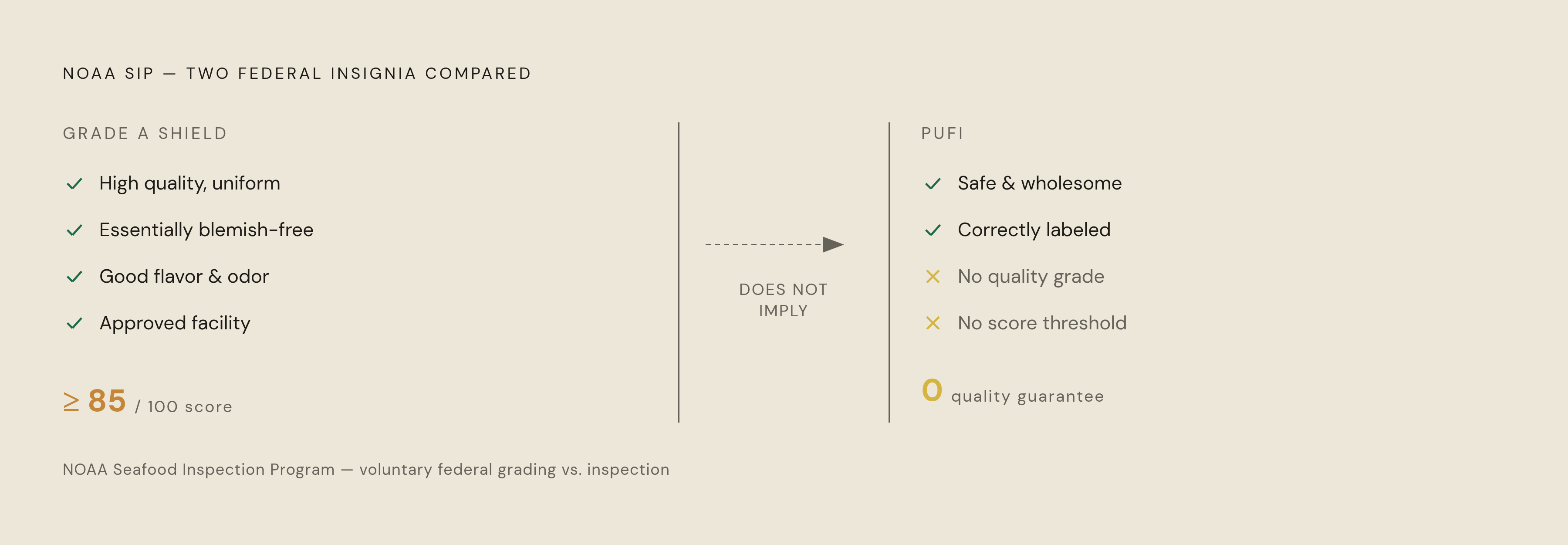
NOAA SIP issues exactly two quality insignia, and mixing them up costs money and credibility.
A federal agency responsible for grading standards. Grade A Shield means the product is high quality, uniform, essentially free of blemishes and defects, in excellent condition, and good on flavor and odor. To earn it, product has to be processed under federal inspection at an approved facility and hit an established grade standard for its category. The Processed Under Federal Inspection mark, PUFI for short, means something narrower: the product was inspected at an approved facility and found safe, wholesome, and labeled the way it's supposed to be. PUFI says nothing about whether the product is Grade A. It's a wholesomeness and labeling check.
That distinction matters the moment product hits the receiving dock. A distributor looking at a purchase order needs to know which mark applies to which SKU, because representing a PUFI lot as Grade A to a downstream customer is a mistake with real consequences.
It's illegal to put "USDC Approved Establishment," "Processed Under Federal Inspection, U.S. Department of Commerce," or any reference to a federal agency's involvement. Grade on product that hasn't actually been inspected under these regulations. That's a counterfeiting risk, and it's exactly the kind of thing a distributor should be checking supplier paperwork against, not assuming.
How the grade hierarchy is structured: Grade A, Grade B, Substandard, and what separates them
The scoring starts at a perfect 100 and works downward. Every defect an inspector finds gets a point value, those points get totaled, and the total gets subtracted from 100. What's left is the score, and the score determines the tier.
U.S. Grade A requires a score of at least 85 points, and good flavor and odor. Both conditions have to be true at once. U.S. Grade B requires at least 70 points, and at least reasonably good flavor and odor. Anything below that floor, but still meeting the basic product description, gets labeled Substandard.
Flavor and odor is where this system gets interesting, because it functions as a gate rather than just another line item on the score sheet. It's a gate. Inspectors evaluate it organoleptically: they actually smell and taste the cooked product, and that evaluation runs independent of the point total. Good flavor and odor, the Grade A threshold, means the cooked product tastes and smells the way that species should, with no rancidity, no bitterness, no staleness, no off-flavors of any kind (that specific language governs breaded fish products; plain fillets use a slightly different standard, requiring flavor "characteristic of" the species and freedom from staleness and off-flavors, without calling out rancidity and bitterness by name). Reasonably good flavor and odor, the Grade B threshold, is looser: it just needs to avoid anything genuinely objectionable.
A lot can score 90 points on the defect table and still fail to reach Grade A if it doesn't pass the flavor and odor check. A lot can score 90 points on the defect table and still fail to reach Grade A if it doesn't pass the flavor and odor check. The number doesn't override the smell test. The smell test overrides the number.
All of this lives in Part 5 of the USDC Seafood Inspection Manual, updated as recently as November 2024, and it runs through a long list of species and product categories: catfish, chilled or frozen shrimp, fish fillet blocks, frozen fried fish portions, frozen fried fish sticks, frozen raw breaded and fried scallops, frozen raw breaded shrimp, frozen raw scallops, general fillets (revised November 2024), halibut steaks, headless dressed whiting, minced fish blocks, raw breaded fish portions and sticks, raw fish portions, salmon steaks, and whole and dressed fish. Each one has its own defect table. A distributor who buys across several of these categories can't assume the thresholds that apply to shrimp apply to fillet blocks. They don't, because each category's defect table sets its own thresholds.
How defect points are assigned: the scoring mechanics behind the number
Inspection happens in two states, frozen and cooked, and different defects get checked at each stage.
Take frozen fried fish portions as a worked example, since the manual spells this one out clearly. In the frozen state, inspectors look at package condition, meaning excess oil, loose breading, loose frost, and dock points accordingly: a small degree of the problem costs 3 points, a large degree costs 6. Broken portions, defined as a break or cut greater than half the width or length of the piece, cost 10 points each. The sample unit for this category is 10 frozen fried fish portions, pulled at random from one or more packages in the lot.
Before any of that scoring even applies, there are pass/fail minimums that have nothing to do with the defect table. Frozen fried fish portions have to weigh more than 1½ ounces and measure at least three-eighths of an inch thick. They also have to contain 65 percent fish flesh by weight, determined by the official end-product method. That's a compositional floor, not a deduction, and a product that fails it doesn't get graded at all, no matter how clean the rest of the lot looks.
Shrimp works differently. Instead of a simple point-deduction table, the scoring approach differs from the simple point-deduction table used for frozen fried fish portions. It's a different computation entirely, which is really the broader point: the scoring mechanics aren't universal across the manual. They're built product by product.
Then there's the deviant sample rule, which governs whether the lot as a whole gets confirmed at its grade. A lot passes when the number of sample units classified as deviants stays under the acceptance number set in the applicable sampling plan. One bad piece in a sample doesn't sink the lot. The system has built-in tolerance, with defined limits on how much tolerance it allows.
The practical upshot for anyone buying seafood: a lot can rack up point deductions across several categories and still be at 85, still earn Grade A. The grade is a floor, not a claim of perfection. A distributor who actually understands the defect table can read a certificate of inspection and know what it's really saying, instead of treating the grade stamp as a blunt pass or fail.
How a lot gets inspected: the workflow from request to certificate
There are two ways product gets into this system.
Lot inspection, sometimes called non-contract inspection, applies to a specific lot in which the applicant has a financial stake. It results in an official certificate covering that lot alone, and it's the only route available for product coming from processors that aren't approved by the relevant certifying body, including a large share of imported seafood. Approved Establishment inspection is different: it's a standing, contract-based relationship where a facility operates under continuous or periodic federal inspection, and the facility itself gets to carry USDC marks on all its eligible product.
As of October 1, 2024, every lot inspection request has to go through NOAA's Seafood Inspection Services Portal, SISP, online. Requesters specify what kind of inspection they want, net weights, quality and condition, counts, check loading, a federal grade such as. Grade A, whatever applies. If a buyer doesn't specify anything, the lot still gets checked against a baseline: the Minimum Acceptable Quality Standard covering Quality and Condition, Flavor and Odor. That baseline protects a buyer even when nobody bothered to write a custom spec.
The physical handling during sampling matters too, because it appears on the paper trail. Cases that samples get pulled from are marked "sampled," or double-stamped and resealed with packing tape. Every sampled case gets "Officially Sampled" stamped on all four sides and the top. Once sampling wraps, the inspector fills out NOAA Form 89-805, the Certificate of Sampling.
None of this comes free. The basic hourly fee for full-time, contracted, non-HACCP inspection was set at $238.00 per hour effective November 1, 2022, and distributors should check with NOAA directly for the current rate, since fee schedules move. What comes out the other end is an official certificate, and that certificate is the document a distributor actually relies on, for purchasing decisions, for import clearance, and for whatever claims get made to customers downstream.
The audit-based alternative for high-volume approved establishments
High-volume approved establishments producing Grade A or PUFI product have another option: audit-based inspection, which skips having an inspector physically present for every lot.
To qualify, a facility has to build and put into practice a Product Management Plan, a PMP, that proves, lot by lot, that finished product meets the standard for whichever mark it's claiming. Once that plan is approved, the firm can use the USDC SIP mark on every eligible lot the PMP covers, with periodic audits standing in for constant inspector attendance.
National Fish and Seafood, operating under the AFS name, holds this kind of contract with USDC as part of the voluntary program, which subjects the facility to quarterly unannounced audits. Passing those audits is what lets AFS produce and label product as USDC-graded, including both Grade A and PUFI. North Coast Seafoods has described full Grade A compliance as putting a processor in the top 1% of seafood processors nationwide, and that's not just a marketing line. It reflects how few facilities actually clear this bar.
For a distributor evaluating a supplier's claim of USDC Grade A status, the useful question is where that grade actually comes from: a lot-by-lot inspection certificate, or an approved-establishment audit program. The documentation looks different depending on the answer, and so does the verification path.
What distributors can and cannot do with grade marks in labeling and sales
A grade mark on a certificate opens the door to matching claims on the label and in sales materials, but only for the product that was actually inspected. That's a narrower permission than it might sound.
The prohibitions are absolute. No label can carry "USDC Approved Establishment" or "Processed Under Federal Inspection, U.S. Department of Commerce" language for product that wasn't inspected, and no statement referencing a federal certifying body's. Grade can appear on uninspected product, full stop. Fish and fishery products that weren't processed under federal inspection simply can't be approved to carry grade or inspection marks. Lot inspection is the only path open to product from non-approved establishments, and even then, the resulting certificate covers just that one lot, nothing broader.
A supplier invoice that mentions "Grade A" with no NOAA certificate attached is an unverifiable claim, and distributors should treat it that way. The certificate is the actual document. The label is just a summary of it, and summaries can be wrong.
There's a real payoff to getting this right, though. Institutional buyers, foodservice operators, school nutrition programs, healthcare procurement, often specify USDC Grade A outright, and distributors who can supply certified product with the paperwork to back it up get access to a buyer segment that's closed to everyone else. Part 5, Chapter 4 of the manual covers Child Nutrition labeling requirements specifically, for anyone selling into that channel. On the export side, Part 5, Chapter 6 addresses international sales, and USDC certificates may carry weight with international buyers, which matters for distributors running international accounts.
Reading a USDC grade in the context of the broader product spec: what the grade does not tell you
Grade A certifies quality against a defect table and a flavor and odor standard, for the specific lot that got inspected. It doesn't tell a buyer everything else that matters.
It doesn't specify species, since Part 5 sets out separate standards for different product categories and grades don't carry across them. It doesn't speak to every commercial specification a buyer may require. It says nothing about glaze percentage either, and that one has real financial weight: IQF product often carries a glaze that adds to the shipped weight, industry practice draws a line between net fish weight and glazed-as-shipped weight, and higher glaze levels have to be declared. A Grade A stamp doesn't tell a buyer the net weight is what they think they're paying for. It also doesn't distinguish IQF from block frozen format, and those are operationally different products even sitting at the identical grade. Origin, harvest method, and sustainability certification sit entirely outside the grading system too.
Buyers aren't stuck with just the minimum, though. Specifications submitted through SISP let a distributor or importer layer extra inspection criteria on top of the baseline grade standard, and the inspector applies those specs right alongside the grade check. Chapter 2 of Part 5 sets minimum flesh content requirements, and Chapter 3 covers official cooked fish yields, both separate tables that matter enormously for portion-cost and yield math on the foodservice side. A distributor buying for that kind of account needs the grade certificate and the flesh content data, not one or the other.
And the grade only speaks to the moment of inspection. It says nothing about what happens to the product afterward, temperature control, storage conditions, thaw management, all of that sits entirely on the distributor's side of the ledger. Grade A opens doors in a lot of procurement conversations, and in some categories it's close to a requirement for premium placement. But it was never meant to function as a complete purchase spec on its own, and distributors who treat the defect table and its limits as working knowledge, rather than fine print, write cleaner purchase orders, avoid more receiving disputes, and represent their product to customers with a level of accuracy that a grade stamp alone can't provide.