Turning After-Hours Voicemail Orders Into Seafood ERP Drafts Overnight
Automation turns late-night seafood voicemails into ERP orders overnight.

Voicemail and phone order transcription for food distribution requires three steps to turn a customer’s message into a usable ERP draft overnight. The workflow must transcribe the recording accurately, interpret seafood-specific grades and catch weights, and write the result into the ERP’s existing fields. The right output is a draft ready for human review before the morning pick window.
Why voicemail orders persist in seafood distribution after hours
Restaurant and foodservice buyers walk their coolers during or after service, when the distributor’s order desk is no longer staffed. They decide what to buy outside office hours as part of that routine, with no earlier order missed. Seafood inventory follows an equally irregular clock. Product lands when the boat lands, catch registers arrive by text from vessels, and the available stock may have only days to sell.
That mismatch becomes concrete at 5:40 a.m., when a voicemail is written on a pad and typed into the ERP by someone who was not on the call. The person entering it must reconstruct what the buyer meant while the time available for picking contracts. There is little room for clarification. The most time-sensitive orders can therefore arrive in the format that requires the most work before anyone can act on them.
What the manual chain from voicemail to ERP actually costs
The manual chain starts with listening to the voicemail, often twice, before decoding shorthand, matching items to SKUs, and keying the lines into the ERP. Each handoff consumes time before the pick window closes. It also creates another opportunity for an error. Across a steady volume of orders, listening, callbacks, and re-keying become a substantial labor load. As the number of accounts grows, the work grows at about the same rate.
The consequences extend beyond the order desk because the ERP line directs picking, invoicing, and delivery. A rep who types “16-20 count” shrimp as “10-20” changes the product requested by a kitchen ordering for Saturday service. The mistake travels with the order. If the voicemail was not processed until the morning shift started, the pick line already has less time to absorb a correction. In seafood, that delay also competes with the short period in which the product can be sold.
Orders held in a salesperson’s inbox or on a personal phone may become inaccessible when that person is absent or leaves. One employee may know the shorthand while the order data has no way to show what it means. The operational cost is therefore more than entry time. The business also has to rely on those people being available when orders need to be processed outside staffed hours.
Step one: transcribing a seafood voicemail accurately enough to work from
Seafood transcription begins with recordings made in kitchens and on docks, where background noise can obscure the words that distinguish one order from another. Messages may arrive in Chinese or use mixed-language shorthand, and buyers may omit quantities that seem obvious to them. A voicemail cannot answer a follow-up question itself. The transcription stage must therefore preserve what was actually said without treating missing information as though it had been supplied.
Species names, grades, and units need extra care because a small change can change a whole line. Halibut and haddock must remain distinct under noise, while “tilapia” and “talapia” require recognition of the intended species name. Rapidly spoken “sixteen-twenty” or “sixteen to twenty” must retain the numeric content needed for later interpretation. Units are equally important to preserve accurately. Pieces, pounds, kilograms, boxes, and cartons cannot disappear from the transcript merely because the product name was captured correctly.
A recording rendered with its count grade, quantity, and unit intact gives the next stage something reliable to interpret. A dropped grade leaves an ambiguity that later processing cannot resolve from the transcript alone. If the error instead produces a plausible but incorrect word, the next stage may have no indication that anything was missed.
Step two: interpreting catch-weight and species-specific shorthand
Even when the transcript is right, some of its terms need to be read in light of how seafood is bought. Finfish may be whole round, gutted, head-on or headless, fillets, portions, or loins, with further distinctions such as skin-on, skinless, and pin-bone out. Shrimp introduces HOSO, headless shell-on, peeled and deveined, tail-on or tail-off, and raw or cooked. Each combination can point to a distinct SKU, so interpretation must preserve form and preparation.
Shrimp grades express pieces per pound or per kilogram, with count grades specifying a range and U-grades specifying an upper limit of pieces per unit weight. Whole fish and fillets instead use weight bands. The buying standard supplies the necessary frame of reference. A spoken shrimp grade must be read with its unit and the standard enforced by US foodservice buyers, since the number alone leaves out that context.
Frozen glazed product introduces a separate question about what the weight includes. If the message leaves out whether price and weight refer to net, deglazed product or gross weight, part of its meaning is still unclear. That ambiguity can become a pricing dispute. It needs to be resolved or flagged before the draft is written, rather than hidden behind a product description that otherwise looks correct.
Catch weight needs to show two measurements at once, standard units such as boxes, cartons, or pieces and actual weight in kilograms or pounds. Ordered quantity, shipped quantity, and invoiced quantity may legitimately differ. “Two boxes” does not specify how much the product weighs. Foodline AI tracks ordered weight, shipped weight, and invoiced weight as three separate numbers so that variances remain visible.
BlueTrace’s roadmap identifies multi-channel parsing of email, photos, and voicemail that extracts items, matches SKUs, confirms units, and places the order into the system. The proposed capability connects that work to per-customer pricing and delivery-window logic. An experienced rep already makes many of these connections. However, knowledge held in a rep’s head for familiar accounts is not automatically available to the ERP, or available at 11 p.m. when the message arrives.
FSMA 204, the Food Traceability Rule, lists finfish, crustaceans, and molluscan shellfish, including bivalves, and has a compliance deadline of July 20, 2028. Misidentifying species, grade, or origin can disrupt a traceability chain that runs back to the vessel.
Step three: writing a structured draft that maps to existing ERP fields
A correctly interpreted order becomes useful only when its values reach the fields the ERP expects. The item must be identified by the correct SKU, and quantity must use the unit against which the ERP prices it. Catch-weight values each need their own field so they stay separate. Customer pricing must also remain customer-specific. A draft using list price can be structurally valid while still being commercially wrong.
BlueTrace’s proposed agent design checks requested ship dates against route schedules and cutoffs before writing the draft, and applies per-customer item pricing held in the system. These checks connect the buyer’s request to an executable order. Without them, an accurately captured delivery request may still require a correction call before the pick line can act.
A capture layer writes drafts into an existing ERP for human review, while a fully integrated platform also runs pricing, picking, and invoicing from the same data. Both models are legitimate options for this workflow. The choice depends on whether the existing ERP already handles those functions well and which system holds the authoritative product, customer, and pricing data. When an order has been captured, the business still needs systems for inventory, purchasing, accounting, and invoicing.
Writing into a live ERP also creates a bounded architectural question about prompt injection, where message content attempts to manipulate the output. The defense described for this workflow limits the model to filling a schema, takes prices from the ERP’s pricing tables, and gives the integration user order-write permissions without access to change pricing or credit terms. Incoming words must not become system authority. Human review then governs release, with exceptions presented for approval rather than concealed in an apparently complete record. For catch-weight items, that review can prevent a small variance from cascading into invoicing and settlement errors.
How the three steps connect into a working overnight workflow
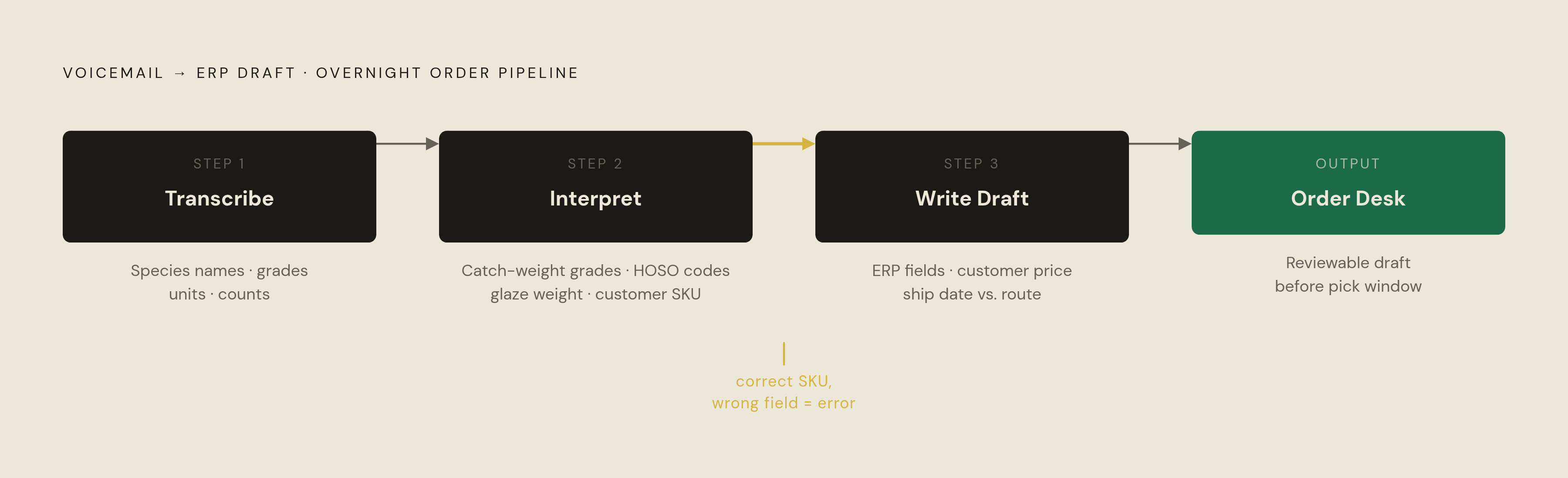
A usable morning draft has the correct item, grade, quantity, and unit, with catch-weight distinctions preserved, customer pricing applied, and the requested date checked against delivery constraints. Any unresolved interpretation is visible for review. The order desk can then assess exceptions before release instead of reconstructing the message from the beginning. The overnight benefit depends on that difference.
A dropped species name or size grade can yield a plausible interpretation that is wrong before the ERP is involved. Matching a shrimp grade to the nearest SKU rather than the correct one produces a clean-looking draft that the pick line cannot catch as incorrect. An output error instead wastes an otherwise accurate interpretation by using the wrong field, list price, or an incomplete catch-weight split. That record may need to be built again before it can be reviewed.
Timing makes these failures more expensive to resolve. The draft needs to reach the morning order desk before the pick window opens, with enough clarity for review and release. A workflow that depends on a correction call after 7 a.m. has already lost the benefit of overnight automation.
How do you evaluate a system for after-hours voicemail orders?
A useful evaluation examines how the system handles each conversion step and where a person reviews the result. For transcription, that means assessing multilingual input, industry-specific phonetics, grades, and units rather than accepting a general claim of voice support. For interpretation, it means examining the catalog and customer context used to resolve the order. “The usual Dungeness” requires more than keyword matching. A distributor’s own catalog and customer-specific order history provide a different basis for resolution than a generic product database.
Ordered weight, shipped weight, and invoiced weight should each have their own field so that a single quantity cannot hide variances. The same scrutiny applies to ERP integration and approval. For a distributor whose ERP already handles pricing, picking, and invoicing well, capture-only integration is the smaller change. The review interface should surface unresolved SKUs, ambiguous grades, and quantities outside the customer’s normal range before release.
BlueTrace’s roadmap connects the specified intake channels with SKU matching, units, customer pricing, and delivery checks, while Foodline AI’s stated catch-weight approach makes the three weight measures explicit. inecta’s seafood AI agent design includes vessel, trip, catch register, and quota context so that freeform information can be interpreted against actual lot and traceability records. Those are distinct capabilities to evaluate against the operation’s needs. A proposed capability should also remain distinguishable from a function already offered.
Channel coverage and data ownership complete the evaluation. The same customer may send voicemail, text, WhatsApp, WeChat, email, handwritten-note photos, and PDFs on the same night, so voice-only capture addresses only part of intake. The distributor’s data on customer ordering patterns, species preferences, and price history helps it compete. The review should check whether that data trains a shared model, whether the system learns from the team’s corrections, and whether captured orders go through pricing and invoicing without a handoff. The decisive test is a reviewable ERP draft by morning.