How Seafood Distributors Handle Overrun and Short Orders
Fast response to catch variability protects both margin and customer relationships.
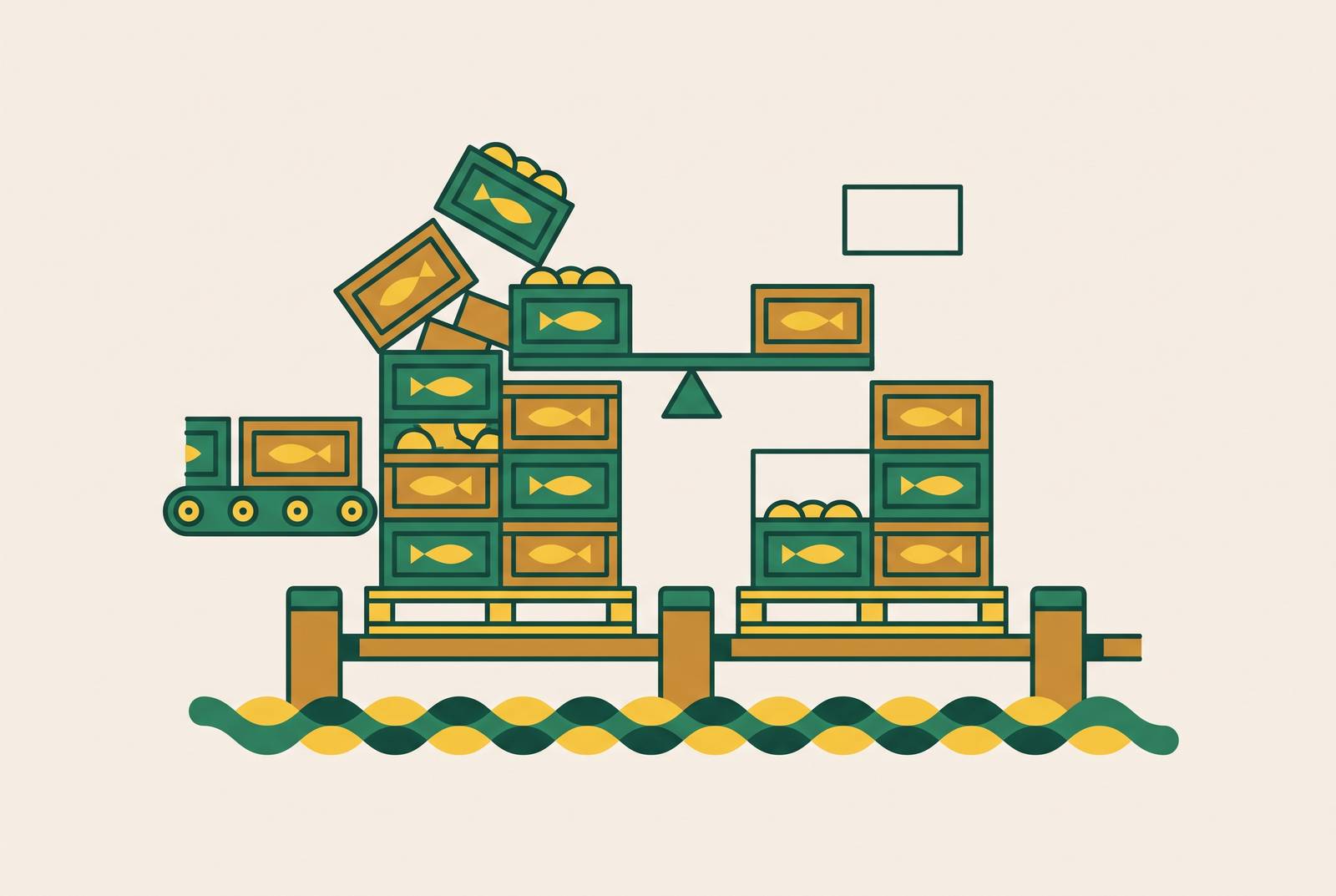
Seafood distributors handle overrun and short orders by checking actual landings against what customers have ordered, selling excess quickly, and using approved substitutions to fill shortages before loading. These are daily operating conditions, and the speed of the response protects margin and customer trust. Voicemail and phone order transcription for food distribution helps them do this when it turns customer messages into structured ERP orders and flags lines that a person needs to check.
Why seafood distribution runs on overrun and short orders, not exceptions to them
The shelf-life clock starts when seafood leaves the water, before the distributor knows exactly what can be sold. Inventory depends on the catch, and the catch does not arrive exactly as expected. Unlike durable goods, this stock cannot wait while supply and demand are reconciled. The gap between the order book and the landing is therefore a structural condition of fishing.
A landing above committed orders creates overrun that must be placed before its value collapses. A landing or stock position below commitments creates short orders that need substitution, partial filling, or notification before the truck loads. Both demand a response in hours. Excess that goes unsold can spoil and eat into margin, while shortages that are handled badly can cost the distributor accounts.
What the spec and the weight system actually look like before triage begins
That response begins with the specification. An order line can combine processing method, size grade, and cut form in shorthand such as “skin on, pin-boned, 2–3kg”. Each element limits what can fill the order or replace a missing line. Grading can therefore reveal a shortage in one SKU and an overrun in another even when the landing’s total weight meets expectations.
Count designations add another constraint. “16–20 count” means pieces per pound for shrimp, and the desk must recognize when a buyer’s “large shrimp” refers to that SKU. Tools for food distribution, including Asakana, are trained to read this language and flag whether the SKU in stock matches. Recognizing the words matters because a missed specification becomes a picking error or a disputed delivery.
Catch weight also means that ordering, picking, and invoicing involve different numbers. A customer orders “6 salmon sides”, the picker records actual weight, and the invoice reflects what was weighed. For frozen seafood, glaze is ice coating rather than product, so gross weight cannot stand in for net product weight. NFI’s October 2022 industry guidance calls for samples to be weighed when they arrive to check net weight, and for suppliers and distributors to agree on how to handle short-weight shipments. Triage must work from those product quantities.
How overrun triage works: placing excess product before shelf life makes the decision for you
Once the landing exceeds commitments, the first task is to connect actual availability with account demand. The person who knows the landing total must also see open account capacity, or share a system with the person who does. Otherwise, procurement holds the supply picture while sales assembles its calls, and the product waits. Overrun is a perishable liability until a buyer commits to it.
The first placement calls go to existing accounts whose standing orders or recent purchases show demand for the species, size grade, or form available. The second pass goes to buyers who welcome opportunistic purchases or regularly accept “whatever’s landed” lines. These spec-flexible accounts can absorb product that does not match a fixed order.
Each offer needs the species, size grade, form, price, and delivery window. A buyer deciding at 5 AM needs another conversation before acting on a message that is vague about what is available. Fast placement at a modest discount can preserve margin, whereas waiting until a steep discount is unavoidable sacrifices it and teaches buyers to expect distress pricing. Standing “day-boat special” lines reduce the need for separate placement calls by giving surplus a ready destination.
The order book and pricing must reflect the landing as these decisions happen. For example, automated capture systems such as Asakana convert inbound texts, emails, and calls into structured order data, freeing staff for placement calls and negotiation. The automation removes typing that would otherwise consume selling time.
How short order triage works: substitution sequencing and what happens before the customer finds out
Short-order triage begins with when the gap becomes visible. A shortfall found while the landing is graded and weighed gives the desk hours to respond. Finding the shortfall at the pick face leaves minutes to fix it, while finding it after loading is too late to fix it before the truck loads.
When a short still reaches the pick face, the protocol depends on an approved substitute. The picker replaces the missing line on the spot within that approval. The substitute takes that customer’s own price for the line being replaced. This prevents the distributor’s shortfall from becoming an unexpected price penalty for the buyer.
The replacement also needs a line note recording what it replaced and why. The bill then has to show what was actually picked in place of the product that was ordered but unavailable. These steps link what is shipped to the account price and the invoice. Without that link, even a replacement the buyer accepts can lead to a dispute over the bill.
Approval remains bounded by the customer’s specification. A different cut or size grade is not an equivalent merely because it is available in the warehouse. Where the shortage cannot be resolved through an approved replacement, the desk needs a specific offer. Shorts and unavailable lines across the full pick are gathered into one message when picking finishes, so the customer receives a coherent decision.
Why customer communication around both scenarios follows the same underlying logic
Overrun offers and shortage notices serve the same purpose, which is to give the buyer a decision that can still be acted on. Speed matters because an offer arriving after the menu is set or competing orders are placed has missed its window. Specificity matters because the buyer needs enough information to accept without a follow-up call. Experienced seafood buyers expect catch variability, but they judge whether the distributor handles the resulting excess or shortages or merely reports them.
The message also has to travel through the relationship’s working channel. A buyer ordering through WhatsApp at 4 AM may not be checking email at 6 AM. Sending a complete offer to the wrong place can therefore have the same practical effect as sending it late. This makes communication dependent on intake, because the desk needs both the order details and the channel context before it can respond.
How multichannel order intake makes triage harder and slower than it needs to be
Orders arrive through email, WhatsApp, voice notes, text, phone calls, and voicemail, often before the desk is staffed. Staff must resolve product shorthand, find the SKU, check stock, apply account pricing, and enter the order into the ERP. Until that work is done, the desk cannot reliably see which commitments the landing fails to cover.
A short landing therefore collides with the morning entry queue at exactly the wrong moment. Notifications wait behind transcription and entry, narrowing the customer’s substitution window. After-hours voicemail orders create the same bottleneck when staff must listen and re-enter them each morning. Transcription alone leaves that bottleneck in place if staff still have to match the text to a SKU and enter it into the ERP by hand.
Overrun suffers from the same delay in a different way. “Whatever’s landed” orders cannot be finalized until the catch is known, so they can remain queued while more explicit orders are entered first. Those are precisely the flexible commitments that could help absorb surplus. Meanwhile, affected buyers need replies across their own channels. The delay comes from the gap between message arrival and usable order data.
What the ERP needs to hold for overrun and short-order triage to work at all
Even a faster desk makes poor decisions if the actual weights are kept outside the ERP. Catch weight tracked in Excel, manual adjustments, and scale readings re-entered by hand disconnect stock from the figures used for shipping, costing, and invoicing. That separation also weakens confidence in margin. For triage, it means the available quantity can already be wrong when a placement or substitution decision begins.
Overrun placement requires the actual landing weight to appear in real time. Otherwise, sales can offer product that the warehouse cannot confirm through the system. To find short orders during processing, staff need to see each lot in the incoming landing and how it matches open orders. The ERP must keep both pieces and actual weight through each step so staff can trace the original request, what was picked, and the invoice.
Seafood-specific or seafood-configured ERP options include CAI/Seasoft, Aptean/Inecta, NetYield, and Canopy. The system needs to keep this triage record, which matters here more than how many business features it has. It also needs approved substitution mappings at the account level. Without them, a warehouse equivalent can violate a particular buyer’s specification or price arrangement, and the pick-face protocol cannot work consistently at scale.
Where AI-assisted intake changes the triage timeline for overrun and short orders
AI-assisted intake changes the starting point of the morning’s work. Instead of waiting for messages to be entered in a batch, the system extracts orders as they arrive. With catch-weight lines captured, cut specifications attached, and account pricing applied, the desk can begin with structured demand in the ERP. Its attention then goes to exceptions.
When customer phone orders are automatically transcribed into an ERP, speech capture and complete order intake do different jobs. The latter must connect the transcribed request to product codes, account terms, and stock checks. Asakana captures orders across phone calls and voicemail as well as email, text messages, WhatsApp, and WeChat, and processes inbound messages with potential issues flagged for human review. ManualOut describes seafood intake that matches cut specifications to product codes and uses the pricing set for each account. These capabilities address the work that remains after words have been transcribed.
For short orders, earlier structured demand allows stock checks against the landing during processing. For overrun, it lets the desk check what customers have ordered and find accounts that could take the excess without waiting for someone to add up orders by hand. Lines that depend on the catch still need to be checked against the landing. Flagging “whatever’s landed” for review preserves that uncertainty instead of converting it into a guessed product or price.
Human review is therefore a design requirement. A shortfall with a truck loading in two hours is a poor setting for a confident but incorrect automated substitution. Lines that need someone’s judgment must reach the desk with the details needed to make that call. When intake also retains the account’s ordering channel, a substitution offer can return through the appropriate thread rather than forcing staff to reconstruct where the conversation began.
The data quality prerequisite that determines whether triage automation works or fails
This workflow depends on a catalog that gives the system something reliable to match against. Seafood catalogs can contain multiple descriptions for the same product, while requests such as “the usual cod” depend on customer history. Automation needs a clean catalog and enough training history to match those references to the right products reliably. With poor data, automation can be expected to choose the wrong substitutions under the same time pressure that makes it appealing.
Product records need to be cleaned up, and approved substitutions need to be mapped for each account. As confidence in those references grows, more lines can pass through automatically. Lines below the confidence threshold still go to the desk with the information needed for an informed decision.
This work can proceed incrementally rather than waiting for every catalog entry to be corrected. Clean the most frequently ordered SKUs first. Build the substitution mappings for the highest-volume accounts next, then expand from that base. The first useful automation boundary is the set of products and account rules the distributor can already describe accurately.