SIMP Recordkeeping Requirements for Seafood Importers and Distributors
Importers must retain two years of harvest-to-entry records to pass SIMP audits.

Seafood Import Monitoring Program (SIMP) recordkeeping requirements reach beyond the customs filing. For seafood importers and distributors acting as importer of record, compliance means connecting a valid permit, harvest-level reporting, and a retrievable chain of custody. Those records must start upstream and be kept for two years after entry. Treating SIMP as paperwork to file at the border can leave gaps in the records and disrupt the supply chain.
What SIMP is and why it applies to seafood importers and distributors
NOAA established SIMP through a final rule published December 9, 2016, to prevent seafood associated with illegal, unreported, and unregulated (IUU) fishing and seafood fraud from entering U.S. commerce. NOAA's National Marine Fisheries Service (NMFS) and U.S. Customs and Border Protection (CBP) jointly administer this federal risk-based traceability program. Its permitting, reporting, and recordkeeping requirements are enforceable obligations. The Congressional Research Service's SIMP report states that, as of FY2023, the program covered approximately one-third of all U.S. seafood imports, amounting to roughly 1.7 billion pounds. Shrimp, tunas, and cods account for the majority of covered imports.
The 13 covered species groups and what triggers SIMP obligations for a shipment
The NOAA SIMP Compliance Guide (January 2024) identifies 13 covered species groups, including Atlantic cod, Blue crab (Atlantic), Grouper, Red snapper, Shrimp, and Tunas. The covered tunas are albacore, bigeye, skipjack, yellowfin, and bluefin. The grouper and tuna designations encompass related species with physical similarities, so a shipment combining species within a covered group still triggers reporting for that group.
For a particular product, coverage is determined by Harmonized Tariff Schedule (HTS) codes. SIMP therefore applies to products classified at customs under covered codes, and misclassification creates exposure even when an importer believes a product falls outside the program. A reliable scope assessment depends on that classification. SIMP is also not a consumer-facing labeling program. NOAA Fisheries states that information collected through the International Trade Data System (ITDS) is confidential.
The International Fisheries Trade Permit: the first gate every importer must pass
Before importing a covered product, the importer of record must have a valid International Fisheries Trade Permit (IFTP) from NOAA Fisheries. Without that permit, no SIMP-compliant entry can be filed. Its number must be on every covered entry filing through the Automated Commercial Environment (ACE), CBP's main electronic system for import data. The permit anchors the audit trail by connecting the responsible entity to the harvest-level information filed and retained.
Responsibility rests with the entity identified to CBP as importer of record on each entry filing. A distributor importing its own seafood purchases takes on the full SIMP obligation, rather than merely responding to a downstream request for documents. That distinction matters because a distributor's commercial role does not, by itself, establish the extent of its regulatory responsibility. If the distributor is named as importer of record for the shipment, both reporting and recordkeeping sit with that entity.
What data must be reported at entry and what it actually requires from the supply chain
The NOAA SIMP Fact Sheet and Compliance Guide (January 2024) set out the harvest and importer information needed for covered shipments. For the harvesting or producing entity, the fields include vessel name and flag state, evidence of authorization to fish or farm, and a unique vessel identifier when available. Authorization may be documented through a permit, farm registration, or license number, and aquaculture records require the name of the farm or facility. Fishing gear types must be reported using the reporting convention and codes of the competent authority, or FAO fishing area and gear codes if that authority has no such reporting requirements.
The fish records must identify the species using the ASFIS three-alpha code, the landing or offloading dates, and the points of first landing. They must also show the product forms at landing or offloading, including quantity and weight. Origin information covers the areas of wild capture or aquaculture harvest, with the farm address for aquaculture. The records must name the entities to which the fish was landed or delivered. These fields require documentation from the source fishery or farm to support entry at the U.S. border.
The importer information includes name, affiliation, contact information, and a valid NOAA-issued IFTP number. The documentation must also cover transshipment through harvesting or carrier vessel declarations and bills of lading, as well as processing, re-processing, and commingling. Suppliers therefore need to be vetted and contracted to provide structured documentation before shipment. When an entry contains seafood from multiple harvest events, information is required for every relevant event. The importer need not specify which portions came from which event, but consolidation still multiplies the records behind a single entry.
Weight reconciliation adds a separate demand. SIMP requires weight at harvest, when the product was first offloaded from the vessel or at the aquaculture facility, while CBP requires the final imported product's weight. Processing or transformation between those points must be documented to explain the difference. A shipment may therefore require at least two distinct weight records plus the processing records that connect them. The task is not to make the figures match, but to preserve the evidence explaining why they differ.
Chain-of-custody recordkeeping: the two-year retention obligation and how audits work
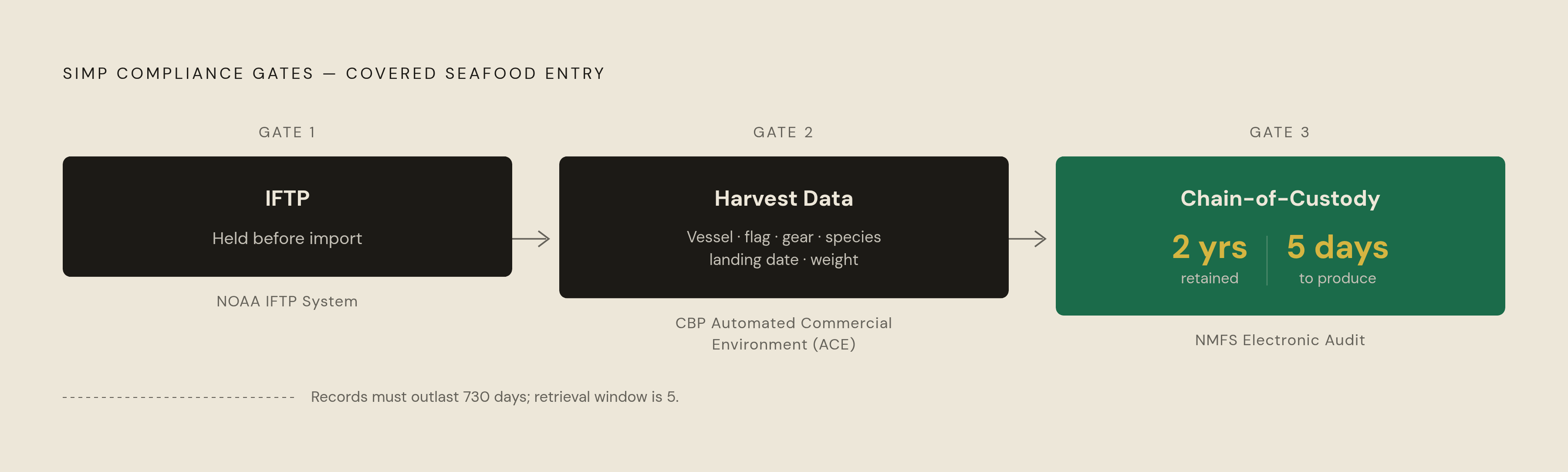
The NOAA SIMP Compliance Guide (January 2024) requires records to be retained at the importer of record's place of business for two full years from the date of entry. Electronic and paper formats are permitted. The retained material must include all information reported at entry and the product's path from harvest through processing, reprocessing, commingling, and transshipment to U.S. entry. NMFS can call for the supporting records during the retention period.
For records provided electronically, the response deadline is five days after receipt of an NMFS record request or audit notification. Paper records have a longer response window, but their permitted format does not reduce the required documentary coverage. The operational test is whether the importer can produce the complete chain for a specific shipment, rather than simply demonstrate that documents exist somewhere. Searchable storage matters because an audit request requires retrieval.
The Congressional Research Service's April 2026 SIMP report notes that only 26 importers were on the SIMP-Compliant Importers List (SIL) as of Q1 FY2026. NMFS established the SIL to recognize a demonstrated history of excellent audit compliance, with reduced audit frequency for listed importers. That small pool is a useful measure of the discipline needed to earn recognition across a program of this scale. NMFS updates the list quarterly, so status reflects an ongoing compliance record.
Where SIMP ends and FDA traceability begins: managing two overlapping regimes simultaneously
SIMP documentation does not provide a complete answer to food traceability obligations. The FDA Food Traceability Rule requires critical tracking events (CTEs) and a Traceability Lot Code for certain seafood products to support rapid traceback during a foodborne illness outbreak. Its focus differs from SIMP's harvest-origin fields, which support verification of catch legality before U.S. entry. The programs also involve different agency relationships, with FDA administering its rule and NMFS and CBP administering SIMP.
For an importer subject to both, the burden is maintaining parallel record sets with different identifiers, data structures, and points of application. SIMP vessel and landing information does not line up directly with FDA records of downstream handling, transformation, and distribution. A distributor that receives imported SIMP-covered seafood and moves it domestically may therefore face FDA duties that the import documentation cannot satisfy. Operationally, the systems must preserve each regime's required information rather than assume that one traceability record substitutes for the other.
Why seafood's operational characteristics make SIMP recordkeeping harder than it looks on paper
With catch-weight variability, the product's quantity can change from the figure used when it was bought. Seafood is ordered by piece and sold by weight, while processing, filleting, freezing, and other transformations separate the harvest record from the imported product. With multi-harvest consolidation, one container can hold seafood with histories from several fishing trips. Manual recordkeeping must preserve those histories while the goods continue to move.
Time pressure makes that work harder. Seafood lands when the boat lands and has a short window to sell, so documentation must keep pace with the product. Species complexity also limits what can safely be inferred from a finished product description. Species within grouper, snapper, and tuna complexes can look alike, so it is important to identify them correctly at harvest.
The MAFAC draft recommendation to NOAA illustrates how species and quantities can fail to match through an anomaly in which a quantity of tilapia is received and a smaller quantity of red snapper filets comes out. The reduction in weight during processing must be considered together with the species records, a task that currently depends on manual processing records.
How structured recordkeeping systems and AI-assisted tools can reduce SIMP compliance risk
Seafood-specific ERP systems that record SIMP fields at receiving can meet the needs for how records are set up, and tools for processing yields and scale-connected packing help with catch-weight reconciliation. General food-distribution functions do not, on their own, establish that the necessary vessel, landing, and processing fields are present. The relevant test is whether the system preserves the data and relationships the importer must report and retain.
AI-assisted intake can also help when information comes in through unstructured communications. Fresho's OrderPilot converts emails, texts, WhatsApp messages, voicemails, and PDFs into structured sales orders ready for approval. Brown Foodservice uses Pepper Order Automation to get more orders right and save its representatives time. These examples demonstrate an intake-automation model, but neither tool natively captures SIMP fields. They are not evidence of complete SIMP compliance.
Applied to shipment documentation, the same model would structure supplier messages, vessel landing notices, and processing records when they arrive. That approach can reduce the inconsistent or incomplete transcription that leaves gaps in a shipment's history. Its value depends on capturing the required SIMP fields, rather than merely converting a message into a generic record. Anomaly detection should then flag possible discrepancies for people to review, including the species-and-weight mismatch in the MAFAC example, while leaving compliance judgment to people.
Whatever system an importer uses, the retained records need to be searchable and retrievable as a complete shipment history. Digitized records make it easier than scattered paper files or saved email threads to meet the two-year retention obligation and five-day electronic response deadline. Structured intake and reliable retrieval address different points in the same process. The former reduces errors as information enters the system, while the latter makes the supporting evidence available when NMFS requests it.
What the November 2024 SIMP action plan and April 2025 presidential directive mean for importers planning ahead
The Congressional Research Service's SIMP report updated April 21, 2026, describes NMFS's November 2024 action plan. The plan aims to strengthen traceability and risk detection, tackle forced labor in the global seafood supply chain, promote fair practices in global seafood trade, and build the capacity to put the program into practice more effectively. In January 2026, Congress directed NMFS “to move forward with implementation of the Action Plan to Improve [SIMP]” in FY2026 through the explanatory statement accompanying P.L. 119-74. Congress also appropriated $6.2 million to NOAA for SIMP in FY2026, giving implementation both direction and funding.
The April 2025 presidential directive creates uncertainty about the scope of future change. It called on the Secretary of Commerce to consider “revising or rescinding recent expansions” and to evaluate and “further improve” SIMP. That directive does not suspend current requirements. NMFS has also indicated its intent to develop a proposed rule considering a two-tiered system, with current covered species and other high-risk species in one tier and all other seafood imports in another. The requirement would extend across seafood imports only once the rule is finalized.
NOAA also plans pre-entry risk screening that would move the requirement to provide data from the point of entry into U.S. commerce to before entry. This would move the documentation deadline upstream and increase the value of structured capture at receipt. Importers should build systems that meet today's requirements and can also cover more species and report data earlier.