Connecting Order Intake Automation to the ERP Your Seafood Operation Already Runs
ERP-integrated order intake automation for food distributors cuts the work of typing in orders by turning customer messages into structured orders in the ERP that already runs the business. For seafood operations, this keeps its value over time only if buyer shorthand, variable weights, and lot references map to that ERP’s own data model. Customers should not have to change how they order, and distributors should not need a replacement system of record.
Why seafood order intake sits at the intersection of the industry's hardest data problems
A customer orders cases, but the distributor invoices weight. The case count can stay the same while the shipped weight changes, so the final invoice can differ from the estimated order value. Daily price changes add another source of variance. DynamicsFoodERP’s supply chain overview explains that shipments arriving heavier, lighter, earlier, or later than expected can affect production plans, customer commitments, inventory value, and margins. The uncertainty reaches beyond the order desk.
That makes seafood a different data problem from fixed-unit food distribution. Catch weight requires the business to preserve two quantities for the same product through fulfillment and accounting. Meanwhile, the buyer may describe that product through species nicknames, U/10 count references, IQF or fresh designations, trim levels, and size bands. Those distinctions identify what must ship. A generic interpretation of the words can lose the specification even when it captures the quantity correctly.
Cold chain pressure makes delayed interpretation a product risk. An order left in an unprocessed inbox overnight is not merely an administrative backlog when product quality depends on timing. Automation therefore has to do more than accelerate transcription. Its connection to the ERP must preserve the product, weight, and allocation rules that make the order executable.
How orders actually arrive at a seafood distributor, and why that fragmentation is structural
Seafood buyers use whichever channel is fastest when they need to order. Text, email, WhatsApp, WeChat, phone calls, and voicemail all belong to that intake landscape, with no single channel dominating the mix. The fragmentation reflects established trading relationships in which long-standing accounts have built their routines around calls and informal messages. Deploying a portal does not make those routines disappear.
Staff must still transcribe the orders that arrive elsewhere, creating a two-track operation in which automation handles only part of the work. Each order that staff still have to type in is another chance to mis-key a product code, weight specification, or delivery address. A wrong weight specification can then affect the accounting for every unit on the order. Multi-channel capture is therefore a prerequisite.
Order intake requires accepting the channels customers already use and bringing their messages into one intake process. That preserves the relationship while removing the need to re-enter each message manually. Turning the captured message into an order that keeps the same meaning when it enters the business system is harder than collection.
How do you automate customer order intake without replacing your current ERP system
The connection must resolve seafood-specific ambiguity before committing an order. Phrases such as “more steak,” “five of the usual,” and “2–3kg skin-on pin-boned” do not identify a reliable order line in isolation. Their meaning depends on the distributor’s catalog and the customer’s ordering history. The automation layer has to use that context to select the exact product code. Passing the original words into a description field does not complete the work.
The resulting line must also preserve two units. The customer orders cases or pieces, while the price is based on pounds or kilograms, and actual invoice weight still needs to be confirmed. E21 ERP’s seafood module describes an architectural capability to support products inventoried in one unit of measure and priced in a variable unit of measure such as pounds or kilograms. The integration must map both quantities into this dual-unit structure.
Each line needs a lot reference when the order is created, and first-expired, first-out allocation must use current inventory at that point. This connects the reservation to the product’s shelf-life clock and supports the bidirectional linkage needed for FDA compliance and recall workflows. The order must be traceable from its creation. An incorrect product code, weight unit, or lot reference undermines the shared operational data before fulfillment begins.
The ERP landscape seafood distributors actually run on, and what each system does and does not support natively
The receiving ERP determines how much translation the connection needs. CAI/Seasoft is a purpose-built seafood distribution ERP covering procurement through delivery, with catch weight and lot traceability embedded in its seafood data model. NetYield is also purpose-built for seafood. An intake layer connecting to either must use the structures already responsible for those functions.
E21 says it has robust catch weight processing and complete bidirectional lot traceability built in for seafood. Its module also supports FEFO/FIFO allocation and integrations for B2B e-commerce and EDI. As a broader food ERP, E21 still requires configuration for the operation, but that does not make its catch weight support a superficial add-on. Aptean and Blue Link are also broader food ERP systems that need configuration to meet seafood requirements.
Canopy serves the broader food and beverage distribution sector with real-time data insights and automation. FoodReady’s platform guide describes a cloud system linking receiving, lot tracking, FIFO/FEFO rules, quality inspections, and sales orders. FoodReady handles financial accounting through integrations rather than a native general ledger, which changes the route from order data to invoicing. These systems offer different integration starting points: purpose-built seafood systems have the native model built in, broader food systems need configuration, and general-purpose platforms need the most work to get seafood right.
What goes wrong when the automation layer and the ERP don't share the same data model for seafood
The first failure appears when catch weight becomes only a product flag. Marking a product as variable-weight does not change the logic used to price or invoice it. If the receiving system lacks variable-quantity invoicing, it can calculate revenue from the estimated order weight, which can differ from the weight actually delivered. The draft may still look perfectly orderly. Across commodity proteins with daily price changes and variable weights, that mismatch can distort invoicing and monthly margin calculations.
The second failure concerns the missing lot reference. An intake layer can display the correct product and quantity while leaving the ERP without the linkage required for FEFO allocation and a bidirectional recall trace. The visible order is complete, but its operational relationships are not. DynamicsFoodERP describes the extra work when systems are disconnected, with purchasing calling the warehouse, sales checking with operations, and finance reconciling afterward. As volume and complexity grow, keeping those separate versions aligned takes more effort.
The third failure is a valid code for the wrong fish specification. Matching “the usual halibut” without consulting the catalog and customer history can select the wrong trim, size band, or origin. Nothing about a valid SKU alone exposes that discrepancy. It may become visible only in a delivery dispute. Language resolution must therefore establish the intended product.
These failures support a legitimate objection to bolt-on AI capture. Even when extraction gets the order right, the receiving system must still be able to price, allocate, and invoice it correctly. The ERP must remain responsible for lots, catch weight, routes, and costs, while the automation layer writes to its data model. Otherwise, faster intake simply moves reconciliation downstream.
What a well-integrated order intake layer actually does at each step from message to ERP record
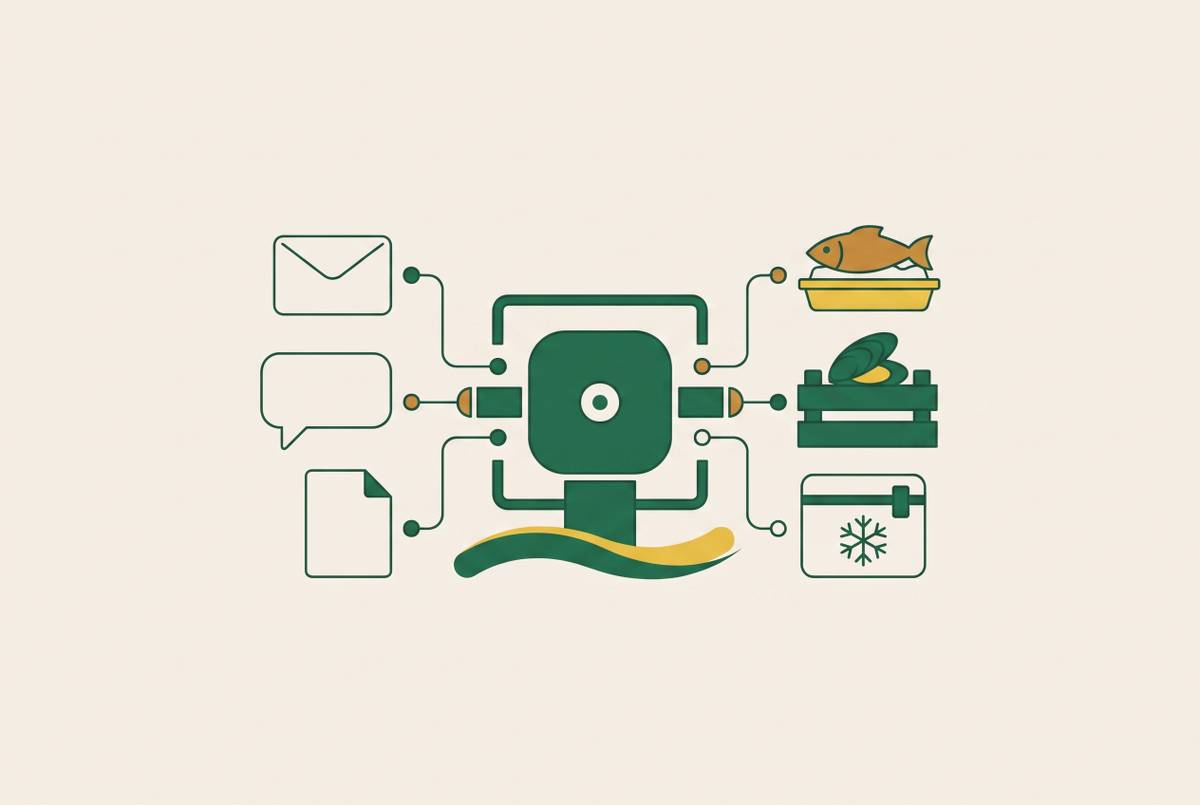
The intake layer receives texts, emails, WhatsApp and WeChat messages, calls, and voicemails, then normalizes the raw message without requiring a new ordering habit. It next resolves the language against the distributor’s catalog and the customer’s order history. Species nicknames, multilingual wording, count references, trim specifications, and size bands all inform the match. “The usual” must resolve to a specific SKU.
Once the product is resolved, the layer structures the quantities. Each line records the ordered unit count and the pricing unit in fields that map to the ERP’s own dual-unit model. It also identifies that actual invoice weight will be confirmed at pick. The layer then queries current inventory, applies FEFO rules, and attaches the appropriate lot reference. This pre-allocation connects the order to traceability and shelf-life requirements before the record is committed.
A person must review the order before the final ERP write. A staff member receives a draft with unresolved or low-confidence interpretations flagged for attention, rather than an apparently confirmed order that conceals uncertainty. This is particularly important when a wrong weight unit would affect downstream accounting. The person reviewing can see what needs confirmation. Automation removes transcription work without bypassing judgment at the point where ambiguity remains.
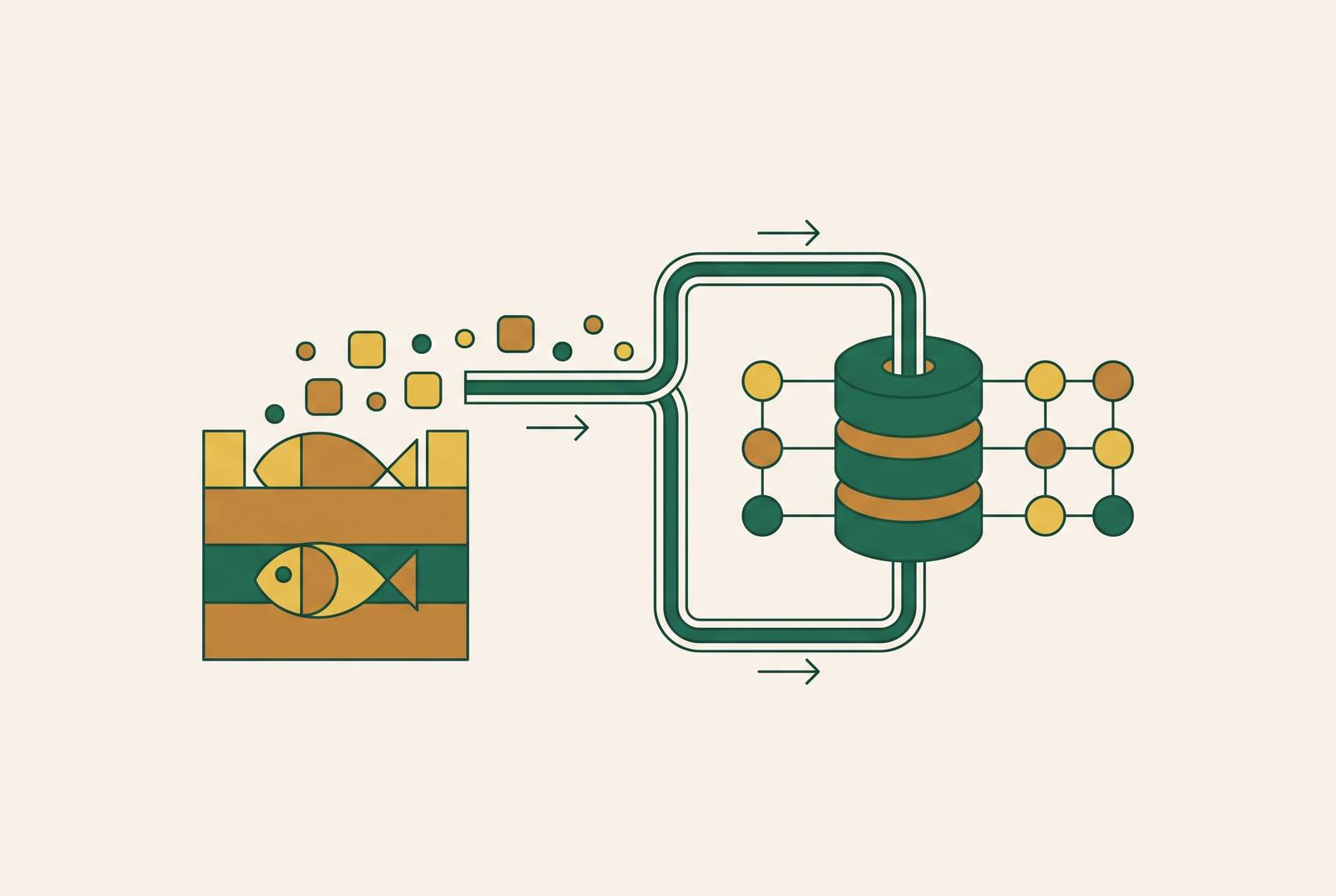
After confirmation, the layer writes a structured order directly into the existing ERP. It does not place the order in a separate system for later synchronization. Warehouse, finance, and compliance teams then work from the record created in the business system, rather than reconciling an intake copy against an operational copy. Pricing, allocation, invoicing, and compliance remain there. The ERP stays the system of record.
How operators should evaluate whether an automation layer is actually ready for a seafood ERP
Operators should begin with a live catch-weight demonstration using a real product. The test is whether the integration preserves ordered units and the variable pricing unit, rather than sending one quantity and leaving reconciliation to finance. Invoicing and margin calculations must use the weight actually delivered. A clean screen is not sufficient evidence. The proof of concept should expose how the order maps into the receiving ERP.
The next test should use the shorthand customers actually use. Asking the vendor to show how its disambiguation logic works on those messages reveals more than a demo that uses formal product descriptions. The evaluation should also establish when the lot reference is assigned. It must be assigned at order creation for the allocation and traceability workflow described here. Product matching and lot assignment both need to work in that demonstration.
Operators should then establish where the confirmed record is written. A direct write to the ERP’s native order record differs from creating a parallel record that synchronizes on a schedule. Scheduled synchronization creates a period in which the intake layer and ERP can show different order states, an operational risk in next-morning delivery. Human review deserves the same scrutiny. The system should show its confidence signal and unresolved details.
Operators should ask for documented, tested integrations with their ERP version and identify the method, whether API, EDI, or direct database write. They should also ask what customer data, order history, and catalog information the vendor uses to train or improve its model. Those records belong to the distributor. Using them to train a shared model transfers competitive intelligence beyond the business.
Finally, operators should ask for records that show the seafood expertise behind the integration. The relevant evidence is knowledge of catch weight data models, cold chain timing, lot compliance, and the informal language buyers use. Connections for accounting, logistics, and e-commerce also need to fit how the business already works. The vendor’s proof should be an actionable seafood order in the distributor’s own ERP, created from the message the customer already sends.