Seasonal Availability Windows for Wild Seafood in North American Markets
Wild seafood supply opens and closes on nature's schedule, not the market's.
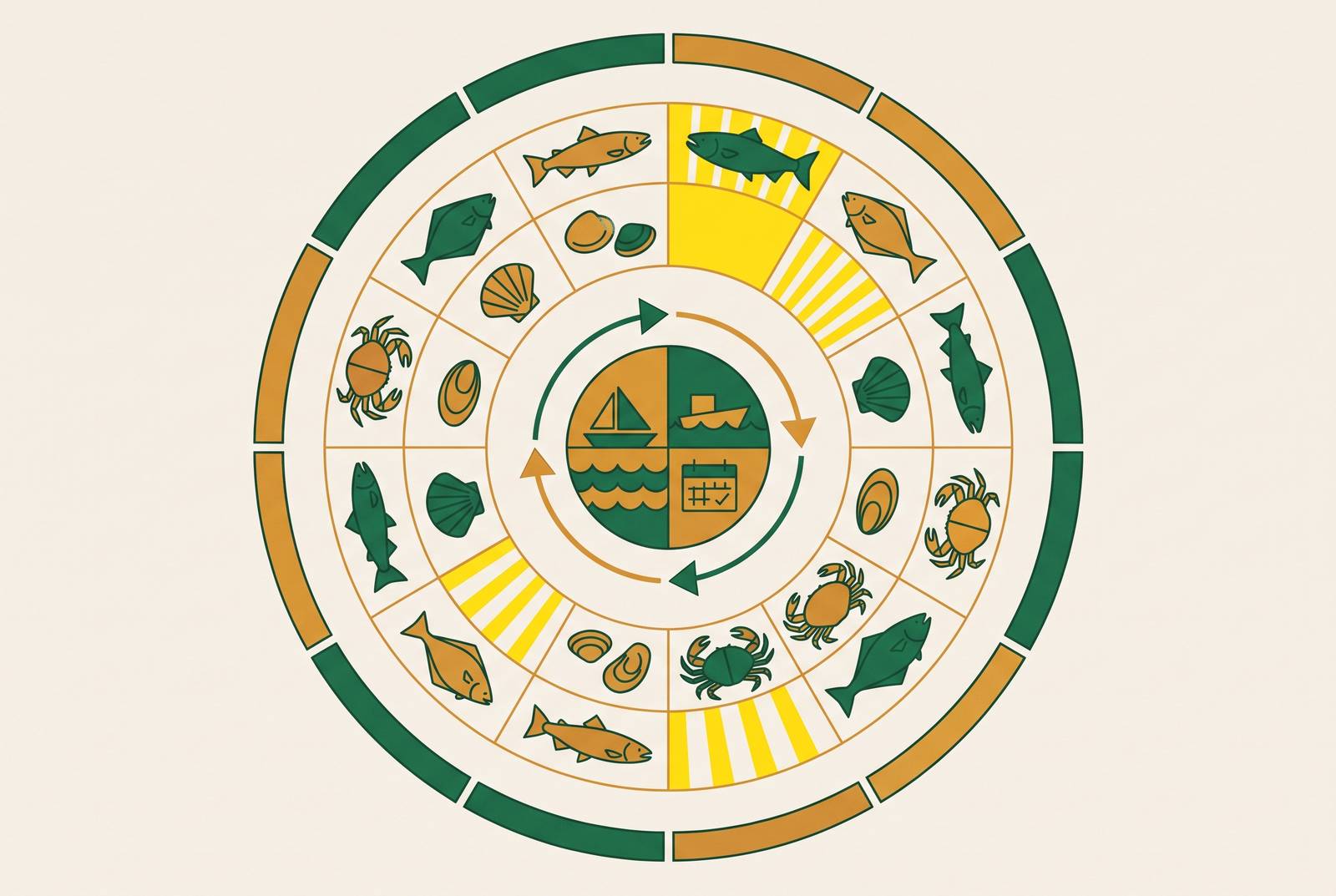
Seasonal Availability Windows for Wild Seafood in North American Markets.
Wild seafood availability is a calendar problem, not a commodity problem
Wild seafood availability in North American markets follows species-specific windows set by biology, regional fishery structure, and regulatory timing, and understanding those windows is what separates reliable procurement from constant improvisation. Most distributors carry a blend of wild and farmed product, and the farmed side behaves the way any negotiated commodity behaves: contracted volumes, leveled production, predictable delivery. Wild supply doesn't work that way. It cannot be negotiated into consistency, no matter how good the buyer's relationship with a supplier is, because the constraint sits upstream of any contract, in spawning runs, migration corridors, and water temperature thresholds that don't consult a purchase order.
That gap, between fixed customer expectations and a supply that opens and closes on its own schedule, is where a lot of distributor pain actually originates. None of this is a failure of sourcing effort. It's a mismatch between calendar logic and commodity logic.
Three forces shape every wild seafood availability window. Biology sets the outer limits: spawning runs, migration corridors, temperature thresholds a species won't cross. Regulatory timing narrows those limits further, through quota frameworks, escapement requirements, and season-opening orders that can close a fishery well before the fish stop running. What follows covers the major commercially relevant wild species across North American markets, organized by region and season, with enough specificity that a procurement calendar could actually be built from it.
The 2026 harvest structure and its effect on procurement timing on Alaska's salmon calendar
Alaska is the primary wild harvest engine for North American distributors, and the salmon season is its organizing event. The season's entry point is late May, when Chinook, known commercially as King salmon, begins arriving, bringing Coho, Pink, and Sockeye alongside it, with active fishing running through October.
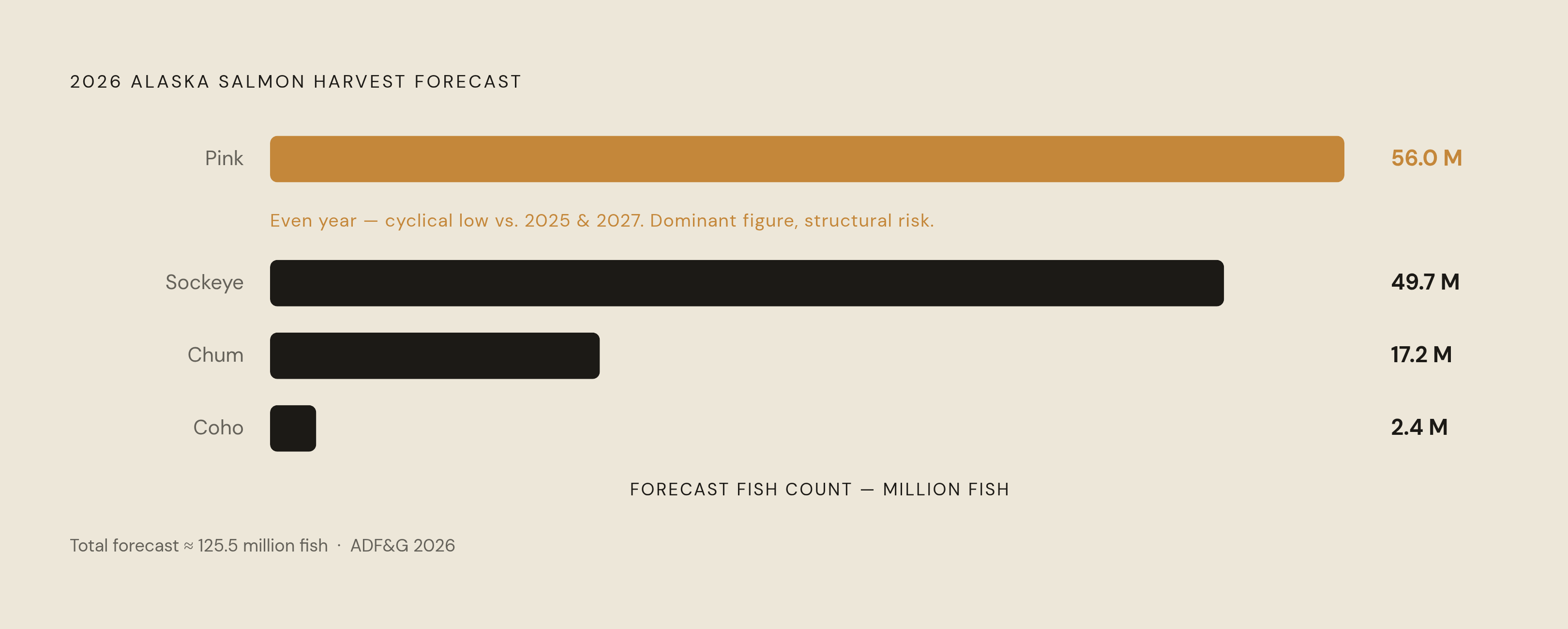
The 2026 Alaska Department of Fish and Game forecast gives distributors real numbers to plan against. Pink salmon is highest by volume at 56 million fish, Sockeye is 49.7 million, Chum is 17.2 million, and Coho is 2.4 million, for a forecasted total harvest of roughly 125.5 million fish Alaska Department of Fish and Game. Those totals look reassuring on their own, but Pink salmon runs follow a strong odd-year and even-year cycle, and 2026 falls on the even side, meaning lighter Pink runs than either 2025 or 2027. Anyone pricing or allocating around Pink volume this year needs to build that cyclical discount into the plan rather than treating the forecast as a flat number.
The sharper lesson, though, comes from the Chinook troll fishery. The second Chinook retention period of the 2026 general summer troll season opened August 13, targeting approximately 33,000 fish, and closed September 4 at 11:59 p.m., a roughly three-week window for fresh Chinook troll supply Alaska Department of Fish and Game. That's not a seasonal availability; it's an event. Fresh Chinook arrives, gets caught within a defined retention period, and the window shuts. Missing the window leaves only frozen inventory or substituting a different species entirely.
Commercially, 2026 looks like a strong year. The ex-vessel value of the purse seine harvest is expected to exceed both of the prior two seasons and the 2016 to 2025 average of $56.5 million Alaska Department of Fish and Game. But a strong aggregate number says nothing about how that value distributes across species or product formats, and treating "a good year" as evenly distributed abundance leads to fulfillment gaps later in the season.
NOAA quota frameworks structurally tighten Pacific salmon availability regardless of run size
A healthy run doesn't guarantee more fish reaching the market. NOAA Fisheries harvest quota frameworks tighten wild Pacific salmon availability through species-specific escapement requirements, and this is a structural constraint, not a seasonal or episodic one. Escapement rules exist to protect spawning populations, which is a sound and necessary policy goal, but the practical effect on a distributor's supply chain is the same regardless of intent: harvest limits cap Sockeye and Coho availability no matter what retail price signals suggest about demand.
That disconnect creates a documented industry challenge. Foodservice operators have to balance fixed menu commitments against Alaska salmon run timing variability, and this challenge is documented across the sector, not an isolated complaint from a handful of unlucky buyers. A restaurant group that builds a spring menu around Sockeye availability is making a bet on a number that regulators, not the market, ultimately control.
The demand side of this equation keeps climbing regardless. The North America Salmon Market was valued at $13.8 billion in 2026 and is forecast to reach $20.69 billion by 2035, a compound annual growth rate of 4.60% MarkWide Research ift.onlinelibrary.wiley.com. Demand is rising steadily, and regulated wild supply is not rising at anywhere near the same rate, since escapement requirements don't loosen because a market got bigger. That's the structural pressure every distributor sourcing wild Pacific salmon is operating inside, whether the forecast year is generous or lean.
Quota pressure's effect on the formats and pricing tiers distributors receive
Quota pressure doesn't just shrink volume, it changes what form the volume takes by the time it reaches a distributor. Alaska processors have responded to tightening quotas by diverting more product into frozen H&G formats rather than fresh fillet production, and that's a supply-chain adjustment. H&G, meaning headed and gutted, is the standard dressed format, head and entrails removed, and it becomes the default export format whenever fresh fillet economics stop making sense at scale.
Freezing method matters just as much as the cut. IQF, individually quick frozen, lets a buyer thaw portions selectively, which suits retail packs and foodservice portioning. Block-frozen product serves a different purpose, feeding reprocessing lines and bulk catering, and it carries a different price point. The same fish, frozen two different ways, ends up serving two different markets at two different prices Alaska Department of Fish and Game. Format specification at the order stage isn't paperwork, it's the decision that determines margin and end use.
Weight itself gets complicated by glazing, the protective water coating applied to frozen seafood before shipment. That's a margin line, not a rounding error at volume.
Species also carry pricing tiers that don't move with the seasonal calendar alone. Chinook and Sockeye command premium positioning concentrated in retail channels, and distributors serving foodservice buyers need to price accordingly in their order workflows rather than treating salmon as a single undifferentiated line item. These are the specifications that have to match precisely between what a buyer intends and what a supplier delivers. Glazing adds 4%–10% to the weight of seafood, a procurement math issue in which a 10-lb order may contain less than 10 lb of fish depending on whether the supplier quotes net or gross weight GFS. PBO/PBI (pin bone out/pin bone in) and weight bands (e.g., 3–5 oz, 5–7 oz) are the shorthand layer through which format decisions travel in actual distributor orders.
Pacific halibut's long season and availability across fresh and frozen windows
Pacific halibut looks, on paper, like the most forgiving species on this list. The 2026 commercial fishery runs from March 26 through December 7, and Alaska's recreational sport fishery can open as early as February 1 in some areas, making it one of the widest regulatory windows of any wild Pacific species.
But the regulatory window and the practical fresh-product window are two different things, and conflating them is where planning goes wrong Alaska Department of Fish and Game. Peak commercial fishing activity actually concentrates from May through September, when weather conditions cooperate with vessel operations. Outside that stretch, boats can technically fish, but they often don't, or can't, at the volume that steady fresh supply requires.
Fresh has a defined window, and frozen exists specifically to bridge the months fresh can't cover. The fresh-versus-frozen boundary is as much a customer expectation problem as a sourcing one. Menus and standing orders built around the phrase "fresh halibut" have a seasonal ceiling, regardless of whether anyone wrote that ceiling down. Pacific Seafood, a major West Coast processor and distributor, works directly with the halibut fleet to provide fresh halibut 8 months of the year, with frozen product available year-round, illustrating the operational template in which fresh has a window and frozen bridges the gap.
East Coast seasonal windows: how species rotate across the spring-to-winter calendar from New England south through a neighboring coastal region
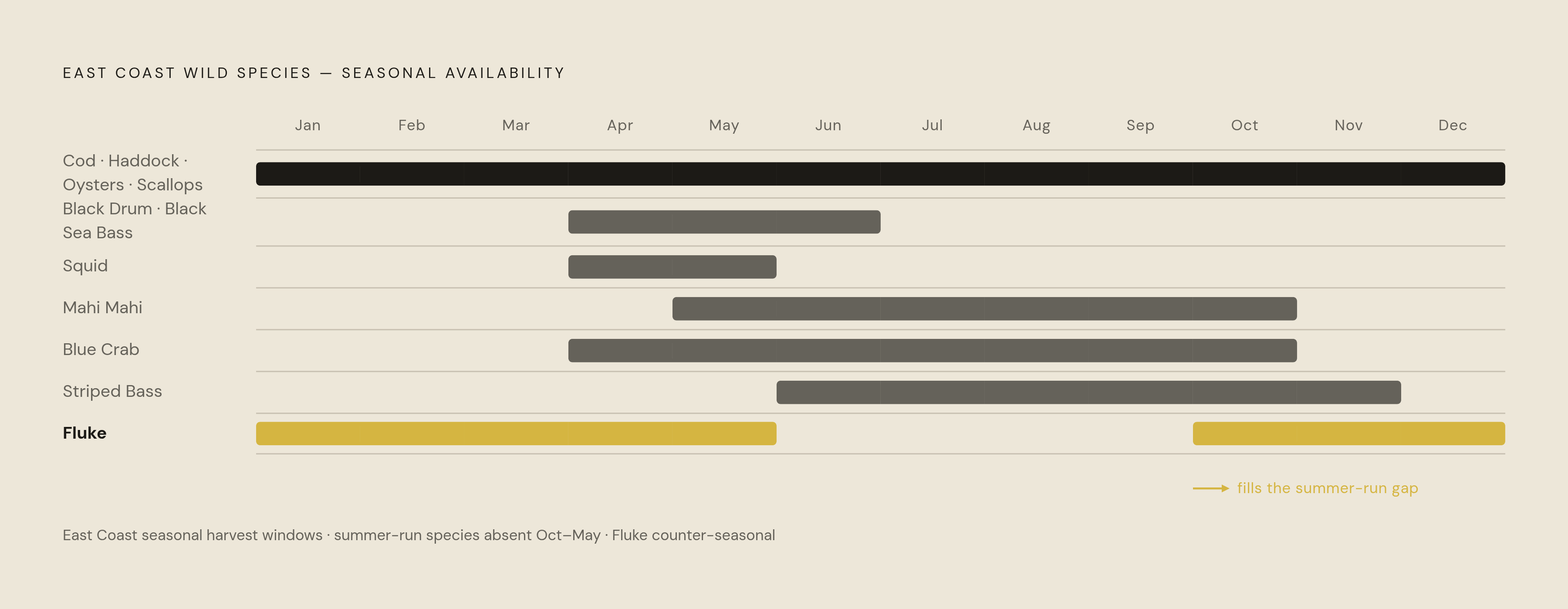
New England's fishery splits cleanly into two categories, and the distinction matters for anyone building a year-round offering https://www.ourwickedfish.com/local-in-season-seafood-new-england. A group of groundfish species stays in the region all year: skate, monkfish, hake, Acadian redfish, dabs, Atlantic pollock, haddock, dry sea scallops, steamers, oysters, and Atlantic cod. These species form the stable backbone a New England distributor can plan a baseline menu around without worrying about a seasonal cliff.
Everything else moves through defined windows further south along the coast. Black Drumfish runs April through June, as does Black Sea Bass. Striped Bass, often sold as Rockfish, holds from June through November. Blue Crab runs April through October, while Blue Crab Meat extends slightly later, May through November. Mahi Mahi, also called Dolphin, runs May through October. Fluke, the market name for flounder in much of this region, inverts the calendar entirely and runs October through May, which makes it one of the few species filling a fall and winter gap left by the summer-run fish.
New England's own seasonal additions layer on top of the year-round groundfish base, and they shift by season in a pattern worth knowing cold. Fall brings Dogfish, Bluefish, Scup, Swordfish, and Yellowfin Tuna. Spring brings Bluefish back along with Scup, sometimes called Porgy, and Squid. Winter is thin by comparison, limited mostly to Bay Scallops and Sea Urchin, sold commercially as Uni. Summer is the widest window of the year, adding Tautog (commonly called Blackfish), Black Sea Bass, Scup, Dogfish, Tilefish, Bluefish, Striped Bass, Yellowfin Tuna, and Swordfish all at once. Squid's spring appearance lasts only a handful of weeks, and fresh local Striped Bass simply isn't available once winter sets in, two examples that show how narrow some of these windows really get, and how much planning risk sits inside a single missed week.
North Carolina and the South Atlantic: how coastal geography splits availability within a single state's waters
North Carolina complicates the regional picture further, because its waters support over 70 different marine species that can be commercially harvested, and not one of them is available year-round NC State Cooperative Extension lee.ces.ncsu.edu. The state's estuarine system, the second largest in the country, is large enough that a single coastline behaves like two separate fisheries depending on where along it a boat is working Alaska Department of Fish and Game.
The northern coast, running from Currituck down to Beaufort, and the southern coast, from Pamlico down to Brunswick, see genuinely different availability driven by water temperature and current patterns. August offers a clean illustration. Blue crab, oysters, and shrimp show up along the entire coastline that month, but tuna and tilefish run more plentiful up north, while clams, grouper, and triggerfish favor the southern waters.
The consequence for procurement is straightforward and easy to miss: a "North Carolina" catch designation tells a buyer almost nothing useful on its own NC State Cooperative Extension lee.ces.ncsu.edu. Without knowing which coast the product came from, a buyer cannot tell which species are actually available. NC Sea Grant publishes seasonal availability charts specific to this split, and that's the kind of granular, state-level reference distributors need to be working from instead of leaning on generic national seasonality charts that flatten this variation away.
The procurement vocabulary distributors need to specify orders accurately across species and formats
None of this seasonal detail translates into a usable order unless the vocabulary attached to it is precise. H&G, headed and gutted, describes a dressed fish with the head and entrails removed. IQF, individually quick frozen, means pieces are frozen separately, which allows a buyer to thaw only what's needed rather than an entire block. PBO and PBI specify whether the pin bones, the row of fine bones running along a fillet's midline from the nape for roughly a third of its length, have been removed or left in.
Yield itself, the percentage of a given fish that's actually edible or sellable, is a separate number from weight entirely, and conflating the two is a common source of disputed invoices Alaska Department of Fish and Game. Sushi grade deserves particular care too: it isn't a formal USDA grade at all, but a designation indicating the product was processed under a parasite destruction guarantee, with freezing regimes that vary by jurisdiction.
Grading itself operates across several levels at once, and a distributor needs to know which level a given claim refers to. Fishery-level grading covers size, quality, and sustainability criteria, sometimes with origin data attached and sometimes without. Vessel-batch grading applies to a single landing, net haul, or trap set. Individual-fish grading, reserved for high-value species like tuna, lobster, salmon, and snapper, often involves tagging a specific fish. Organoleptic scoring, the sensory evaluation of odor, gill color, eye clarity, and flesh firmness, is the language used at receiving docks and in supplier conversations to settle quality disputes in real time.
An order that names a species without specifying format, freeze method, weight band, and bone status is an ambiguous order. In a market where substitutions happen constantly because a window closed early or a run came in light, that ambiguity doesn't stay contained. It compounds, and it lands as a fulfillment problem days or weeks after the order was placed, when there's far less room left to fix it. Industry-standard specification shorthand, sourced from Gordon Food Service (gfs.com) and Wholey (wholey.com), gives distributors the procurement vocabulary needed to specify orders accurately across species and formats. Glazing is a protective water coating frozen onto seafood that adds 4%–10% to stated weight, making the net vs. gross weight distinction important for pricing and yield calculations GFS.
Seasonal windows create order intake pressure that generic order management tools aren't built to handle
Layer all of this together: the second Chinook retention period of the 2026 general summer troll season opened August 13 (targeting approximately 33,000 fish) and closed September 4 at 11:59 p.m., a window of roughly three weeks; some New England groundfish species such as skate, monkfish, hake, Acadian redfish, dabs, Atlantic pollock, haddock, dry sea scallops, steamers, oysters, and Atlantic cod stay in region all year as a stable backbone; and North Carolina has over 70 different marine species that can be commercially harvested, not all available throughout the year (and a clear pattern emerges) Alaska Department of Fish and Game NC State Cooperative Extension lee.ces.ncsu.edu. Peak season doesn't just mean more orders. It means compressed timelines, higher order frequency, and a multiplication of the specification variables riding on every single one of those orders at once. A distributor fielding Chinook, Blue Crab (April–October), and Fluke (October–May) orders in the same week, against a roughly three-week Chinook troll window, is juggling separate calendars and separate windows of risk for a missed cutoff Alaska Department of Fish and Game.
Generic order intake systems built for steady, contracted volume assume a kind of stability that wild seafood simply doesn't offer. The species-level detail covered here, harvest forecasts that shift year to year, quota frameworks that cap supply independent of abundance, format and freeze-method distinctions that determine margin, regional splits inside a single state's coastline, is the operating environment. Distributors who build their planning calendars around it are working with the market as it actually behaves. Everyone else is negotiating with a fish that already left weeks ago.
Sources
- North America Salmon Market Size, Share, and Industry Trends Forecast 2026-2036 | MarkWide Research
- New England Fish - In Season — Our Wicked Fish, Inc.
- Spotlighting Seasonal Seafood in NC - Lee County Center | N.C. Cooperative Extension
- Inseason Alaska Salmon Summary, Alaska Department of Fish and Game