Live Seafood Transport Logistics for Distributors
Metabolic state, not just temperature, determines whether live seafood survives transit intact.
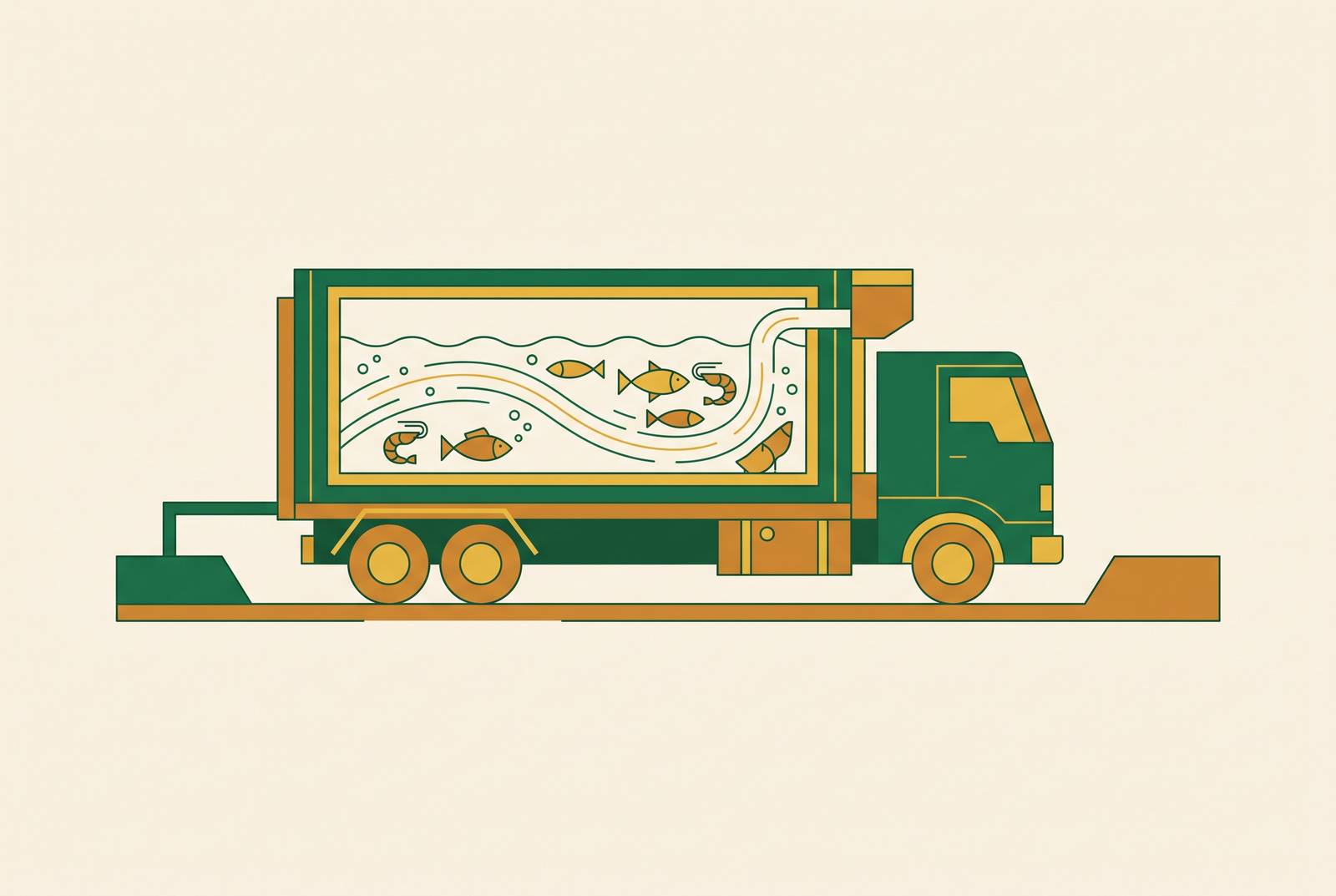
Live seafood is the one category in food logistics where the cargo can die between pickup and delivery. That single fact changes everything about how a distributor has to think: temperature, oxygen, handling time, and species tolerance all interact at once, correcting or compounding each other in real time, and a decision made about one of them changes what the others can tolerate. Frozen fish sits well below freezing. Fresh fish holds between zero and 5 degrees. Both of those are packaging problems: get the product into its target range and keep it there. Live seafood is a different problem entirely, and distributors who run it like a frozen or fresh freight lane are the ones who lose the shipment before the truck leaves the dock.
The animal is still consuming oxygen, still producing waste, still responding to stress, right up until it lands on ice or in a tank at the customer's dock. The whole job is slowing its metabolism down enough that it survives the trip. That is a physiology problem, and it demands a different kind of attention than anything else moving through a cold chain. It is a physiology problem, and it demands a different kind of attention than anything else moving through a cold chain.
Scale keeps this from being a niche concern. In 2024, farmed aquatic animal production hit 103 million tonnes, 53% of total aquatic animal output worldwide, and a meaningful share of that volume moves live at some point in the chain. A typical shipment also passes through something like 10 to 15 intermediaries between the water and the final buyer. Every one of those handoffs is a place where a live animal can get mishandled, delayed, or exposed to conditions it won't survive.
The three physical variables that determine whether live product arrives sellable
Temperature comes first, and the margin for error is thin. Too hot, and the animal's metabolism spikes past what the available oxygen can support. Too cold, and it goes into shock or dies. Insulation failures rarely cause one bad moment. They build over hours, especially on long-haul routes or in weather that swings 20 degrees between pickup and delivery.
Lobster is the clearest example of temperature working as a tool instead of a threat. Dropping a lobster's body temperature to a point partway down a common cold-holding scale causes its metabolic rate to fall low enough that it can survive on the oxygen in ambient air, no water required. That is the mechanism that keeps a lobster alive without a safety cushion built into the shipping process, a physiological state engineered deliberately, and it only holds for that species at that exact range. Moving to crab, or shifting the water temperature by a few degrees, changes the numbers completely. There is no universal chart here. Every species runs its own math.
Oxygen delivery is the second variable, and it fails fast when it fails. Aerated tanks and oxygen-enriched bags are load-bearing, not optional, and when a system stops mid-transit, oxygen levels crash within a short window. Any delay after that, a missed connection, a customs hold, a truck stuck on the interstate, turns into a suffocation clock running against the driver. Lobsters and crabs are especially exposed here, since they can't regulate their own oxygen uptake the way some finfish manage to.
The third variable is what happens inside the animal under stress, and this is where the science gets specific rather than speculative. Air transport tends to push crustaceans into physiological stress states the animal has to fight to correct on its own. Researchers have tracked haemolymph lactate, the byproduct of anaerobic metabolism, building up in brown crab, snow crab, spiny lobster, and Norwegian lobster during emersion and transport. Lactate accumulation is the biochemical signature of an animal running out of options, measurable rather than merely inferred.
Acceptable mortality, grading at source, and margin leaks
Industry practice treats mortality below 3 to 5% of total shipped weight as the acceptable band for live lobster shipments. Crossing that threshold causes a premium SKU to stop behaving like one. Margin doesn't erode gradually here. It falls off a shelf, because dead product on a live order isn't discounted, it's usually unsellable.
What pushes mortality past that line traces back to three things: how freight staff physically handle the cargo, how steady the temperature held in transit, and what the animal walks into on arrival. That last point gets ignored more than it should. A customer's own holding tank, running poor filtration or letting ammonia concentrations climb, can undo everything the carrier did right across the entire transit.
Grading at the point of harvest is where most of that risk actually gets managed, long before it becomes a transit problem, and distributors who skip this step are gambling with the entire shipment. Separating weaker or lower-quality animals out for processing, instead of shipping them live, keeps fragile stock out of the live channel. That is the mechanism that makes the 3 to 5% threshold achievable. Assessing quality animal by animal, rather than writing off an entire catch as unfit for extended holding, means a distributor isn't throwing away sound stock alongside compromised stock. That distinction is worth real money on a per-shipment basis. Distributors who ignore it pay for it in mortality, not on the invoice. The cost is easy to miss until the numbers are already bad.
Transport mode decisions between air and ocean freight
Air freight earns its cost premium when the animal's physiology won't tolerate a longer trip. Full stop. High-value, time-sensitive shipments, live lobster bound for a market days away, belong here almost by default, because the alternative is losing product weight, losing quality, or losing the animal.
Ocean freight makes sense for bulk or less time-critical loads, where the savings outweigh the extra days at sea, but only if the containers are sealed, temperature-controlled, and properly ventilated for the entire crossing. Cutting a corner on ventilation to tighten the seal stops paying off the moment the mortality count comes back.
Reefer trucking covers the ground in between, and the equipment specs determine survival rates directly. Reefer trailers used for live seafood, fresh fillets, and shellfish run adjustable temperature ranges, with GPS tracking and real-time temperature logging on every load. Sanitation standards on those trailers aren't cosmetic either, given what's riding in the back.
For fresh product specifically, air freight or refrigerated truck should be the default choice, not a fallback. Quality starts declining the moment the animal comes out of the water, so any mode decision that adds unnecessary transit time is a quality decision, even if the person making it doesn't realize that's what they're deciding.
The language of live seafood: grading terminology that must survive the order process intact
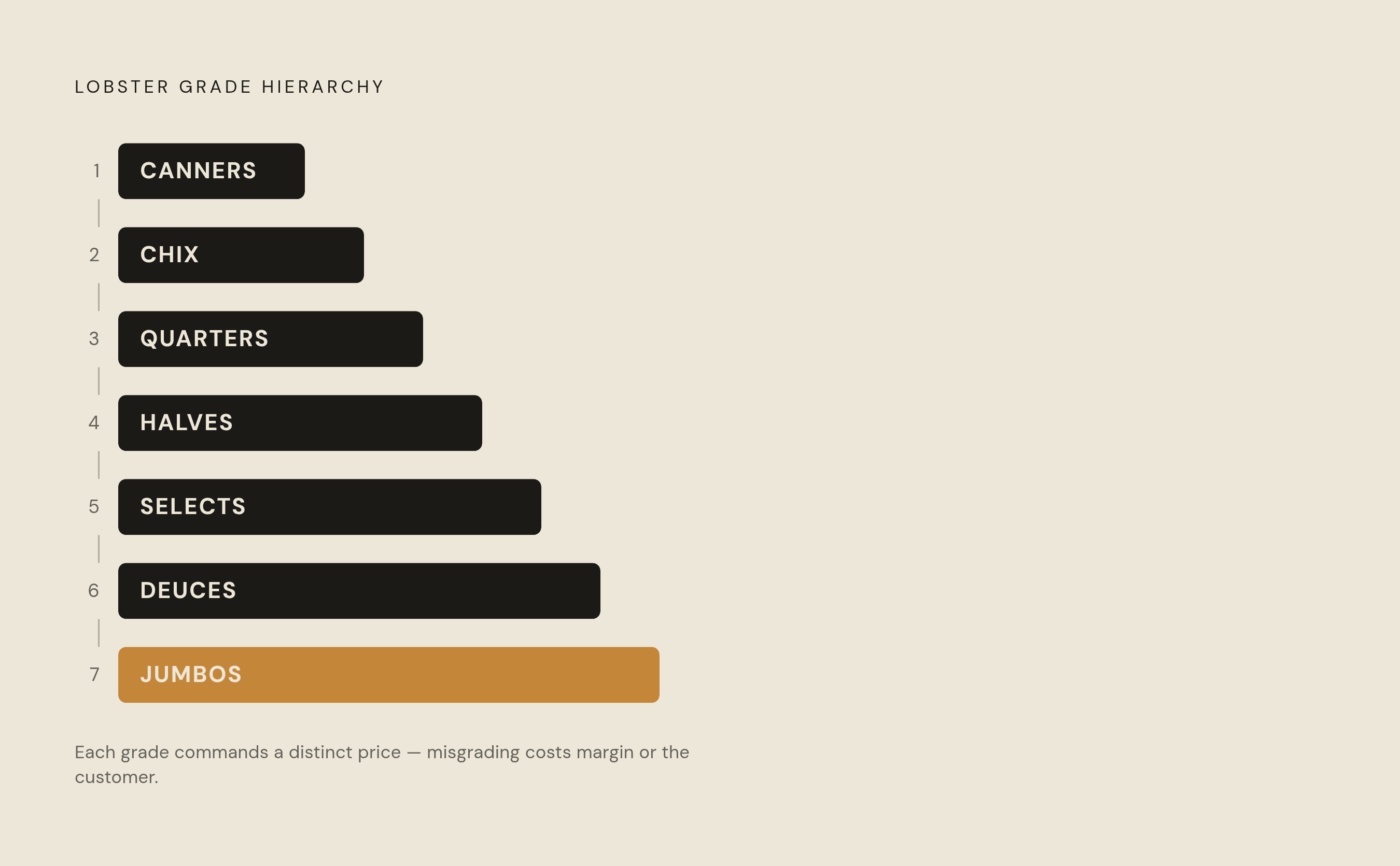
Lobster grades run canners, chix, quarters, halves, selects, deuces, and jumbos, in ascending order of size, and each band carries its own price point. Get the grade wrong on an order, and someone's either shorted the customer or given away margin on the substitution. There is no third outcome.
Soft-shell crabs split into five sizes: medium, hotels, primes, jumbos, and whales. Hard clams, or quahogs, grade by shell measurement: littlenecks at 1½ to 2¼ inches, topnecks, cherrystones, and chowder clams over 3 inches, each size tied to a distinct market use, from premium table service down to culinary preparation. Sea scallops carry a count-per-pound spec, something like 10/20 or 20/30, and that number isn't a description of the product. It is the product spec, full stop, and treating it as flexible is how the wrong scallop ends up on the wrong plate.
How order intake failures compound live seafood's physical risks
Orders for live seafood arrive by email, text message, WhatsApp, voicemail, a handwritten note handed to a driver, and a faxed PO that somehow still exists in 2024. Customers in this category have never standardized how they order, and because the product is time-sensitive, fixing a mistake after the fact costs more here than in almost any other freight category.
The broader numbers on order processing back this up, and they aren't flattering. More than half of finance teams spend over 10 hours a week manually entering order and invoice data. Only 5% of purchase orders match correctly on the first attempt, and 39% of invoices contain errors. A single 40-line order entered by hand can take 7 to 8 minutes, and for a distributor juggling live inbound shipments across multiple species and grades, that lag is a window where a tank's oxygen system runs down while someone is still keying in line items.
SKU ambiguity is where this problem takes a shape unique to seafood. A customer who orders "large shrimp" or "select lobster" means a specific count grade or shell condition, mapped to a specific SKU in the distributor's system. If whoever's entering that order by hand guesses wrong, the wrong product ships. Or the right product ships at the wrong price. Neither error gets caught until the animal is already in transit, and in this category, that means the mistake is unrecoverable the moment it happens.
Requirements for a distributor running live seafood logistics without compounding its own risk
Species-specific protocols need to be written down, not carried around in someone's head. Water quality parameters, oxygen system requirements, temperature regime, and maximum transit duration should exist as documentation a new hire could follow on day one.
Grading discipline has to start at the purchasing conversation, not after the animal shows up at the dock. A distributor that specifies shell condition, size grade, and individual quality criteria when placing an order with a supplier is managing mortality risk before the animal ever sets foot, or claw, in a truck or a tank.
Mode selection belongs in a standard operating procedure, tied to species and destination, with clear rules for when to escalate. Port congestion or a reefer shortage can change the math on a route that normally runs by ocean freight, and leaving that call to be made fresh on every shipment invites inconsistency exactly where consistency matters most.
What separates carriers in this category, in the end, is track record, plain and simple. Midland Transport, for instance, has more than 40 years in the seafood industry, a 99% exception-free rate, and a substantial volume of pounds handled every year. Numbers like that describe operational discipline built over decades. For a category where the cargo can die in transit, that kind of track record is table stakes. It's the floor a distributor should be checking before anything else.