From Broken English Texts to Clean Order Drafts How Seafood Distributors Handle Vietnamese Restaurant Accounts
AI interprets multilingual seafood orders in real time so distributors meet tight morning cutoffs.

AI-assisted order intake turns multilingual WhatsApp messages into structured order drafts by matching informal product names and specifications with the account’s order history, then sending uncertain matches to a person before they go into the ERP. For seafood distributors serving Vietnamese restaurants, the answer is better decoding within the way customers already order. The same buying question applies to other messaging platforms, though the deployments described here do not show that those platforms are supported.
Why Vietnamese restaurant accounts create a distinct intake problem for seafood distributors
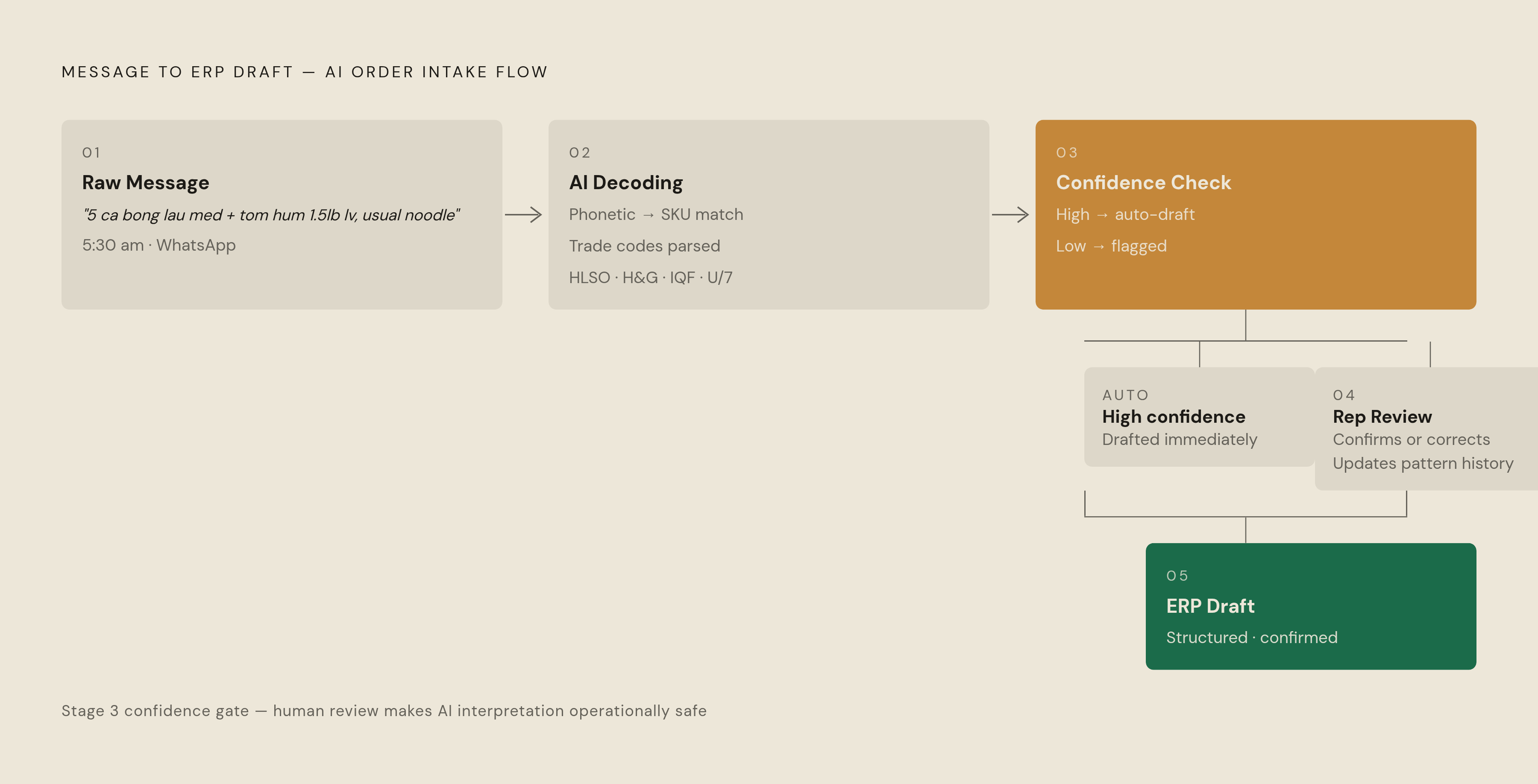
A Vietnamese restaurant’s seafood order may blend informal English, phonetic Vietnamese product names, kitchen shorthand, and numeric specifications in no predictable sequence. An illustrative morning text might read “5 ca bong lau med + tom hum 1.5lb lv, usual noodle”. A fluent operator familiar with the account can interpret those fragments, but an intake system needs explicit product, quantity, size, and processing fields.
The channel adds another layer to that mismatch. These accounts favor SMS, WhatsApp, and voice notes over structured portals or email, reflecting business communication norms that prioritize relational, low-friction contact over formal documentation. A short message relies on what the customer and rep both know. That includes seafood terminology and what this kitchen usually buys. The distributor’s obligation is therefore to build intake capacity around the customer’s communication, rather than treating the customer’s language as something to correct.
The 5–7am intake window and why it has no tolerance for decoding delays
Between roughly 5am and 7am, orders arrive simultaneously through texts, emails, WhatsApp messages, voice notes, PDFs, and photos of handwritten lists. Each order needs to be a confirmed order draft before the morning cut-off. Orders in all these formats wait in the same queue. A mixed-language message adds interpretation to the same workload that already requires product matching, specification checks, and data entry, so a decoding delay can slow more than one account.
It can take seven to eight minutes to enter a single 40-line order by hand. Across hundreds of accounts per week, that work takes a substantial share of the morning before any language ambiguity is resolved. An early delivery can encounter a kitchen without storage room, leaving the distributor to absorb the loss and redeliver at cost. A late delivery of whole snapper intended for a Vietnamese restaurant’s daily special can leave customers unserved at dinner.
What seafood terminology actually looks like in a Vietnamese restaurant's text message
GGS means Gilled, Gutted, Scaled, while H&G means Headed and Gutted. HLSO means Headless Shell-On, HOSO means Head-On Shell-On, and IQF means Individually Quick Frozen. These abbreviations identify different product characteristics. A processor must distinguish them while also interpreting U/7 whole-fish weight brackets and count-per-pound notations that describe, for example, an average range of scallops per pound.
“5# HLSO” paired with a count-per-pound range combines weight, processing state, and size information. Vietnamese naming adds another vocabulary to that structure. “ca bong lau” refers to catfish, “tom hum” to lobster, “ca chep” to carp, and “muc” to squid. These are culinary product references rather than catalog SKUs, so recognizing the name does not by itself resolve the item the distributor must supply.
NOAA’s official grade standards list quality factors including flavor and odor, appearance, size, absence of defects, and character. Size-sorting, also called grading in aquaculture, instead groups fish into similar sizes. A restaurant may simply request “big one,” “medium,” or “nhỏ”. Intake must match those words to the right catalog specification and keep size separate from quality grade, even when the message also has processing abbreviations and quantities.
Why catch weight and invoice adjustment make decoding errors expensive, not just inconvenient
A case of whole snapper is stocked in units but priced by actual weight, and its weight depends on the fish inside. The SKU alone does not settle the invoice. A wrong size, species, or count notation can therefore create a discrepancy that must be resolved at delivery, even when the number of cases appears to match the order.
An actual delivered weight that differs from the ordered weight requires invoice correction. A wrong species or grade can have a more expensive outcome, including customer refusal, product destruction, and redelivery at the distributor’s cost. Perishability narrows the room for recovery. Foodservice distribution already operates with thin margins, customer-specific pricing, lot tracking, and credit limits, so an intake error enters a financial process with little slack.
Over-ordering seafood creates spoilage, while under-ordering can leave the kitchen unable to serve its menu. Both can begin with the same poorly decoded message. Getting the words right before the order goes through helps avoid a dispute that neither side can settle just by changing an order line after delivery.
How distributors currently handle the decoding — and where the process breaks
The manual or semi-manual baseline places a rep or administrator between the message and the order system. That person reads the request, maps Vietnamese names and trade abbreviations to SKUs, checks specifications against account history, and enters the result into an ERP or spreadsheet. The work depends on accumulated account knowledge. A rep may know that an account’s “catfish XL” refers to “ca bong lau” and that its usual lobster order is 1.5lb live.
Another processor may have memorized which size codes correspond to each restaurant’s informal naming conventions, without leaving a transferable record. Absence exposes the dependency immediately. When that person is unavailable or leaves, a colleague must reconstruct the meaning while incoming orders continue to accumulate. The weakness is not staff competence but the concentration of essential interpretation in individual memory.
Volume makes that dependency harder to manage. As accounts send messages within the same two-hour period, the decoding queue grows, confirmations slow, and speed competes with accuracy. Voice notes add a different processing burden. A kitchen manager speaking beside extraction equipment leaves a listener to separate the order from background noise while interpreting accent and trade vocabulary. Nothing can be entered reliably until those layers have been resolved.
How does AI turn multilingual WhatsApp orders into structured drafts for distributors?
AI-assisted intake reads the message as it is and uses the account’s order history to match informal wording and product names in different languages to items in the catalog. The output is a structured draft. Human review remains the boundary before ERP entry. That distinction directly addresses the manual process’s weakness by moving first-pass interpretation out of the rep’s transcription workload without removing the rep’s authority to confirm the order.
The matching task spans several vocabularies at once. Phonetic Vietnamese names are connected to SKUs using prior orders, while HLSO, H&G, IQF, U/7, and count-per-pound ranges become structured specifications. Account history also gives context to shorthand. References such as “usual,” “same as last week,” and “more” are resolved against recent orders, with uncertain interpretations flagged for review before commitment.
The practical distinction is between translating words and preparing an actionable draft. A translated product name still needs a catalog match, a specification, and the account context that determines what the customer intended. Translation alone does not complete that work. For buyers evaluating multilingual order capture through WhatsApp and other messaging platforms for food distributors, the relevant criteria are supported channels, account-specific matching, specification extraction, exception review, and ERP integration. The available cases establish different parts of that picture for specific languages and channels.
Cases where AI intake handled unstructured WhatsApp and voice ordering at distributor scale
FlowGo’s June 2026 case study describes a B2B food wholesaler whose customers ordered through WhatsApp. Its system read unstructured messages, checked them against the product catalog and pricing rules, and drafted sales orders on its own. The measured change concerned how much correction those drafts needed. Within four weeks, the edit rate fell from over sixty percent to under thirty percent, while the average number of fields edited per order fell from 1.5 to below 0.6. Daily order volume increased without added data-entry headcount.
Food Service Company (FSC), South Africa, introduced an AI-powered WhatsApp ordering platform in August 2026 that allowed chefs and kitchen managers to order through text or voice notes directly from their kitchens. FSC developed the platform with Stubber and Linx Systems. The partners had distinct roles in the deployment. Stubber provided AI-powered business automation across messaging and communication platforms, while Linx Systems integrated sales, warehouse, and logistics operations into FSC’s fulfilment process. The platform was designed so routine orders did not require customers to navigate a traditional ordering portal.
Pepper shows how ordering and sales-automation tools can connect to an ERP while keeping it in place. Loffredo Fresh Foods is reported to have generated substantial incremental weekly revenue through the platform, while Henry’s Foods is associated with a reported threefold increase in sales. Those results are commercial outcomes. However, the evidence is not interchangeable, and these cases do not establish Vietnamese seafood-name accuracy, performance in other languages, or support for other messaging platforms.
The objection that counts is what happens when AI misidentifies a Vietnamese product name
An English-language catalog does not guarantee that a phonetic Vietnamese name will map to the right SKU. That is a legitimate operational concern. In a catch-weight setting, selecting the wrong species or size can produce a refused delivery, spoilage, and a billing dispute together. Evidence that AI can process informal messages does not prove that every seafood match will be correct.
The safeguard is the architecture around the match. The system flags low-confidence interpretations for human review before confirmation, prompting the rep to resolve uncertainty before ERP entry. The correction also informs later matching for that account. A rep who resolves “ca bong lau” to catfish medium teaches the system how that customer uses the phrase. The account context is essential because a correction should resolve the customer’s intended product for that account.
FlowGo’s declining edit rate provides evidence that draft correction can fall as the system is used. It does not establish error-free operation or a Vietnamese seafood accuracy rate. Continued manual intake does not remove mis-mapping risk either, because it leaves interpretation distributed across staff whose knowledge may be undocumented and whose errors lack a systematic feedback loop. The comparison is between two ways of managing uncertainty.
What the intake window looks like when multilingual orders flow in without a decoding bottleneck
With first-pass decoding handled by AI, the rep’s morning work shifts from entering every line to reviewing flagged matches, confirming ambiguous specifications, and handling genuine exceptions. Account phrasing becomes available through the system. That changes who can cover the window. A new staff member has access to the same account-level pattern history as a ten-year veteran, while growing order volume need not require a proportional increase in intake headcount.
People still have to handle HACCP controls, approved source verification, and receiving temperature traceability for fresh seafood, even when they have an order draft. Staff still have to resolve catch-weight discrepancies at delivery. Better decoding reduces the chance that those discrepancies began with a misunderstood request, but it does not eliminate the physical difference between ordered and delivered weight.
The Vietnamese restaurant account still sends a WhatsApp message at 5:30am in a mix of Vietnamese and English. The distributor no longer needs a bilingual seafood specialist on call at dawn to interpret every routine line, while staff remain responsible for the exceptions that require judgment.