Air Freight vs. Ocean Freight Trade-Offs for Perishable Seafood Imports
Spoilage risk and grade loss, not shipping cost, determine whether fresh seafood needs air freight.
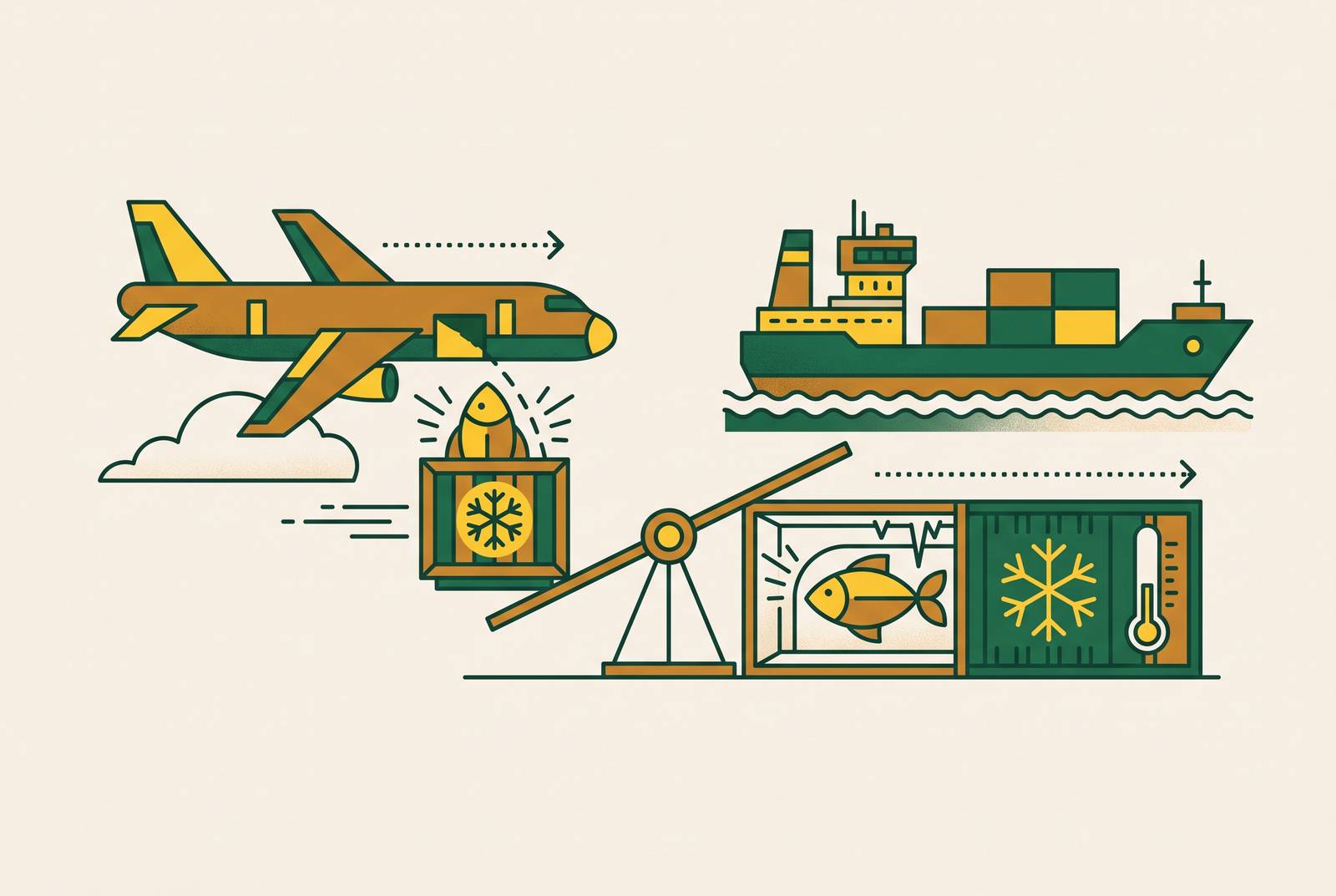
An order desk comparing two freight quotes for the same lane will almost always see the ocean number come in lower. That comparison is the wrong one to make first. For seafood importers, what decides the mode is how long a product can survive in transit without losing quality, not which mode costs less per kilogram. Reefer containers give frozen seafood, and plenty of other temperature-sensitive cargo, full cold-chain control at ocean rates, so "perishable" by itself tells an importer almost nothing useful. What decides the mode is shelf life measured against the delivery window the market demands. Every other factor in the decision, rate, route, customs paperwork, sits downstream of that one branch point. An importer who frames the choice as "air is expensive, ocean is cheap" is answering a question nobody asked; the one that actually matters is what a delay costs in spoiled product, downgraded grade, and a customer who doesn't reorder.
How fresh and frozen seafood travel completely differently through global supply chains
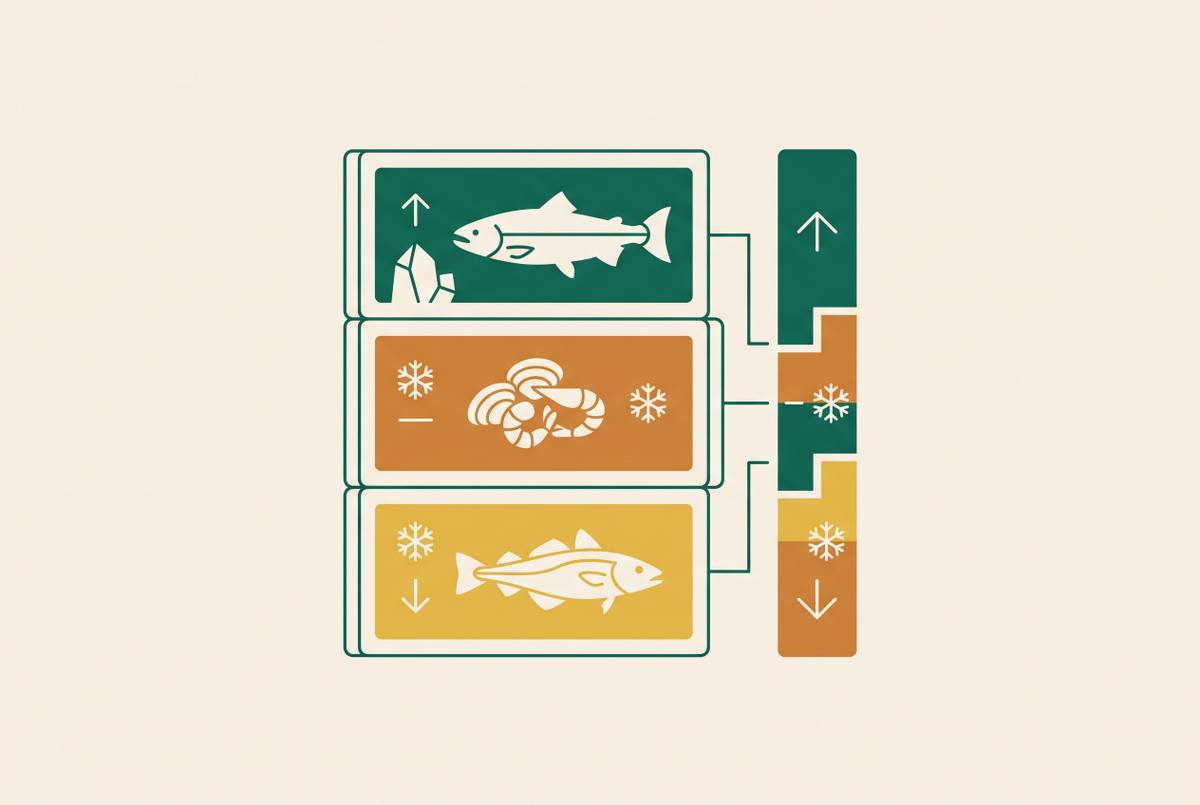
Fresh and frozen seafood don't share a supply chain so much as run two separate ones that happen to end at the same distribution center. Treating them as variations on one workflow is where a lot of operational mistakes start. Premium fresh fish, Atlantic salmon out of British Columbia and New Brunswick bound mostly for the US market, moves by air because no other mode gets it there inside the seven-to-eight-day window that buyers require. Frozen product runs on a different map entirely: seafood now arrives from Vietnam, Chile, Indonesia, and Norway. A single distributor can be managing air shipments from one hemisphere and ocean sailings from another in the same week. Seafood supply chains already count among the most complex, multi-scale systems in global food trade, because multiple actors and processes run across different timeframes and geographies at once. The fresh/frozen split is one layer sitting inside that larger complexity, not a simplification of it. For a distributor, the practical result is two inventory logics, two compliance paperwork trails, and two pricing structures running at once, not one unified operation with a fast lane and a slow lane.
Tracking orders across both modes at the same time requires understanding this distinction and all the operational data flowing from it; the complexity of dual inventory logic and compliance documentation enters the picture there. Tools built to handle food distributor ordering complexity, with real seafood expertise, can help importers capture and structure orders that reflect these actual supply-chain splits instead of forcing a choice between simplicity and accuracy.
What transit time actually costs when the cargo is fresh fish
For frozen seafood, transit time is a scheduling variable. For fresh seafood, it decides whether the cargo arrives sellable, degraded, or worthless. That makes the air premium a cost of goods sold. Ocean freight door-to-door on Asia-to-US routes runs several weeks total, and even on shorter lanes, port-to-port transit alone exceeds the seven-to-eight-day freshness window that refrigerated fish allows. But air freight gets door-to-door in three to eight days on most international lanes, so it's the only mode that fits inside the freshness window premium fresh species need.
What you should compare is total landed cost, not rate per kilogram. Ocean's longer transit ties up more capital in inventory, demands more safety stock, and raises warehousing and insurance exposure, costs that matter a great deal for shelf-stable goods and almost not at all for fresh fish, because fresh fish can't be held long enough for those costs to accrue. The real cost of a missed air shipment is the full invoice value of spoiled product, plus whatever it costs to lose a customer's order on top of it.
Some operators assume refrigerated ocean service can stretch fresh fish's viability far enough to close that gap. Cold storage and careful routing matter, but neither changes the arithmetic: a seven-to-eight-day shelf life against an ocean transit that alone exceeds that window leaves no room, however well the product is chilled along the way.
When importers compare air and ocean quotes, what decides the call is what a delay costs in spoilage and lost revenue. Capturing that context in order records, transit window, product form, spoilage risk, turns a cost comparison into a business decision, and doing that well requires systems built to understand food-distribution language rather than generic purchasing data.
Grade loss as a hidden cost that makes the mode decision more expensive than it looks
Fresh seafood can arrive inside the freshness window and still lose a meaningful share of its value. Seafood processing generates distinct SKUs by grade, by size, by quality, and by product form, skin-on versus skinless, bone-in versus practically boneless, glazed versus unglazed, IQF versus solid-pack frozen, and each of those carries its own pricing and, in some cases, its own HTS code. A shipment that technically beats the clock but spends too long exposed to temperature swings can get downgraded from premium to commodity status on arrival, and the importer eats that margin loss directly; the freight bill doesn't change, but the revenue the product was supposed to generate does.
A middleman or processor grades product by size, quality, or other attributes the market will pay extra for, and losing those attributes in transit erases the premium without refunding any of the freight cost already spent. The consequences run deepest for certified product. A sustainability-certified lobster lot destined for a premium grocery channel can end up sold as plain commodity through a chain restaurant if the qualities that earned the certification don't survive transit, the certification cost stays on the books, and the premium it was supposed to buy simply disappears. The figure that should drive the mode decision is the grade-adjusted value of what actually arrives.
Ocean Freight Conditions in 2026 for Frozen Seafood
Frozen seafood defaults to ocean reefer, and that default still makes sense for most volume. But the conditions that make ocean the rational choice aren't fixed, and 2026 has given importers several reasons to check the assumption rather than inherit it from last year's rate sheet. THE Alliance carrier partnership dissolved, with Hapag-Lloyd departing to form the Gemini Cooperation alongside Maersk, while ONE, HMM, and Yang Ming rebranded as the Premier Alliance. The new alliance structures are still settling into stable service patterns, and that transition has opened service gaps and schedule risk on smaller routes. A frozen seafood importer running a secondary lane faces more schedule uncertainty than the published transit times suggest.
Trade policy has added its own layer of unpredictability. Post-IEEPA tariff changes have shifted trade patterns, and so has the Section 301 forced-labor duty that replaced the Section 122 exemption when it expired on July 24, 2026, and that pushes importers toward front-loading ahead of anticipated changes. Importers who built their planning around predictable ocean schedules now face demand-side uncertainty on top of the carrier-side disruption.
Port congestion, blank sailings, and lane disruptions can shift the underlying math further, and in some cases steep peak-season surcharges or transit times stretching from weeks into months make air freight genuinely competitive on cargo that would never have considered it a year earlier. None of this argues for moving frozen seafood onto air freight as a matter of course. It argues for treating the ocean cost advantage as something to check against current lane conditions on a rolling basis, not something to assume holds steady from one contract cycle to the next.
When a Hybrid Air-and-Ocean Strategy Is the Right Answer
A hybrid strategy, fresh product by air as a rule, frozen product by ocean on planned schedules, air reserved for emergency replenishment when ocean slips or a customer order creates a stockout, is the right structure for most seafood importers carrying mixed fresh and frozen portfolios. The split works because it matches the mode to the product's actual shelf life and the business's actual exposure to delay, rather than applying one freight policy across cargo types that behave nothing alike.
The model only works, though, for distributors with real forecasting discipline and the operational infrastructure to run two compliance trails, two sets of vendor relationships, and two inventory behaviors at once. Distributors without sophisticated demand forecasting run into the opposite outcome: the hybrid model multiplies paperwork and vendor management rather than simplifying anything. A distributor with reliable demand data can commit to ocean sailings with confidence and plan around them. One running on gut feel defaults to emergency air shipments far more often than the economics justify, and each of those emergency shipments costs more than just the air rate.
The de minimis threshold changed on August 29, 2025, and that raises that cost further. Every low-value commercial parcel, seafood included, now needs a full customs declaration regardless of product type, and that adds documentation burden specifically to small air-freighted shipments. So importers have one more concrete reason to consolidate air shipments into fewer, larger, better-planned consignments rather than running frequent small emergency orders through air. The fix for the forecasting gap is to invest in the forecasting and order-management infrastructure that lets more volume travel by ocean on a planned schedule and less by last-minute air, which directly improves landed cost.
Where order intake breaks down when a distributor runs both air and frozen inventory simultaneously
Dual-mode supply chains create a specific kind of order intake problem, and manual processes handle it poorly. When catch-weight pricing, short-dated substitutions, product-form specificity, and fresh and frozen SKUs all run through the same order desk at once, you get the exact conditions where manual entry generates costly errors. Fresh seafood SKUs carry a tighter order-to-dispatch window than frozen ones, and an order logged late, or logged with the wrong product form, IQF instead of solid-pack, skin-on instead of skinless, can miss the air shipment window, miss the correct price tier, or both at once.
Frozen ocean inventory and fresh air inventory need different reorder logic. Frozen volume can be planned against a sailing schedule weeks out; fresh volume has to be ordered against confirmed catch and available air capacity on a much shorter clock. Running both through a single manual intake process means applying the wrong lead-time assumptions to one or the other, and the mistake isn't always obvious until the shipment is already late. Seafood industry shorthand and catch-weight items get mispriced whenever order intake depends on someone correctly interpreting a handwritten or verbally relayed order, and multiplied across hundreds of customers a week, that is a structural error rate built into the process itself. Seafood already travels through one of the most fragmented supply chains in the global food system, and that fragmentation doesn't stop at the loading dock. This fragmentation appears again in the order inbox every morning, in every text, email, and voicemail an order desk has to interpret correctly before the truck leaves.
How AI-assisted order intake helps seafood distributors manage the dual-mode complexity without adding headcount
An AI order intake system built to understand seafood-specific terminology, catch-weight logic, and product-form distinctions removes the manual bottleneck that makes dual-mode distribution fragile, without requiring customers to change how they place an order. Asakana captures inbound orders from the channels seafood customers already use, text, email, WhatsApp, WeChat, phone calls, and voicemails, and turns them into structured order drafts inside a distributor's existing ERP or spreadsheet. Customers keep texting the way they always have; the distributor doesn't have to replace the backend system it already runs on.
The system reads multilingual messages and the exact shorthand the industry actually uses: IQF, H&G, skin-on, catch weight, short-dated, the vocabulary a manual process depends on a trained employee to interpret correctly, order after order, every single day. Because fresh and frozen seafood demand entirely different sourcing geographies, compliance trails, and pricing structures, an order intake system has to understand seafood-specific context: which sourcing region, which product form, which shelf-life window applies to a given line item. Asakana's grounding in seafood distribution includes parsing exactly those distinctions from the way customers actually phrase orders across both air and ocean lanes, which is what lets a distributor run the hybrid freight strategy this piece describes without needing to add headcount just to keep the two modes from tangling with each other at the order desk.