Distributor Strategies for Managing Seafood Inventory During Supply Shocks
Persistent supply shocks demand permanent operational changes, not temporary fixes.

Seafood distributors are no longer waiting out a rough patch between stretches of normal trading. RaboResearch Seafood Analyst Novel Sharma told SeafoodSource that climate change, tightening feed ingredient supplies, and geopolitical pressure are reshaping global seafood markets at the same time, and he advised the industry to plan for continual uncertainty instead of treating each new problem as its own isolated event. Fish oil prices, as of that same report, cost double what they were a year earlier. That's not a short-lived spike so much as a possible reset of what a normal cost baseline now looks like.
The import exposure makes the U.S. distribution layer uniquely fragile: the vast majority of seafood consumed in the U.S. The vast majority of seafood consumed in the U.S. Most seafood consumed in the U.S. Food Trade News reports that most seafood consumed in the U.S. is imported, so every tariff move and every weather event in a producing region hits domestic distributors directly. There is no insulating layer of domestic supply to soften the hit.
Distributors that lived through the COVID-era demand surge already know what a reactive posture costs. That cycle drove overbuilding, then oversupply, then a price collapse, and it left the industry with a hard lesson about how fragile price points really are. A strategy built around riding out the current disruption and returning to a prior baseline assumes that baseline still exists. It doesn't, at least not in any form a distributor can plan around with confidence. The operating condition now is continual adjustment, not periodic emergency response.
How disruptions travel from global markets to a distributor's dock
A tariff announcement or a bad harvest doesn't stay abstract for long. It turns into a coordination failure across a chain where nobody has visibility into what everyone else is doing. Distributors commit to purchasing decisions months ahead of arrival, so when trade policy shifts mid-cycle, there's no way to reposition inventory fast enough. The lag is built into how seafood procurement works.
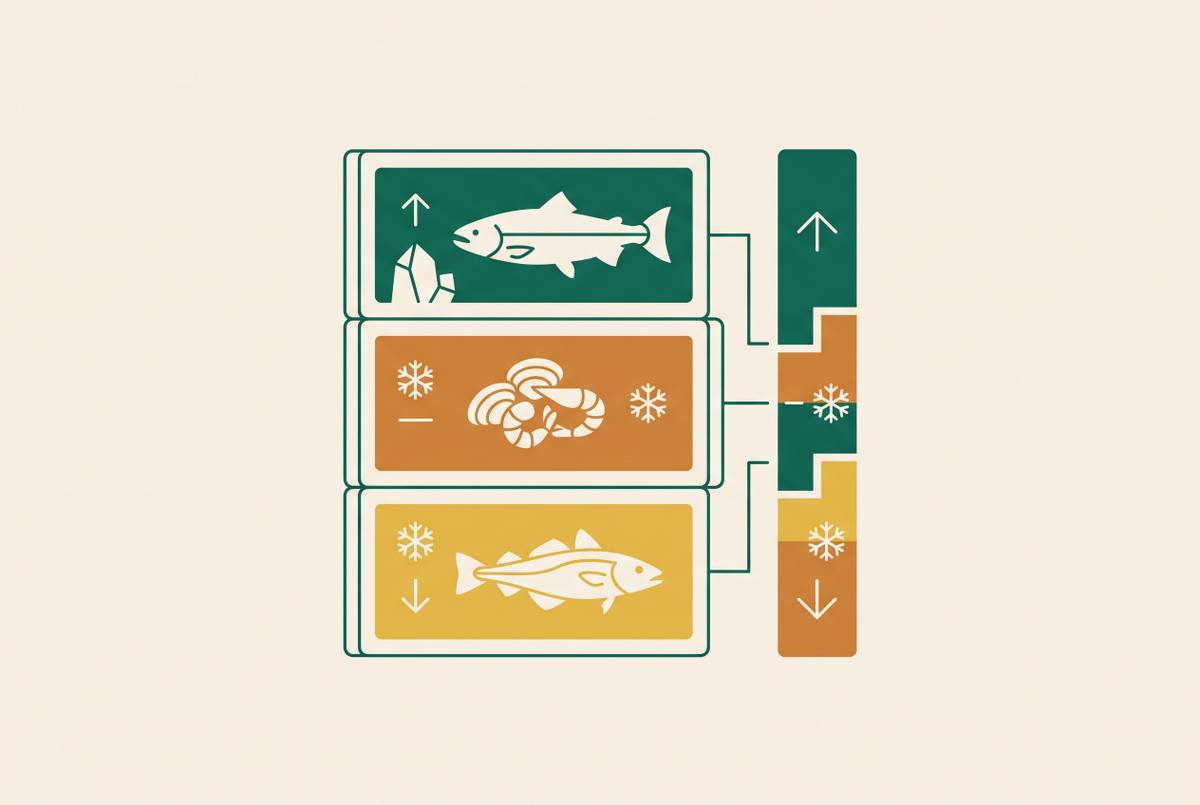
Different species carry different shock mechanics, and that matters because a single buffer strategy can't cover all of them. Shrimp production adjusts quickly because grow-out cycles are short: tariff pressure is currently weighing on India and Vietnam, and to a smaller degree Indonesia, while Ecuador expands into the gap. Wild whitefish moves at the opposite speed. Groundfish Forum projections show declining global supply for Atlantic cod, Pacific cod, and pollock, with haddock the only species expected to grow, and buyers substituting away from cod are already bidding haddock prices upward. Salmon sits somewhere in between: growth is expected to slow sharply through early 2026, staying flat to only marginally higher in the first half, even as Norway's harvest-ready biomass rose meaningfully year over year by the end of May, while Chile remains exposed to El Niño-driven climate risk.
None of this would be quite so unforgiving if seafood had the shelf life of canned goods, but it doesn't. Markets expect properly refrigerated product delivered within seven to eight days of catch, which leaves almost no room to absorb a logistics delay. Fishers land a catch without knowing what capacity processors have downstream. Processors finish a batch without real-time visibility into warehouse space or available trucking. The distributor, sitting at the end of that chain, absorbs whatever uncertainty accumulated upstream.
Trade-flow redirection stacks sourcing complexity on top of all this. The U.S. ban on Russian seafood, covering pollock, cod, crab, and salmon, has pushed buyers toward Vietnam, India, and Thailand, and Chinese processing of value-added whitefish still carries a 25% Section 301 tariff. Distributors who used to buy from one or two lanes now manage multi-origin procurement out of necessity, not preference.
Why seafood resists the generic inventory playbook
Standard supply-chain tactics, built for products with fixed unit prices and interchangeable SKUs, run into trouble fast when applied to seafood without modification. Catch weight pricing is the first complication: products sell by variable per-unit weight, so the order shows an estimated price while the ERP has to reconcile the actual weight at shipping. Inventory valuation stays unsettled until the product actually ships, and any substitution made during a shortage requires repricing on the spot.
Grading compounds the problem. Two units of the same species aren't interchangeable once size grade, quality grade, origin, sustainability certification, and vessel data all factor into what a customer actually ordered. A distributor substituting across grades during a shock without a system tracking those attributes is taking on traceability exposure. It's taking on traceability exposure. Pricing references move fast too: Urner Barry benchmarks, like 5-8's pricing for shrimp count size, function as shorthand across the trade, and both the purchasing desk and the sales desk work off live figures that shift faster than a spreadsheet can keep up with.
Regulation adds a hard floor: FSMA 204, the FDA's Food Traceability Final Rule, requires detailed traceability records for high-risk seafood products, with a compliance date pushed to July 20, 2028 after an extension. Distributors building inventory strategy now need to build traceability infrastructure in parallel, because every new sourcing lane added to diversify supply adds a proportional amount of traceability complexity to track. Seafood aggregation makes this sharper still: product consolidated from multiple vessels or farms before export gains efficiency at the cost of traceability risk if batch integrity isn't tracked digitally from the start.
Building a tiered inventory buffer that matches product volatility to stock strategy
Distributors need buffer logic sized to how predictable each species' supply actually is.
The debate between just-in-time and just-in-case inventory isn't a binary choice. FDH Aero, a parts distributor cited by Supply Chain Dive, resolved the tension by segmenting SKUs into high-velocity and low-velocity tiers, carrying buffer stock only on the items that were both high-value and high-turnover, and declining to over-invest in slow movers. Seafood maps onto a version of that same split, but along a farmed-versus-wild axis instead of a pure velocity metric.
Spherical Insights notes that farmed species (shrimp, tilapia, Atlantic salmon in Norway) offer more predictable production schedules because aquaculture allows producers to control stocking, feeding, and harvest timing, making moderate JIT approaches viable when trade lane risk is low. That predictability makes a moderate JIT approach workable, provided the trade lane feeding that supply isn't itself under tariff or political strain. Wild whitefish, cod, pollock, doesn't have that lever. Supply can't respond to a demand signal the way a farm can, and with global forecasts pointing downward and the Russian import ban still redirecting competition into other origin countries, these categories call for more deliberate buffer stock.
Premium wild species deserve a category of their own. Dungeness crab, king crab, and wild tuna should be treated as supply-constrained as a default assumption, not an exception. The 2026 Dungeness crab season closed on August 14, and no further detail on how that affects the coming season has been reported. Planning around scarcity here isn't pessimism, it's just reading the calendar correctly.
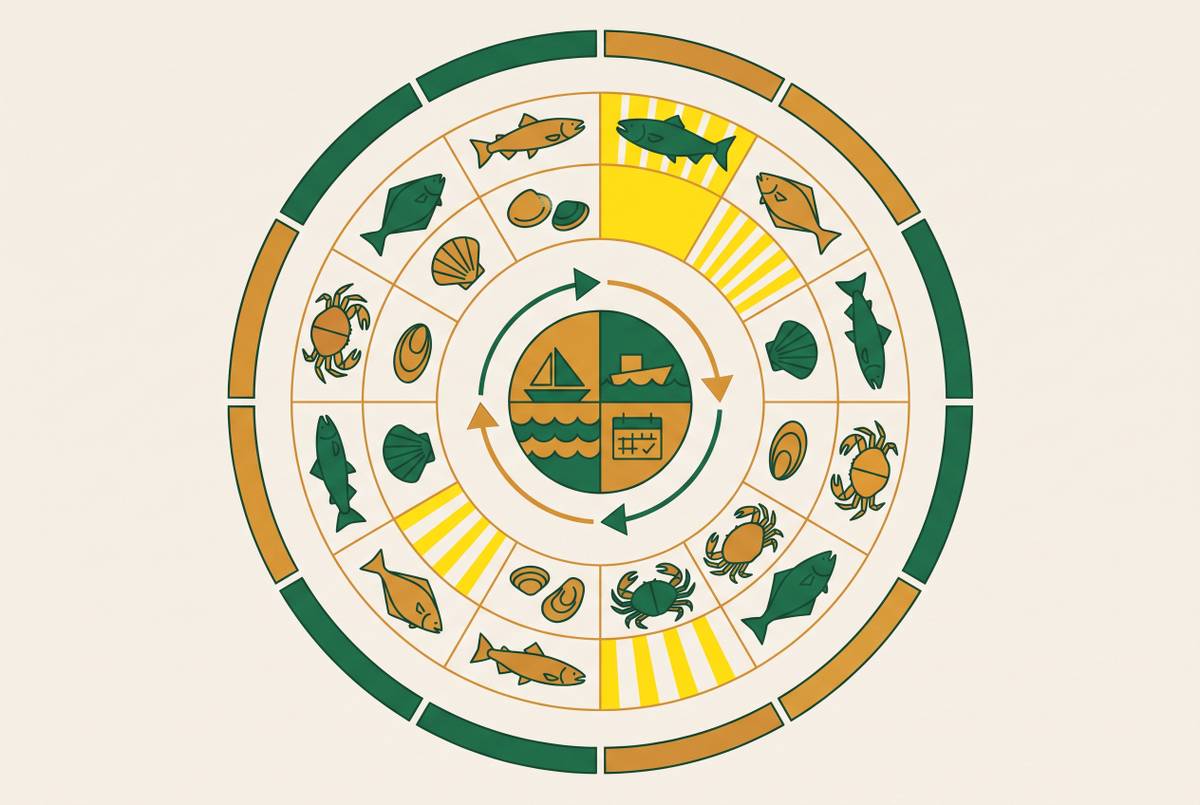
Aquaculture's overall scale gives distributors something to anchor around. FAO data put aquaculture at 102.7 million tonnes of total global aquatic-animal production, a large enough base that farmed species can serve as the stable core of a distributor's book while wild-caught volatility gets managed at the margins. That stratification shouldn't sit static for a year at a time, either. FDH Aero redefines its stratification every three months as new contracts come in or others expire. For seafood, a quarterly cycle lines up naturally with fishing seasons, quota announcements, and tariff reviews, which makes it the more sensible rhythm than an annual review that goes stale halfway through.
Diversifying sourcing origins without creating unmanageable traceability exposure
Sourcing from more than one country is no longer optional for a distributor moving U.S.-bound seafood. It's a structural requirement given how exposed single-origin supply chains have become to tariffs and trade bans. But every new origin lane added without traceability infrastructure to match multiplies the risk of aggregation errors, compliance gaps, and batch integrity failures. Diversification solves one problem and, handled carelessly, opens another.
The shift is visible at the trade-show level already. Seafood Expo Global 2026 drew returning participation from India, Ecuador, Vietnam, China, and Greece, plus new pavilions from Bulgaria, Mexico, Oman, Uruguay, and Venezuela, a fair reflection of how many suppliers are positioning around multi-origin strategy. Tariff-driven trade-flow redirection is accelerating that shift faster than most distributors likely planned for, as buyers move away from Chinese-processed whitefish under the 25% Section 301 tariff and from Russian-origin product to build new supplier relationships in Vietnam, India, and Thailand simultaneously.
A hybrid sourcing model gives this some structure. Farmed species from aquaculture-heavy regions supply predictable volume, while wild-caught species carry the margin and differentiation that premium buyers pay for. That split works on paper. It only holds up in practice if the traceability system behind it can track a batch back to its original harvest point no matter how many vessels or farms it passed through on the way to export. Digital traceability is the infrastructure that makes FSMA 204 compliance achievable once sourcing spreads across several countries at once. SIMP, the Seafood Import Monitoring Program run by NOAA Fisheries, already requires documentation and traceability on certain imports specifically to combat illegal, unreported, and unregulated fishing. Every new origin lane has to clear that documentation bar before it gets folded into a buffer strategy, not after.
The COVID-era diversification attempts show the risk of treating diversification as a sourcing decision alone: distributors that upgraded sourcing without upgrading the systems tracking it ended up reproducing the same coordination failure they were trying to escape, just spread across more countries.
Demand-side forecasting in a hollowing-out middle market
Supply isn't the only side of this equation moving unpredictably. Demand is splitting into two distinct tiers, and a forecasting model built around an average customer misses both of them. Sharma described this as a K-shaped economy: lower-income consumers have seen their purchasing power weaken, while higher-income consumers, who buy most of the high-value salmon and shrimp volume, have grown wealthier, largely on the back of stock market gains.
Rabobank's August 2026 analysis placed shrimp in the middle of that curve, more exposed to shifts in everyday consumer spending, while premium species like salmon have held up better. A distributor's species mix ought to reflect where its own customer base actually sits on that curve, rather than assuming demand moves uniformly across the whole product line. Premium wild-caught demand looks more durable right now than demand for mid-tier commodity whitefish, which absorbs pressure from both price-sensitive consumers and tariff-driven cost increases at once.
AI-assisted forecasting is becoming a realistic tool for catching this kind of split before it shows up as an inventory mismatch. A McKinsey survey of supply executives, cited by Supply Chain Dive, found a large majority already using or planning to use AI in demand planning. The value for a seafood distributor isn't in a bigger aggregate volume number. Carnegie Mellon's R. Ravi made the underlying point in an April 2025 Supply Chain Dive interview: AI needs to solve a real, existing problem rather than get bolted on for its own sake. For seafood distributors, forecasting models built on historical averages don't capture a bifurcating market.
Order intake as the operational bottleneck during a shock
None of the strategy above survives contact with a slow order desk. A tiered buffer, a diversified sourcing map, and a demand model tuned to a bifurcating market all depend on a distributor's ability to process what customers are actually asking for, in real time, while a shock is underway.
That's harder than it sounds because customers order however they've always ordered. Emails, texts, PDFs, voicemails, WhatsApp messages, photos of handwritten notes, faxed POs, the full mix arrives every day, and none of that changes just because supply got tighter. During a shock, the volume and complexity of those messages goes up, since customers start asking about substitutions and availability on top of placing normal orders.
A team keying those orders in by hand runs into a hard throughput ceiling. Manual entry on a 40-line order takes seven to eight minutes per order. At that pace, a distributor cannot flag an out-of-stock item, offer a substitution, or update a customer fast enough to influence a same-day purchasing decision. Every strategy covered above, the tiered buffers, the multi-origin sourcing, the segmented demand forecasts, depends on information moving from the customer to the purchasing desk faster than a shock is unfolding. When order intake can't keep pace, the rest of the strategy has nothing current to act on.
Sources
- Resilient demand propping up seafood prices as early 2026 supplies tighten, Rabobank reports | SeafoodSource
- 4 strategies to manage inventory and supply chain operations in 2025 | Supply Chain Dive
- Climate-driven disruption, constrained supply adding volatility to aquaculture markets in the back half of 2026 | SeafoodSource
- Who Wins the Seafood Sourcing Battle in 2026: Farmed, Wild-Caught or Hybrid? - Expert View by Spherical Insights
- Global Seafood Trends 2026: What to Expect at This Year’s Trade Shows - Food & Hospitality Asia