Why Perishable Food Distribution Demands a Different Class of Order Intake AI
Purpose-built AI catches perishable errors before shelf life makes them irreversible.
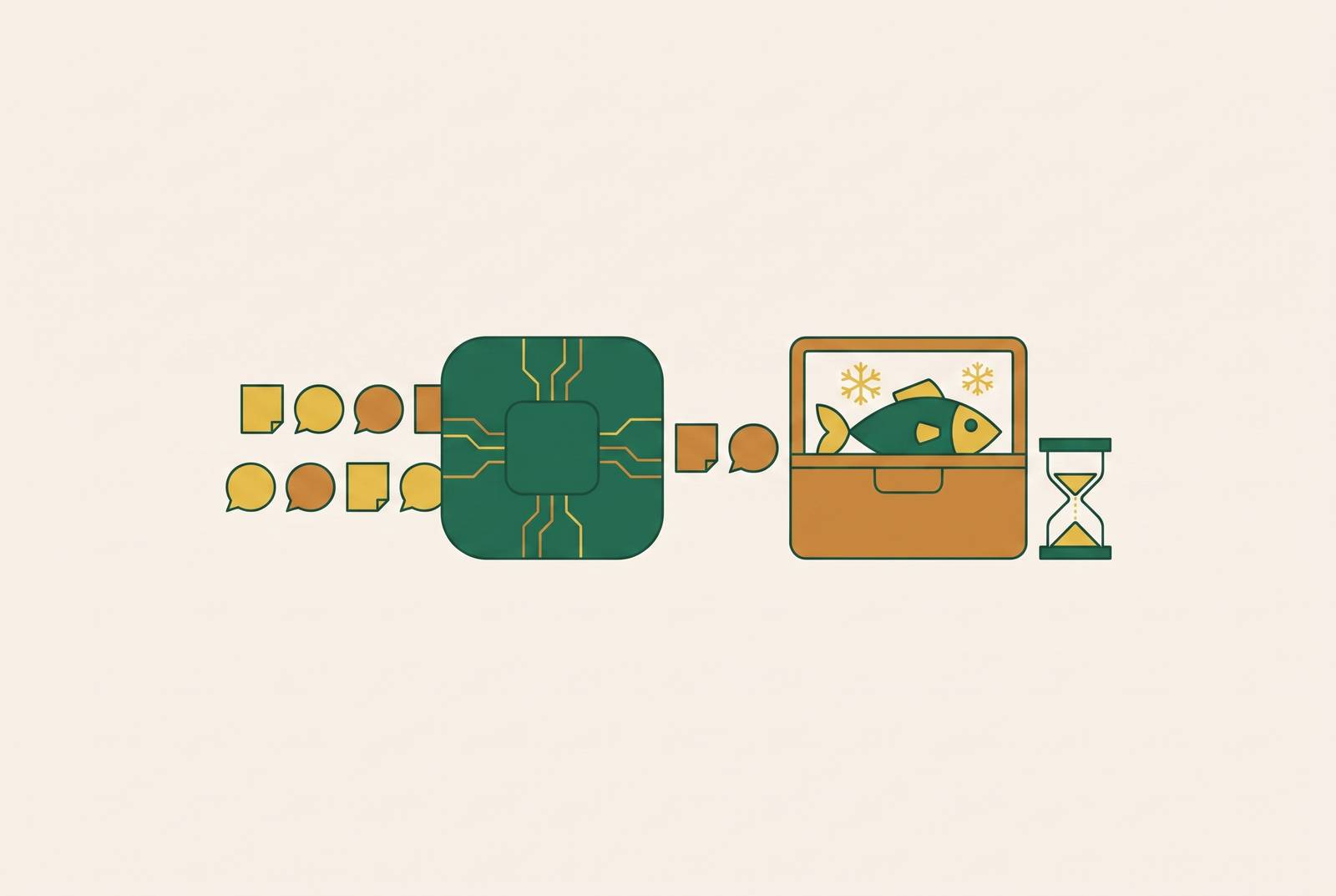
An AI order intake agent for seafood distributors must understand seafood shorthand, keep catch-weight quantities intact, and write structured order drafts into the existing ERP for a person to review. Generic order capture is not enough. Perishable food distribution needs purpose-built intake AI because errors use up the little time left to sell, pick, and deliver the product.
Why perishable food distribution breaks generic order intake automation
Generic order automation promises to turn the requests that come in into sales orders that staff can use. Perishable distribution demands that this happen before the product loses its value. In most distribution categories, an intake error costs rework time, but in perishables it can cost the product itself. A mispicked item, missed delivery window, or quantity error on a short-dated line can leave a SKU unsellable before staff finish correcting the order. Recovery time is part of the loss.
A tool may read the words and quantities correctly yet still fail if it cannot account for when the product expires or when it must be delivered. VAI's 2026 analysis identifies short shelf life, high order volumes, demand volatility, and manual processes as specific pressures on food order management. These pressures interact. Automation built for structured, predictable commerce inputs can do worse than manual intake when it takes away human judgment but cannot handle the constraints that people dealt with.
How orders actually arrive in perishable food distribution
Customers leave voicemails after hours, text a rep's personal number, send photos of handwritten lists by email, and call during the morning rush. The same customer may send more than one version of an order through those channels. Before any product matching begins, the distributor is dealing with requests that differ in format, completeness, and context. There is no uniform document to process.
A phone order gets transcribed into the ERP, a voicemail gets listened to and typed up, and a customer service representative decodes an emailed photo. At each handoff, someone can enter the wrong product code, quantity, or delivery address. The channel is therefore not just a means of transport. It determines how much interpretation and re-keying must happen before the request becomes an order.
Purchase orders, EDI transactions, and e-commerce confirmations offer a different starting point from partial sentences and verbal shorthand. Consider the message “2cs PEI oysters + 10lb P&D IQF, same window as last week”. The product abbreviations, units, and reference to a previous delivery window all contribute to its meaning. A tool that extracts only recognizable product words and numbers has not captured the customer's full request.
What manual order processing costs a perishable distributor
An intake error does not stay at the desk. Someone investigates the discrepancy, contacts the customer, issues a credit or processes a return, coordinates with the warehouse, and re-enters the corrected order. Those tasks draw on several parts of the operation while the product's shelf life continues to shorten. The correction workload and the risk of spoilage run together. Finishing the administrative repair does not necessarily recover the value of the goods.
The same analysis identifies an incorrect SKU, delayed shipment, or inventory mismatch as capable of causing spoilage, compliance issues, or lost revenue. That makes transcription cost only the first part of the business case. The broader cost includes the work triggered by an inaccurate order and the product value put at risk during its correction. Speed alone cannot resolve this problem. Faster entry that sends the wrong line downstream simply moves the discrepancy closer to fulfillment.
As more orders come in, manual intake means more typing and more chances to make those errors. Without a change in the process, correction workload grows with volume, helping explain why administrative headcount grows proportionally in manual operations. Skilled staff also lose time they could spend working with customers or spotting the need for substitutions early. That is a capacity cost as well as a wage cost.
Why seafood represents the upper limit of perishable intake complexity
A case of whole fish is ordered and shipped as a unit but invoiced on its actual weight. Count alone cannot determine the invoice value. The order line must preserve both case count and weight so that the commercial request remains connected to the quantities used in fulfillment and billing.
The requirement extends beyond the intake screen. Good catch-weight handling tracks both quantities from receiving through picking to the invoice, inventory value, and general ledger, with each weighed case tied to its lot. Intake must establish an order structure that supports that chain rather than flattening the request into a single quantity. The system must keep the actual weighed quantities apart from the count that was ordered. Otherwise, the system cannot price the line correctly as the product moves through the operation.
IQF means Individually Quick Frozen, H&G means Headless and Gutted, and PBO means Pin Bone Out. FAS means Frozen at Sea, IVP means Individually Vacuum Packed, P&D means Peeled and Deveined, and S/P means Shatter Pack. These are product distinctions. Expanding the abbreviations is useful only if the AI can map their meaning to the appropriate SKU in the distributor's catalog.
Free-text specifications require the same precision. “Skin on”Skin on”, “pin-boned”, and “portioned” must resolve to the right product code. Size grades such as “2–3kg” and “500–700g”, as well as shrimp count grades, also identify the requested product. A grade error changes more than the description. It can produce the wrong SKU, wrong price, and wrong inventory draw.
Catch-dependent supply makes even a correct interpretation conditional on availability. What a customer ordered yesterday may not exist today in the same grade, size, or cut. The AI must flag that gap for human review rather than auto-confirm against a catalog that no longer reflects the available supply.
Why ERP integration cannot be an afterthought in perishable intake automation
Correct interpretation has limited value if someone must re-key the result into the ERP. That system holds the inventory, pricing, and fulfillment information needed to act on the request. An AI tool that places parsed orders in a separate interface leaves the decisive handoff manual. The output must become a structured draft inside the distributor's existing system.
Catch-weight items can be mispriced, short-dated or out-of-stock items can slip through, and substitutions can be missed. An order can also miss the delivery route cutoff while its details move between systems. These are not simply extraction errors. They arise when the interpreted request is disconnected from the operational information needed to fulfill it.
The existing system holds years of pricing history, customer contract terms, lot traceability, and inventory logic that cannot be replicated without significant cost and risk. VAI describes AI as a layer that enhances the existing ERP. For intake, that means writing catch-weight quantities, lot references, and customer-specific pricing into the right fields. A reporting layer cannot perform that role.
Human review belongs at this boundary as well. A catch-weight mismatch, out-of-stock SKU, or ambiguous grade code should reach a staff member before the order releases. The alternative is an auto-confirmed order whose problem appears only when the warehouse starts picking. That is too late for economical correction in a time-constrained operation.
What must an AI order intake agent for seafood distributors actually do?
For a distributor evaluating options, the first criterion is coverage of the channels customers already use. The tool must process text, email, WhatsApp, phone calls, and voicemails rather than depend on portal submissions or structured forms. Multichannel intake is a functional requirement. A system that accepts only clean documents leaves the informal orders in the manual queue. Its practical reach is limited by the work it cannot accept.
Seafood shorthand, grading codes, size specifications, and cut descriptions must resolve to the requested product without being reduced to a generic match. Multilingual capability belongs in this same test because customers may order in Spanish, Cantonese, or other languages. Language cannot become another manual handoff. The required output is a usable order line.
That line must also preserve its commercial structure. Case count and weight belong in the appropriate fields, with support for the catch-weight workflow at intake. The structured draft must land in the existing ERP, where pricing and fulfillment operate. A parallel tool leaves reconciliation work behind. The distinction between generic extraction and purpose-built intake is whether the information arrives in a form the distributor can actually use.
Exception handling completes that specification. Ambiguous lines, potential substitutions, out-of-stock SKUs, and catch-weight variances should surface for a staff member to confirm. The AI handles parsing and structuring while a person handles the judgment calls. VAI describes automated conversion of voice calls, emails, and text-based orders into structured sales orders, with discrepancies flagged and orders prioritized by delivery constraints. That is a more useful standard than automatic confirmation alone.
These requirements must not come at the customer's expense. Customers should keep ordering as they always have, without adopting a portal or learning a new format to make automation work. The change takes place inside the distributor's operation. Preserving familiar ordering habits removes customer adoption as a barrier and protects established relationships.
How purpose-built intake automation changes the scaling math for perishable distributors
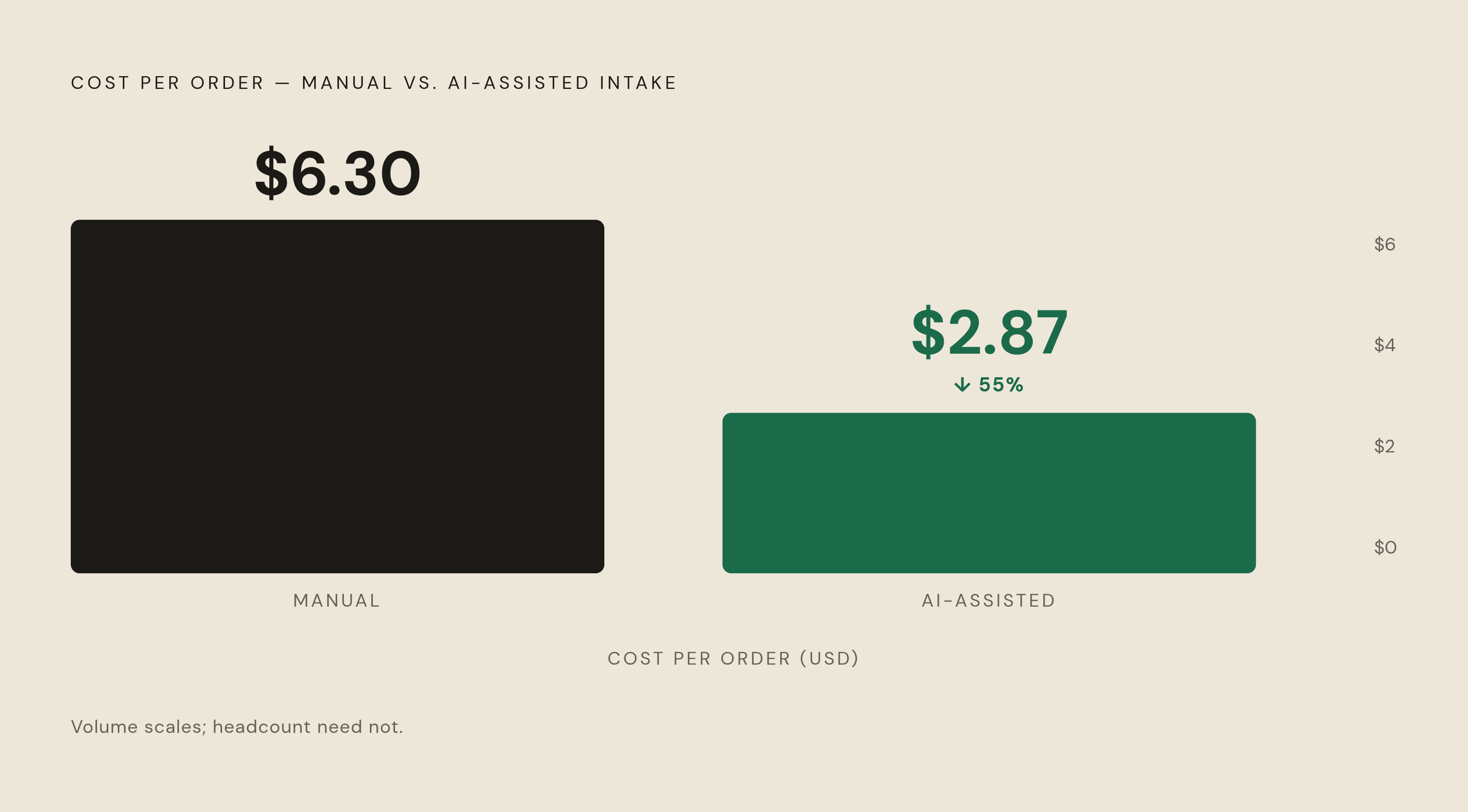
In the manual model, every new customer adds administrative work before a single product ships. More orders require more transcription, more correction, and more staff time spent moving information into the ERP. Purpose-built automation changes that relationship by handling parsing, structuring, and ERP entry without requiring a person at every step. Order volume can rise without proportionate headcount growth. The processing-cost case is a fall from $6.30 to $2.87 per order as AI takes over that work.
The freed capacity has a specific operational use. Staff can use the time they spent on routine data entry to handle substitutions, catch supply issues early, and stay in touch with customers. Those responsibilities remain especially important when catch-dependent availability changes the options for fulfillment. Automation gives staff more time to use their judgment before a product or delivery deadline leaves them with fewer options.
VAI identifies faster processing, greater forecast accuracy, lower operational costs, higher order accuracy, and real-time visibility as benefits that build as AI learns from a distributor's ordering patterns. For seafood and specialty food businesses, growth still depends on preserving the right grade, cut, catch-weight invoice, and delivery window. Customer trust rests on that reliability.